Wall Street
Wall Street is a street in Lower Manhattan in New York that has become a symbol of American financial markets and capital. In a wider sense it also denotes the entire environment of exchanges, banks and investment institutions concentrated around the New York Stock Exchange and other market centres.
Wall Street arose as part of the early urban structure of the then Dutch settlement of New Amsterdam. The name is traditionally interpreted as a reference to a defensive wall or fortification that was meant to protect the settlement at the southern tip of Manhattan. From a place with a practical defensive function it gradually became a street in a fast-growing city, which after being taken over by the English acquired the name New York and began to play an ever more important role in Atlantic trade.
The decisive transformation came in the 18th and 19th centuries, when financial services began to concentrate in the vicinity of Wall Street: trade in securities, insurance, banking and credit. At a time when the United States was expanding economically and building infrastructure, there arose a need for capital and a market which could finance enterprise and state projects. It was precisely here that the environment gradually took shape in which shares in companies and debt instruments were bought and sold, and where the modern form of the financial market was formed.
The key institution became the New York Stock Exchange, which in the 19th century was transformed into the dominant American centre of trading in shares. With the growth of industry and corporations the importance of the exchange grew: the market on Wall Street began to influence which firms would obtain capital, what the pace of investment would be and how asset prices would feed through into the wider economy. Gradually there also formed a culture of the country's „financial heart“, where big money, information and decision-making meet.
History
In the 20th century Wall Street became a symbol not only of prosperity but also of risk. The Wall Street Crash of 1929 and the ensuing Great Depression showed how strongly the financial market can affect the life of an entire society. Regulatory changes followed which were intended to limit the abuse of information and to strengthen the oversight and stability of the market. Nevertheless, the financial world continued to evolve: the growth of investment banks, the globalisation of capital and later the digitisation of trading transformed the way in which trading is conducted, but „Wall Street“ has remained a strong shorthand for American finance as a whole.
At present Wall Street is both a concrete place and a metaphor. It may denote the actual financial district where institutions are based and where part of financial life takes place, but also the system of capital markets which influences savings, investment and economic expectations all over the world. It is a term used in the media and in politics, because it represents an easily intelligible symbol of the power of capital – and at the same time of the space in which profit, risk and the public interest meet.
In practice Wall Street means the environment where issuers (the state and firms which need money) meet investors (people and institutions which provide capital). The exchange and other markets enable firms to obtain financing by issuing shares or bonds and provide investors with the opportunity to buy and sell these securities. A key role is played by valuation: prices on the market in real time reflect expectations about profit, risk and the development of the economy, and thereby influence investment decisions and the availability of credit.
How it works and why it matters
Alongside the exchange, the infrastructure is also important: regulation, oversight, clearing, ratings and disclosure obligations. Without these the market would have no credibility, because investors could not rely on the information being comparable and on trading taking place fairly. At the same time Wall Street is sensitive to psychology and cycles: a period of optimism can inflate asset prices, while panic can rapidly worsen the availability of capital. For this reason the financial centre is often perceived ambivalently – as an engine of growth, but also as a source of crises if risk is underestimated.
The numismatic connection is indirect but useful: Wall Street represents the modern „world of money“, where value is expressed not in metal but by trust and the market. It is precisely this contrast – between the physical coin and the financial instrument – that helps to understand how money has developed from precious metals and circulating tender to today's capital markets and investment.
In our auction and shop
- Code: ZD-3005VALD
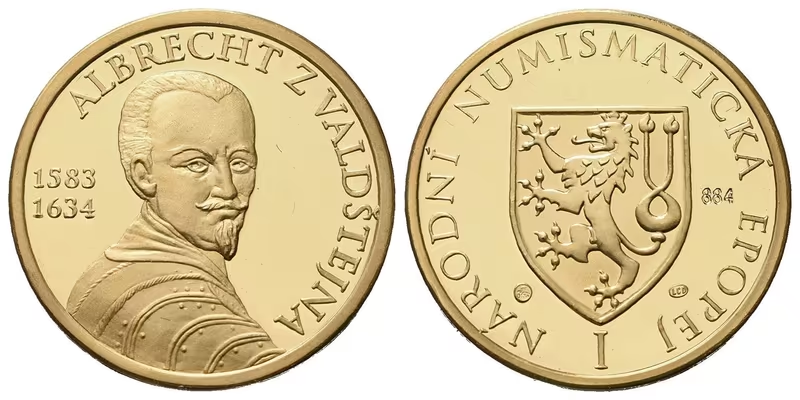
Medaile b.l. - Albrecht z Valdštejna - Národní numismatická epopej
Česká republika (1993 - ) Medaile b.l. (Luboš Charvát) - Albrecht z Valdštejna Au 0,999, 25 mm (7,15 g), certifikát, etue, PROOF Cyklus medailí Národní numismatická epopej Albrecht Václav Eusebius z Valdštejna (nebo také Vojtěch Václav Eusebius z…