Henry III the Black
Henry III the Black was Emperor of the Holy Roman Empire ruling from 1046 to 1056, who represented the peak of the power of the Salian dynasty and imperial authority in medieval Europe. His rule marked the period of greatest expansion of imperial power over the papacy, when at the Synod of Sutri in 1046 he deposed three rival popes and installed his own c…
Henry was born on 28 October 1017 as the son of Emperor Conrad II and his wife Gisela of Swabia. Already at the age of nine he was elected King of Germany in 1026, and two years later crowned in Aachen. This early election ensured the continuity of the Salian dynasty and prevented possible disputes over succession. The young Henry grew up at the imperial court, where he received an excellent education in Latin literature, theology and law.
After the death of his father Conrad II in June 1039, Henry assumed rule as a twenty-two-year-old experienced politician. The first years of his independent rule were marked by the struggle to consolidate power in the Empire. He had to face the revolt of the Lotharingian Duke Godfrey II and resistance in Burgundy. In Italy he suppressed the rebellion of the Milanese burghers and restored imperial authority in northern Italy.
Relations with the Czech principality were initially tense. The Czech Prince Břetislav I took advantage of Poland's weakening, and in 1039 conquered Kraków and brought the body of Saint Adalbert to Prague. The Polish Prince Casimir I the Restorer requested Henry's help against Czech expansion. The Emperor marched in 1040 with a great army into Bohemia, but his campaign ended in disaster. The German knights, unfamiliar with the terrain, became lost in the Czech forests and suffered heavy losses during the retreat.
The second imperial campaign into Bohemia in 1041 was more successful. This time Henry proceeded more cautiously and with better knowledge of the territory. Břetislav I, who was simultaneously facing an attack from the north, preferred to conclude peace. In Regensburg Břetislav paid feudal homage to the emperor and committed himself to paying an annual tribute of 1,200 marks of silver and 30 marks of gold. This tribute, however, did not ruin Bohemia economically, and Břetislav retained de facto independence.
History
Surprisingly, the former enemies became allies. Henry III appreciated Břetislav's military abilities and made use of the Czech army in his campaigns. Břetislav helped the emperor in fighting against Hungary and took part in imperial expeditions into Italy. In return for this loyalty, Henry supported Czech interests, including the elevation of the Prague bishopric and the recognition of the seniority order — Břetislav's laws on succession.
The pinnacle of Henry's power was the Synod of Sutri in 1046. At this time three popes — Benedict IX, Silvester III and Gregory VI — were competing for the papal throne. Henry convened a synod where all three were deposed for simony and other offences. At the emperor's proposal a new pope, Clement II, was elected, who immediately crowned Henry emperor. With this act, imperial power over the Church reached its zenith.
Henry appointed in succession four German popes — Clement II, Damasus II, Leo IX and Victor II. These popes initiated a reform of the Church directed against simony, clerical marriage and the moral decay of the clergy. Paradoxically, these reforms, which Henry supported, later led to the Investiture Controversy and the weakening of imperial power over the Church.
In October 1056 Henry III died at Bodfeld Castle in the Harz at the age of only thirty-nine. The cause of death was probably malaria, which he had contracted during the Italian campaign. He was buried in Speyer alongside his father Conrad II. His premature death meant the end of the period of strong imperial power — his son Henry IV inherited the throne at the age of six, and the Empire fell into a long period of regency and internal struggles.
Economic and monetary policy
Henry III carried out a significant reform of imperial coinage, which also affected the Czech lands. He introduced a more uniform standard for the striking of denarii and sought to limit the right of minting, which local princes and bishops had usurped. The imperial mints in Regensburg, Augsburg and Constance struck quality silver denarii with a uniform weight of about 1.5 grams, which became a model for the surrounding lands.
The Czech tribute paid to Henry represented an important item of imperial income. The annual payment of 1,200 marks of silver corresponded to approximately 250 kilograms of precious metal. The emperor used these funds to finance Italian campaigns and to build castles on the eastern frontier of the Empire. Czech silver from the Kutná Hora mines thus indirectly financed imperial expansion.
Under Henry's rule the long-distance trade between West and East developed. Prague became an important stop on the trade route from Regensburg to Kraków and on to Kyiv. The emperor supported merchants by issuing safe-conducts and founding market sites. Customs duties from this trade filled both the imperial and the princely treasuries.
Henry founded several new towns and supported the colonisation of the eastern regions of the Empire. He granted special privileges to the town of Nuremberg, which thanks to imperial favour became an important commercial centre. The development of the urban economy led to the gradual transition from a natural to a money economy.
In our auction and shop
- Code: SFRA87-C1594D
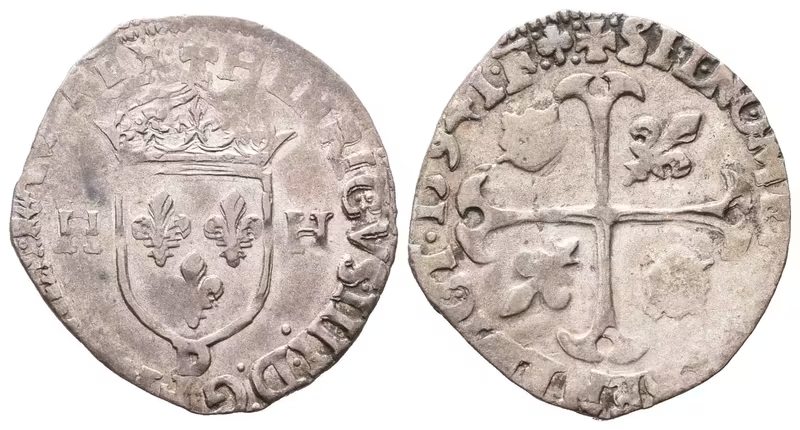
Francie, Douzain (12 Denár) 1594 D
Francie, Jindřich III. (1574 - 1589) Douzain (1/20 Livre Tournois = 12 Derniers) 1594 D, Lyon, Duplessy.1246