John D. Rockefeller
John D. Rockefeller was an American industrialist and philanthropist who built up the Standard Oil petroleum monopoly and became the wealthiest person in modern history.
John Davison Rockefeller came into the world on 8 July 1839 in Richford in the state of New York, the second child of six siblings in a family that lived in uncertain circumstances. His father William Avery Rockefeller was a controversial figure who made his living as a wandering tradesman and charlatan selling dubious miraculous remedies, while his mother Eliza Davison Rockefeller was a deeply pious Baptist whose strict morality and emphasis on thrift profoundly influenced her son's character. The family was often forced to change residence because of the father's fraudulent dealings and debts, which instilled in young Rockefeller a longing for stability and financial security that accompanied him throughout his life.
At the age of sixteen he obtained his first job as an assistant bookkeeper at the Cleveland commission firm Hewitt & Tuttle, where for his hard work he received only 50 cents a day, but already then he showed an exceptional talent for working with numbers and unusual attention even to the smallest details. From his first earnings he kept detailed personal accounts in which he recorded every cent spent and received, and he maintained this habit throughout his life, making it the foundation of his methodical approach to business. After three years of gaining experience, in 1859, at the age of just twenty, he dared to found, with his partner Maurice Clark, his own commission firm dealing in agricultural products and other goods.
The outbreak of the American Civil War in 1861 paradoxically presented the young entrepreneur with a unique opportunity, since his firm obtained lucrative army contracts to supply food, hay and meat for the Union troops, which brought him his first significant capital and valuable business contacts. The real breakthrough in his career, however, came in 1863, when he decided to invest the accumulated funds in an oil refinery in Cleveland, although the oil industry was still in its infancy and many investors considered it too risky. Oil, which had been discovered in Pennsylvania only four years earlier in 1859, was rapidly becoming a strategic raw material for the lighting of households, and Rockefeller with visionary foresight recognised that the real future and stable profits did not lie in uncertain and risky extraction, but in the refining and distribution of oil products.
His entrepreneurial genius emerged in full in 1865, when he bought out the shares of all the partners and became the sole owner of the refinery, which thanks to his systematic reinvestment of profits, continual improvement of efficiency and ingenious use of by-products quickly became the largest processing plant in Cleveland. The founding of the Standard Oil Company on 10 January 1870 with an initial capital of one million dollars represented the beginning of a new era in American industry and launched Rockefeller's path to building the largest industrial monopoly of his time. With ruthless systematicity he began to buy up competing refineries, and against those who refused to sell he unleashed devastating price wars during which he temporarily sold products below cost until the competitors were forced to capitulate.
The key to his dominance was his secret arrangements with the railway companies, which provided him not only with significant discounts for the volume of goods transported, but even paid him commissions on the transport of his competitors' goods, which created entirely unequal conditions in the market. During the so-called Cleveland Massacre of 1872 he succeeded within just three months in taking control of twenty-two of the twenty-six Cleveland refineries, using a combination of financial pressure, threats and promises of future profits. While critics called his methods merciless extortion and unfair competition, Rockefeller himself believed that he was carrying out a necessary consolidation of a chaotic industry that suffered from overproduction and cyclical crises.
History
By 1879 Standard Oil had gained control over a staggering ninety per cent of all American oil refining, and Rockefeller had created the first truly vertically integrated industrial concern, which owned not only refineries but also pipelines, thousands of railway tank cars, storage tanks and an extensive retail distribution network. The revolutionary trust structure he introduced in 1882 made it possible to centrally direct formally independent companies through a fiduciary trust, thereby circumventing state laws restricting the activity of corporations outside their home state. The Standard Oil Trust became a model of monopolistic organisation, copied by other industrial giants in steel, the tobacco industry and railway transport.
Rockefeller's methods, which included systematic industrial espionage through a network of paid informants, the corruption of politicians and judges, the brutal suppression of attempts to form trade unions and the manipulation of prices to destroy competitors, provoked ever greater public resistance. Paradoxically, however, his monopoly also brought positive results, when the price of paraffin used for lighting fell by eighty per cent during his rule, which made artificial lighting accessible to millions of American households and significantly improved the quality of their lives. The investigative journalist Ida Tarbell, whose father was one of the victims of Rockefeller's practices, published between 1902 and 1904 in McClure's Magazine a series of thoroughly documented articles that revealed in detail the unethical methods of Standard Oil and provoked a wave of public outrage.
This journalistic pressure, together with the reform movement of the Progressive Era, led to a series of antitrust suits which culminated in the historic ruling of the US Supreme Court on 15 May 1911, ordering the break-up of Standard Oil into thirty-four independent companies. The irony of fate was that this forced break-up enriched Rockefeller still further, since the shares of the successor companies rose sharply in value over the following years thanks to the growing demand for oil for motor cars. His personal wealth reached its absolute peak in 1913, when it amounted to 900 million dollars, representing an incredible two per cent of the entire American gross domestic product.
From 1897 Rockefeller gradually withdrew from the active direction of his business interests and began to devote himself systematically to philanthropy, which he conceived just as methodically as his business. In 1913 he founded the Rockefeller Foundation with an initial endowment of 100 million dollars, which became a model of modern scientific philanthropy aimed at addressing the root causes of social problems rather than mere charity. His foundation activities financed the founding of the University of Chicago, the Rockefeller Institute for Medical Research, which later became the prestigious Rockefeller University, and extensive programmes to support the education of the black population in the American South.
The Rockefeller foundations achieved remarkable successes in public health, when they practically eradicated hookworm in the American South, contributed to the suppression of yellow fever and malaria, and later supported the Green Revolution, which saved millions of people from famine. In all, during his life he gave away over 540 million dollars, which in today's value represents approximately 14 billion dollars, while his philanthropic philosophy influenced generations of American billionaires including Bill Gates and Warren Buffett. John D. Rockefeller died on 23 May 1937 at the age of 97 at his estate in Ormond Beach, Florida, just two months before his 98th birthday, his funeral being, in accordance with Baptist tradition, surprisingly modest.
Business Methods and Philosophy
Rockefeller's business strategy was based on a combination of horizontal and vertical integration, which in his time represented a revolutionary approach to building an industrial empire. By horizontal integration he systematically gained control over competing refineries throughout the United States, while vertical integration enabled him to dominate the complete chain from the extraction of oil through its transport and processing to the retail sale of the final products. His unshakeable belief in efficiency of scale and in the standardisation of processes brought his refineries the lowest production costs in the sector, which he achieved through constant technological innovations, the ingenious use of by-products that the competition regarded as waste, and an almost obsessive control over every cent expended.
The secret arrangements with the railway companies represented the most controversial but also the most effective instrument of his dominance, with which he obtained not only significant discounts for the volume of products transported but even collected commissions on the transport of his competitors' goods, creating a system in which his rivals in effect financed his expansion. The complex system of rebates, drawbacks and preferential tariffs practically prevented independent refineries from attaining profitability, while Rockefeller maintained that he was only stabilising a chaotic market and bringing consumers the benefits of better-quality products at lower prices.
Rockefeller's personal philosophy represented a fascinating combination of Calvinist work ethic with the principles of social Darwinism, with him deeply believing that the accumulation of enormous wealth was a divine blessing and a proof of being chosen for higher purposes. At the same time, however, he understood that with great wealth came responsibility to society, which led him to create the concept of scientific philanthropy, which focused not only on alleviating the symptoms of social problems but on their systematic solution through investment in science, education and public health.
In our auction and shop
- Code: SUSA-T1969D.1
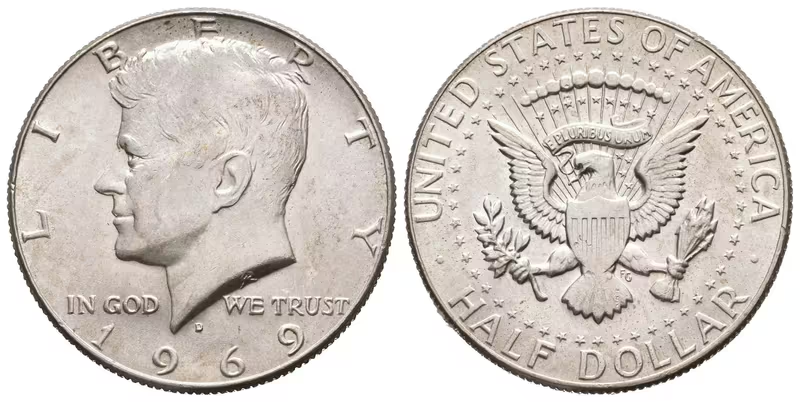
USA, 1/2 Dollar 1969 D - John F. Kennedy / státní znak USA
Spojené státy americké 1/2 Dollar 1969 D - John F. Kennedy / státní znak USA, KM# 202a Ag (.400), 30,6 mm (11,5 g), oběžná, v kapsli. Stav mince odpovídá fotografii. Jedná se o druhotný prodej. (Možná oxidace, atd.. ! - VIZ FOTOGRAFIE !)