American Civil War
The American Civil War was an internal conflict in the United States of America between 1861 and 1865 between the Union (northern states) and the Confederacy (southern states). The war decisively determined the preservation of the federation, accelerated the abolition of slavery and substantially transformed the economy and monetary system of the United S…
The American Civil War broke out after long-standing tensions between the North and the South, which revolved around slavery, the political balance between the states and the question of how strong the federal government should be. The South was economically heavily tied to plantation production (especially cotton) and slave labour, while the North industrialised more rapidly and developed railways and an urban economy. Disputes sharpened already in the first half of the 19th century — every new state admitted to the Union opened the question of whether it would be "slave" or "free", and thus who would gain the upper hand in Congress.
The spark was the election of President Abraham Lincoln in 1860. Lincoln did not originally seek the immediate abolition of slavery in all states, but for many southern elites he represented the threat that slavery would not be allowed to spread further and would gradually lose political protection. A wave of secessions followed: several southern states left the Union and formed the Confederacy. The first clashes grew into open war after the attack on Fort Sumter in April 1861.
The war was exceptionally demanding in both human and material terms. It was a conflict of mass armies, more modern logistics, railway transport and industrial weapons production. The North had the advantage of larger industry, population and naval power, while the South relied on the military skills of its commanders, knowledge of the terrain and the hope of wearing down the North's political will to fight. A key role was played by the blockade of southern ports, which gradually limited cotton exports as well as imports of weapons and goods.
History
The goals of the conflict also changed during the war. A fundamental turning point was Lincoln's Emancipation Proclamation of 1863, which linked the Union's war effort with the liberation of slaves in the rebel states. Through this the war acquired a stronger moral and political dimension and at the same time it weakened the Confederacy's ability to maintain its labour system. In the decisive years 1863–1865 the material superiority of the North gradually came to the fore. The fall of Atlanta, General Sherman's march to the sea and the exhaustion of southern resources led to the defeat of the Confederacy. The capitulation of the main forces took place in the spring of 1865.
The war was followed by the period of Reconstruction, which addressed the reintegration of the southern states into the Union, the civil rights of liberated African Americans and the recovery of the devastated economy. The abolition of slavery was confirmed in law by the 13th Amendment to the Constitution. Even so, social and political tensions persisted for a long time and the results of Reconstruction were in many ways limited. In wider perspective, however, the war determined the modern shape of the United States: it strengthened the federal state, accelerated industrialisation and changed the relationship between politics, the economy and finance.
The American Civil War is exceptionally interesting for numismatics and notaphily, because it was a period of abrupt changes in monetary circulation. Financing a mass war required enormous resources, so paper money and state debt became widespread. On the Union side federal banknotes known as "greenbacks" expanded, helping to cover war expenditure but also raising questions about confidence in the value of paper and its relationship to precious metals. In everyday life this meant that people thought more than before about what they were paying with, what was accepted, and how rapidly purchasing power was changing.
Money circulation, banknotes and numismatic points of interest
The Confederacy issued its own paper money, whose value was heavily dependent on the military situation and on the ability to keep the economy running. Confederate banknotes are now a popular collector subject: they often carry distinctive period graphics, signatures and regional specifics, but they also serve as a reminder of how fragile a currency is without a stable tax backbone and without confidence in the future of the state. Many pieces have survived in various conditions and there are also forgeries or later reprints, so for more valuable specimens it makes sense to verify provenance and obtain an expert appraisal.
Alongside the "official" banknotes, improvisations also appeared during the war: the shortage of small coins led to the use of substitute means of payment, tokens and various local solutions. This is attractive for collectors precisely because such objects reflect everyday reality — when ordinary currency disappears from the market, society helps itself with improvisation. From a numismatic point of view it was a time when money became the visible nerve of the state: the army, supply and industry cannot be sustained without a functioning financial system, and that system changes more rapidly in war than in calm times.
For collectors it is useful to think about the American Civil War thematically: separately for the Union and the Confederacy (banknotes, bonds, tokens), or as a "story of circulation" from metal coinage to paper and improvisations. For banknotes the main role is played by the state of preservation of the paper (folds, tears, stains), the legibility of signatures and overall cleanliness; for coins and tokens it is the original surface without aggressive cleaning. Precisely this combination of great history and tangible currency makes this period one of the most rewarding collector subjects of the 19th century.
In our auction and shop
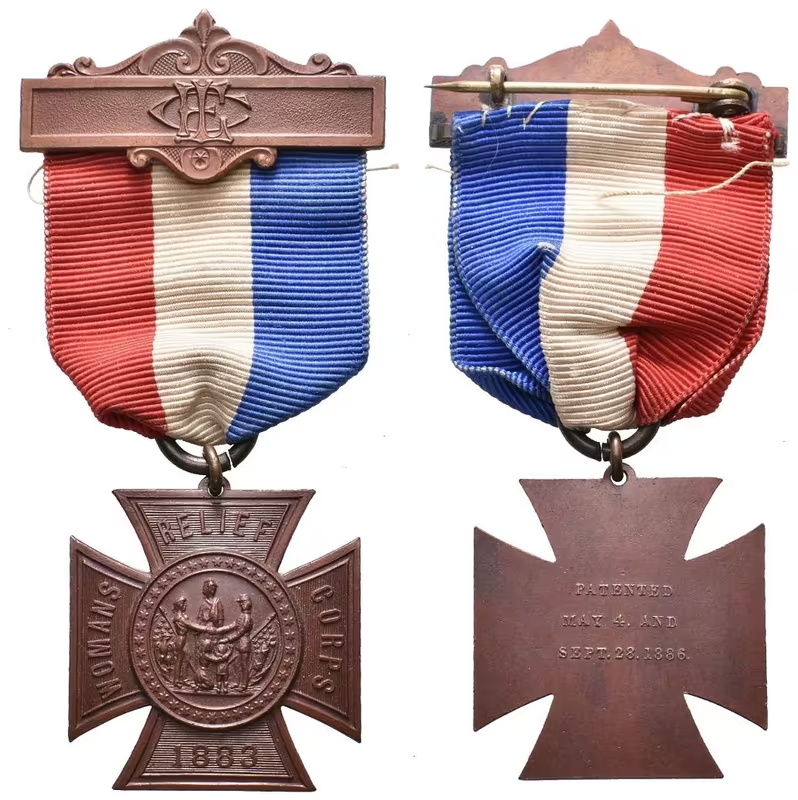
- Code: FUSA-122
USA, Medaile veteránů občanské války
United States of America / Spojené státy americké Grand Army of the Republic Womans Relief Corps Membership Badge (Pamětní medaile GAR pro ženy), měď, stuha
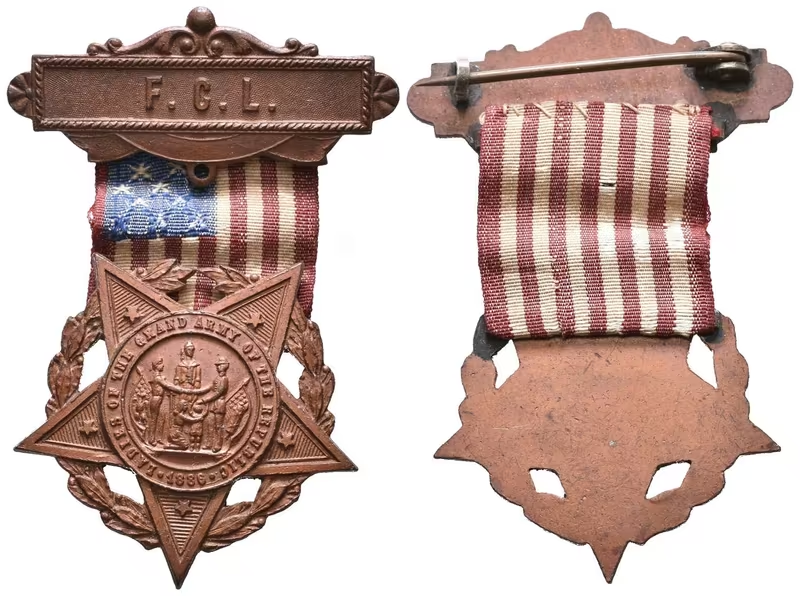
- Code: FUSA-121
USA, Medaile veteránů občanské války
United States of America / Spojené státy americké Grand Army of the Republic Membership Badge (Pamětní medaile GAR pro členy), měď, stuha, vzácné!