Charles Frederick of Baden
Charles Frederick of Baden (1728–1811) was a long-reigning ruler of Baden, first margrave, then elector and finally first grand duke. He became famous as an Enlightenment reformer: he supported education and administration, banned torture and abolished personal serfdom.
Charles Frederick of Baden was born in 1728 in Karlsruhe as a member of the House of Zähringen. He acceded to the throne of the Baden-Durlach branch as a child (1738) after the death of his grandfather, but did not take over actual rule until reaching his majority in the mid-1740s. Baden was at that time one of many smaller states of the Holy Roman Empire which had to balance between the great powers and at the same time build up their own administrative apparatus in order to hold their ground in competition with dynasties possessing greater resources.
The first great turning point came in 1771, when Charles Frederick inherited the Catholic Baden-Baden line as well and thus united the previously divided Baden. In practice this meant not only the enlargement of the territory but also the difficult task of administering a land with differing legal traditions and religious composition. It was here that he showed himself as a ruler of the Enlightenment type: instead of mere courtly representation he laid emphasis on functioning offices, on the economy and on education, because the stability of a small state depended on efficient administration and on the ability to gather revenue without destructive pressure on the population.
Among his best-known reforming acts are the prohibition of torture in 1767 and the abolition of personal serfdom in 1783. These steps fit into the broader Central European trend of Enlightenment reforms, which sought a "more rational" state: clearer law, predictable governance and the curtailment of older practices considered inhumane or inefficient. Charles Frederick at the same time supported education, science and more modern economic methods. In Karlsruhe his era was also reflected in urbanism and architectural culture, as the court wished to adapt the capital to the role of an administrative and representative centre.
History
At the turn of the 18th and 19th centuries the dramatic changes of the Napoleonic era affected Baden. Charles Frederick at first faced pressures from revolutionary France, but gradually managed to gain extraordinary territorial advantages in the new power arrangement. In 1803 Baden was raised to an electorate and in 1806, after the dissolution of the Holy Roman Empire, Charles Frederick became the first Grand Duke of Baden. Baden at that time greatly increased in size and from a previously fragmented state became a more compact territory with greater political weight. This expansion, however, also brought new demands: it was necessary to unify the administration, judiciary and financial system across a far larger area.
In the last years of his reign greater emphasis was therefore placed on legal and institutional modernisation, intended to join different parts of the country into a single functional whole. Charles Frederick died in 1811 and left Baden in a quite different position from that in which he had taken it over as a young margrave: from a state of middling importance it became a grand duchy with a more extensive territory, more stable administration and the reputation of a "model" Enlightenment state.
The substance of Charles Frederick's rule was a combination of Enlightenment paternalism and practical statesmanship. His reform measures aimed at making the state more efficient: less arbitrary power, more rules, better education and more predictable courts. At the same time this was a period when even small German states sought to keep up with modernisation, because the economy and the army already required more precise records, taxes and a functioning administration.
Reforms, administration and numismatic links
In numismatics Charles Frederick is associated with a rich coinage production in south-western Germany. On the coins his titulature in the individual phases of his reign (margrave, elector, grand duke) and the state symbolism of Baden are reflected. For collectors it is precisely the fact that his long reign encompasses different monetary and political stages that is interesting: from the imperial standards of the 18th century, through the upheaval of the Napoleonic era, to strikings that already represent the newly elevated grand duchy. The coins of the Charles Frederick period thus function as a clear "imprint" of history: changes in titles, emblems and the style of strikings often follow the transformation of the state, its prestige and its ambitions.
In our auction and shop
- Code: SFRA-D1990
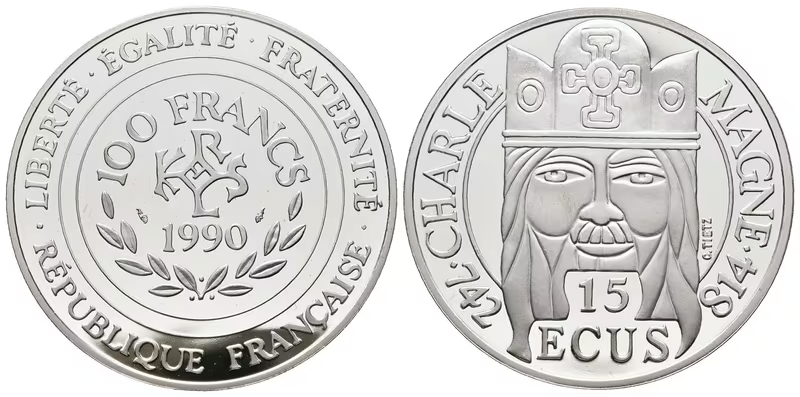
Francie, 100 Francs / 15 Ecus 1990 - Karel Veliký (Charlemagne, 742-814)
Francouzská republika (1958-dosud) 100 Francs / 15 Ecus 1990 - Karel Veliký (Charlemagne, 742-814), KM# 983 Ag (.900), 37 mm (22,2 g), v kapsli. Stav mince odpovídá fotografii.
Skladem 1 ks - Code: M78B-BZ1719
Karel VI., 1/2 Krejcar 1719
Karel VI. (1711 - 1740) 1/2 Krejcar 1719, Kutná Hora-Weyer, oxidace, lehce olámaný_R!
Skladem 1 ks - Code: RASPANEK-1958A
Špánek Karel - Výročí korunovace Jiřího z Poděbrad
Špánek Karel (1883 - 1983) AR Medaile 1958 - 500. výročí korunovace Jiřího z Poděbrad a Kunštátu českým králem Ag 0,900, 29 mm (12,13 g), puncováno luxusní zachovalost, jemná patina, lesk
Skladem 1 ks - Code: RASPANEK-1958A.1
Špánek Karel - Výročí korunovace Jiřího z Poděbrad
Špánek Karel (1883 - 1983) AR Medaile 1958 - 500. výročí korunovace Jiřího z Poděbrad a Kunštátu českým králem Ag 0,900, 29 mm (12,17 g), puncováno luxusní zachovalost, jemná patina, ražební lesk
Skladem 1 ks