Casimir IV Jagiellon
Casimir IV Jagiellon was King of Poland and Grand Duke of Lithuania ruling from 1447 to 1492, one of the most powerful sovereigns of the Jagiellon dynasty, who laid the foundations of the Polish-Lithuanian union as a European great power. On Polish and Lithuanian coins he appears as a symbol of the golden age of the Jagiellonian monarchy, while his half-g…
Casimir was born on 30 November 1427 in Kraków as the youngest son of the Polish king Vladislaus II Jagiełło and his fourth wife Sophia of Halshany. His childhood was marked by dynastic struggles over the Hungarian and Bohemian thrones, claimed by his elder brother Vladislaus, later king of Hungary and Poland. The young prince received a thorough education at Kraków University, where he studied Latin, theology, law and diplomatic skills. In 1440, at the age of only thirteen, he was elected by the Lithuanian nobility as Grand Duke of Lithuania, against the will of the Polish nobility, which wished to maintain the personal union of the two states.
The first years of Casimir's reign in Lithuania were devoted to consolidating the independence of the grand duchy and defending against the expansion of Moscow and the Crimean Tatars. The young grand duke skilfully manoeuvred between various political factions and gradually built up the authority of an independent sovereign. The situation changed dramatically in 1444, when his brother Vladislaus III fell at the Battle of Varna against the Ottomans. After a three-year interregnum, Casimir was crowned King of Poland in Kraków on 25 June 1447, thereby restoring the personal union between Poland and Lithuania, this time, however, with respect for the autonomy of both states.
History
The peak period of Casimir's reign was marked by successful foreign policy and territorial expansion. The Thirteen Years' War with the Teutonic Order from 1454 to 1466 ended with the Second Peace of Toruń, which brought to Poland Royal Prussia, including Gdańsk and Malbork, while the remainder of the Order's state became a Polish fief. Casimir IV Jagiellon thus gained access to the Baltic Sea and control over the mouth of the Vistula, which fundamentally strengthened Poland's economic position. At the same time he successfully countered the expansion of the Grand Duchy of Moscow in the east and maintained Lithuanian control over extensive territories of present-day Ukraine and Belarus.
Casimir's dynastic policy brought the Jagiellons unprecedented influence in central Europe. His eldest son Vladislaus became King of Bohemia in 1471 and King of Hungary in 1490, his other sons John Albert, Alexander and Sigismund gradually sat on the Polish throne, while Frederick became Bishop of Kraków and a cardinal. Casimir supported the development of the urban economy by granting privileges, codified the law by issuing statutes for Lithuania and supported Kraków University. He died on 7 June 1492 at Grodno at the age of sixty-four, leaving behind the greatest territorial extent of the Polish-Lithuanian state in its history.
Coinage and monetary policy
Casimir IV carried out a significant unification of Polish and Lithuanian coinage, which facilitated trade between the two parts of his realm. He introduced a uniform system based on the Prague groschen, with the main denominations – denarius, half-groschen and groschen. The royal mints in Kraków, Toruń and Vilnius struck coins with a uniform silver content, which stabilised the currency after the period of coinage chaos in the first half of the 15th century.
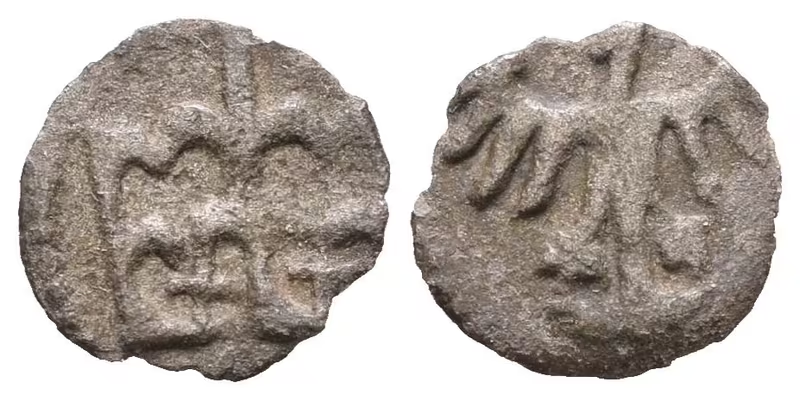
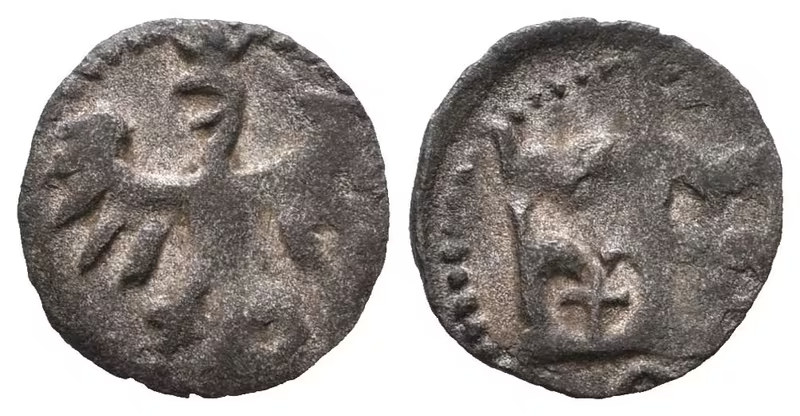
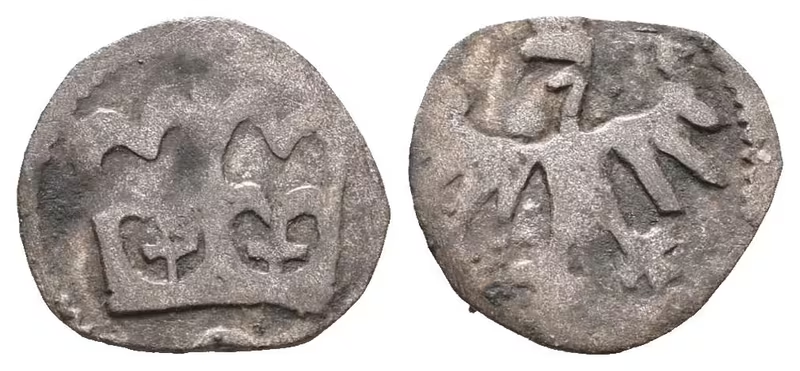
Polish coins bore the image of a crowned eagle with outstretched wings and the king's monogram, while Lithuanian strikings depicted a horseman with a sword, known as Pogoń or Vytis. Prussian coins struck in Toruń and Gdańsk after the annexation of Royal Prussia had a specific iconography combining the Polish eagle with the Prussian shield. The quality of Casimir's coins was high thanks to strict supervision of mints and severe penalties for counterfeiting.
In our auction and shop
- Code: SPOL83-G1447.1
Polsko, Denár b.l.
Polsko, Kazimír IV., 1447 - 1492 Denár, Krakov, Koruna / Orlice, Kop.378-385
Skladem 1 ks - Code: SPOL83-G1447.3
Polsko, Denár b.l.
Polsko, Kazimír IV., 1447 - 1492 Denár, Krakov, Koruna / Orlice, Kop.385 (Připisovaný Janu Olbrachtovi)
Skladem 1 ks - Code: SPOL83-G1447
- Code: SPOL83-G1447.2