Legate
A legate was a senior Roman military and administrative official, appointed by the emperor (formerly also by the republic) to command units or to govern a province. In practice the legate could act as a representative of the highest authority: he commanded a legion, led military operations, governed territory, and supervised finances and order.
The term legate comes from the Latin legatus, meaning "deputy, envoy". Already in the time of the Roman Republic, legates appeared as deputies of the commander-in-chief, who helped him direct the army and fulfil specific tasks. In republican times it was common that the highest commander (consul or proconsul) could not personally oversee all parts of a campaign, and so he had at his disposal officers and deputies who led detachments, negotiated, and supervised logistics.
Under the empire the meaning of the title broadened and became more precise, because the empire needed a stable system of provincial administration and at the same time professional command of the armies on the frontiers. There arose a type of office often designated as legatus Augusti pro praetore — the emperor's legate with the authority of a governor. Such a legate stood at the head of a province, especially those in which legions were stationed. He combined a military role (command and security) with civil administration (judiciary, supervision of tax collection and public order). In provinces with significant garrisons, the legate was a key figure precisely because he held both armed force and administrative authority in his hands.
Alongside this, there also existed the legatus legionis, the commander of a single legion. He was a professional military commander at the level of an entire legion and was subordinate either to the provincial governor (the imperial legate) or directly to the higher commander of the given theatre of operations. The commander of the legion had charge of training, discipline, supplies, construction, and of course combat deployment. At a time when a legion comprised thousands of soldiers, a logistical apparatus, and extensive camps, the legatus legionis was not just an "officer" but the manager of a great military organisation.
History
Legates were also employed in diplomacy. Rome often sent legates as envoys to negotiate with allies and enemies, to conclude treaties, or to settle disputes. In such cases they were persons of high social standing and with the confidence of the highest authority, because they acted in the name of the state. This shows the breadth of meaning of the word: a legate could be a military commander, a governor of a province, or a diplomatic envoy — the common feature was the commission and authority granted "from above".
In the late Roman Empire the titulature and administration were transformed, and some of the traditional offices acquired other names or had their competences shifted. Nevertheless the idea of the legate as a deputy of the sovereign remained alive in European tradition, which is evident also in later ecclesiastical terminology, where the word legate denotes a papal envoy. In the Roman state sense, however, the legate above all embodied the union of military and administrative power in the hands of the emperor's representative.
The specific powers of a legate depended on the type of office. A provincial legate usually had broad competences: he commanded the legions in the province, supervised security, judged in more serious cases, and organised the administration of the territory. The commander of a legion concentrated on the army and its operation, but he too could have a marked influence on the region, because the legion was an economic and construction actor — it built roads, camps, and fortifications, and its presence changed the local market. A diplomatic legate, conversely, had the authority to negotiate and conclude agreements according to the instructions he had received.
Powers, functions, and connections with coins
In numismatics the word legate appears most often in the context of provincial and imperial history: the legate as governor belonged to the highest officials of a province, and his activity could influence the supply of the army and the local economy. Nevertheless his name does not usually appear on coins as often as that of the emperor, because the Roman coin was above all an instrument of imperial representation. There may be exceptions in certain local types or regions where local magistrates are named on strikes; with the Roman provinces, however, it is more common for the coin to commemorate imperial authority, while the legate is the "man behind the scenes" who ensures that the system works.
For historical understanding the legate is important as the link that joined the centre with the province. He shows how Rome governed a vast empire: the emperor could not be everywhere, and therefore delegated power to trusted officials who had both military and administrative competences. Therein lies the principal significance of the term — the legate was a practical instrument of Roman statehood and of its ability to maintain order and control over great distances.
In our auction and shop
- Code: BE049-0780
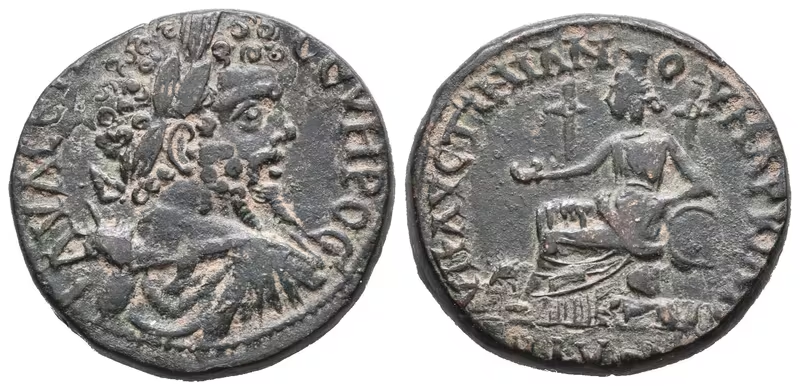
S. Severus, Moesia, Marcianopolis, AE 25
Septimius Severus (193 - 211) Moesia Inferior, Marcianopolis, Flavius Ulpianus jako legát, AE 25-7, Rv: Cybele sedící vlevo na trůně, drží pateru a opírá loket o tympanum, po stranách lvi. Varbanov 780, AMNG 565, krásná zachovalost, pěkná patina
Skladem 1 ks