Riga
Riga is the capital of Latvia and an important port on the Daugava River by the Baltic Sea. For centuries it was one of the most important commercial centres of north-eastern Europe, where German, Scandinavian, Polish-Lithuanian, and Russian influences met.
The territory of present-day Riga was settled even before the founding of the city, because the mouth of the Daugava represented a natural transport axis into the interior. Medieval Riga was founded in 1201 as an episcopal and commercial centre, traditionally associated with the name of Albert of Buxhoeveden, who moved his seat here and supported the development of the city as part of the Christian colonisation of Livonia. The location on the river, which allowed connection to long-distance routes, quickly drew merchants, craftsmen, and urban institutions modelled on Western European examples to Riga.
In the 13th-15th centuries, Riga became a member of the Hanseatic League and grew into a prosperous commercial hub. Goods flowed through the city from the Russian and Baltic areas as well as from Western Europe; trade relied on shipping, warehouses, municipal rights, and the network of contacts among Hanseatic cities. During this period the social structure of the city was also formed, in which German-speaking burghers played a large role, while the surrounding countryside remained predominantly Baltic. The Livonian region was at the same time politically fragmented, and tensions between ecclesiastical power, the orders of knights, and the cities were a constant motif of local history.
A fundamental turning point came in the 16th century with the Livonian War, when great powers clashed over the region and the existing order disintegrated. Riga gradually found itself within new state frameworks, and its further development was determined by the competing interests of regional powers. In the 17th century, Riga was one of the key cities of the Swedish Empire and gained importance not only commercially but also militarily: its fortifications and harbour played a major role in the Baltic region. The Swedish period also brought administrative and educational reforms that influenced the cultural life of the city.
History
After the Great Northern War at the beginning of the 18th century, Riga passed under the control of the Russian Empire. In the following decades it continued to develop as a port and industrial centre, especially in the 19th century, when modernisation accelerated throughout the region. Riga grew demographically, new districts and infrastructure emerged, and the city transformed into a metropolis with a distinctive cultural life. It is from the turn of the 19th and 20th centuries that the exceptionally esteemed Riga Art Nouveau architecture dates, which to this day is one of the most distinctive features of the cityscape.
In the 20th century, Riga underwent dramatic changes of statehood. After the First World War it became the capital of independent Latvia, which, however, lost its sovereignty shortly afterwards as a result of geopolitical upheavals. The Second World War and the subsequent Soviet era brought deep interventions into the society and demography of the city. After the restoration of Latvian independence at the beginning of the 1990s, Riga again profiled itself as the main political, cultural, and economic centre of the country and at the same time as Latvia's natural gateway to the Baltic Sea and Europe.
Riga is known for the contrast between its medieval core and more modern districts. The historic centre with the cathedral, town houses, and traces of Hanseatic wealth is complemented by extensive Art Nouveau development from the period of rapid growth before the First World War. The port and the location on the Daugava continue to determine the economic importance of the city, while cultural institutions and universities make it the main intellectual centre of Latvia.
The city, monuments, and numismatic context
From a numismatic point of view, Riga is interesting as a commercial city in which various monetary spheres historically met. In the Hanseatic period and later within the Swedish and Russian administrations, coins of various origins appeared in circulation, which is typical of port centres. For collectors, local strikes or tokens associated with trade and municipal institutions can also be attractive, especially when they relate to specific periods of administration and to monetary reforms in the Baltic area.
In our auction and shop
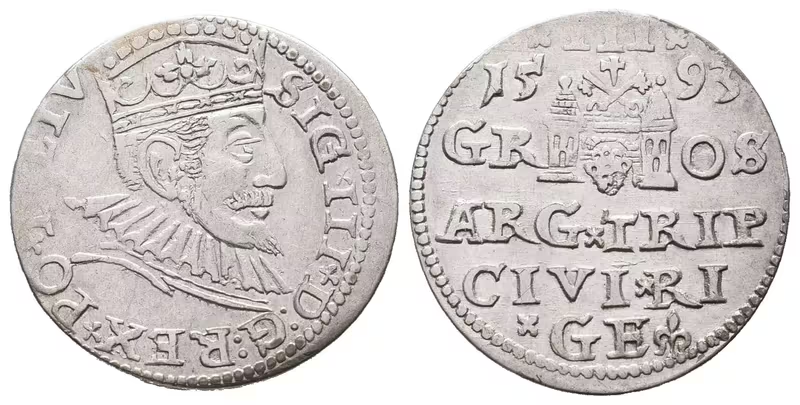
- Code: SPOL89-F1593R
Polsko, III Groš 1593, Riga
Polsko, Zikmund III. Vasa, 1587 - 1632 III Grosz 1593, Riga, Iger R.93.1. var. , pěkná zachovalost, patina, zbytky lesku, lehce exc.
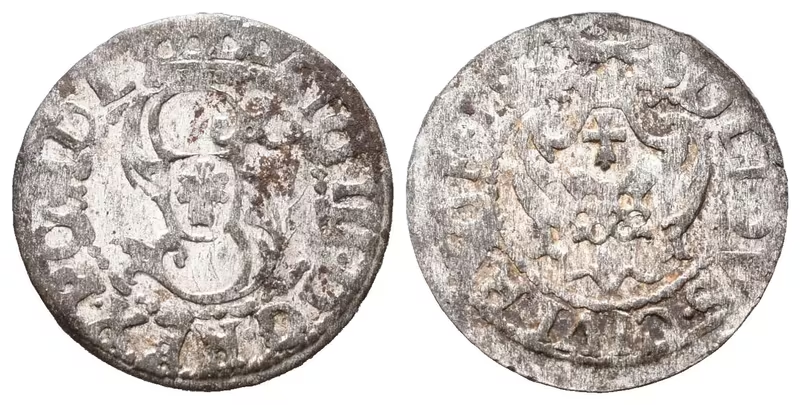
Skladem 1 ks - Code: SPOL89-B1618
Polsko, Schilling 1618
Polsko, Zikmund III. Vasa, 1587 - 1632 Szelag 1618, Riga, Kop.3449, patina, zbytky lesku
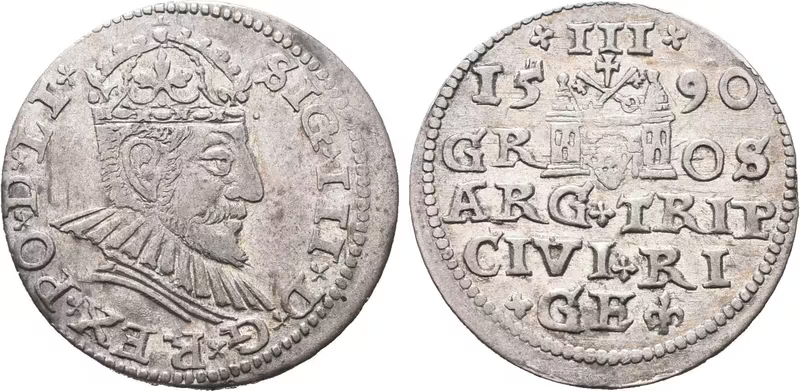
Skladem 1 ks - Code: SPOL89-F1590R
Polsko, III Groš 1590, Riga
Polsko, Zikmund III. Vasa, 1587 - 1632 III Grosz 1590, Riga, Iger R.90.1. var. , pěkná zachovalost, patina, zbytky lesku, lehce exc.
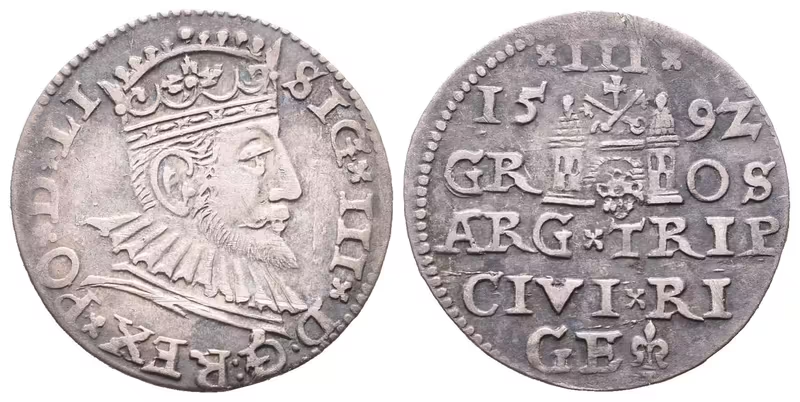
- Code: SPOL89-F1592R
Polsko, III Groš 1592, Riga
Polsko, Zikmund III. Vasa, 1587 - 1632 III Grosz 1592, Riga, Iger R.92.1. var. , pěkná zachovalost, patina, zbytky lesku, drobné rysky