Saalfeld
Saalfeld (officially Saalfeld/Saale) is a historic town in German Thuringia on the Saale river, the administrative centre of the Saalfeld-Rudolstadt district. It is famous for its well-preserved old town and above all for the underground "fairy caves" Feengrotten, which belong among the largest tourist attractions of the area.
The roots of Saalfeld reach back to the early Middle Ages. Settlement developed in the valley of the Saale river, where it was possible to control fords and trade routes and at the same time to make use of the resources of the surrounding mountainous landscape. The oldest written mention of the place comes from the end of the 9th century, when Saalfeld appears in charters as an important point of eastern Thuringia. Two forces that shaped the face of many medieval towns soon joined here: ecclesiastical power and the practical need for administration and trade.
A strong impulse was the foundation of a Benedictine monastery in the 11th century, which transformed Saalfeld into a regional spiritual and economic centre. The monastery did not act only religiously; it also functioned as an economic organiser, owned lands, supported crafts and helped to stabilise the surrounding network of settlements. The town market gradually developed and with it the layers of craftsmen and merchants who needed the safety of walls and predictable rules. In the high Middle Ages Saalfeld grew stronger as a fortified town, and parts of the medieval fortifications and town gates recall this development to this day.
From the late Middle Ages an important role was played by the House of Wettin, which in Thuringia and Saxony helped to shape the political map for centuries to come. Saalfeld became one of the towns where the interests of the individual branches intersected and where frequent inheritance agreements, mergers and divisions of territory were reflected. Precisely this "dynastic mosaic" explains why Saalfeld is later mentioned as a place connected with the Saxe-Coburg and Gotha branch of the Wettins. In the early modern period the town was also influenced by the great ideological upheavals: the Reformation and the changes in ecclesiastical administration affected the monastic institutions, while the economy was built on crafts, trade along the river and on a mining hinterland in the wider region.
History
Saalfeld entered European history in a marked way in 1806, when a battle took place at the town on the eve of the Napoleonic Wars in Germany. The event recalls that the Saale valley was not only a peaceful landscape but also a natural corridor for armies and a strategic space. In the 19th century modernisation and the railway brought a new impulse for development, and in the 20th century the town went through the experience of war and the post-war division of Germany. After 1945 it was close to the inner-German border, which influenced transport and everyday life. After reunification Saalfeld once again opened up more to the region and began to build more markedly on tourism and on the cultural memory of the town.
Saalfeld has retained to this day a legible historic core with churches, burghers' houses and traces of the former fortifications. Above the town the remains of older fortified and castle positions are recalled, which document how important control of the Saale valley was. For the visitor the typical combination is the "town in the valley" and the proximity of the wooded heights of the Thuringian Slate Mountains, so that Saalfeld naturally functions also as a starting point for excursions into the surrounding landscape.
The best-known brand of Saalfeld, however, is the Feengrotten — the "fairy caves". These are not a natural karst in the strict sense of the word, but an underground that arose in connection with earlier mining, where over time colourful sinters and small lakes formed and the place was transformed into a publicly accessible show site. Precisely the combination of an industrial past with an impressive underground world gives Saalfeld a distinctive tourist identity, complemented by associated family amenities and thematic exhibits. In practice this is an illustration of how the town managed to transform an older economic trace into a modern attraction without losing the link to its own history.
Monuments, points of interest and the town's current role
Present-day Saalfeld is also the administrative centre of the district and a natural hub for the surrounding settlements in the Saale valley. It has industrial and service facilities, but its image in recent decades has rested above all on cultural heritage, landscape and tourism. For travellers, the attractive option is to combine a tour of the town with the underground Feengrotten, and for those interested in history, to follow how in a single place early medieval ecclesiastical tradition, the dynastic politics of the German lands and the modern transformation of the region after 1990 all come together.
In our auction and shop
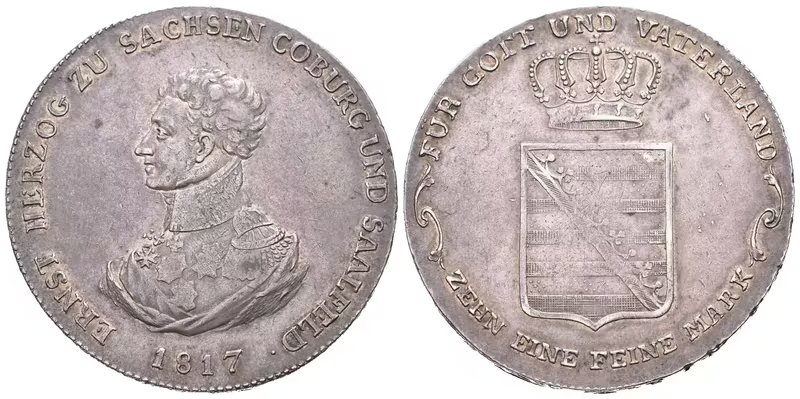
- Code: NASASCO-A1817
Sasko - Coburg, Tolar 1817
Sachsen - Coburg - Saalfeld , Ernst (1806 - 1826) Tolar 1817, Coburg, tzv. "Vaterlandsthaler", Jaeger 233, AKS 126 (28,97 g), velmi pěkná zachovalost, tmavá patina, zbytky lesku, rysky a drobné hranky (vyraženo 7 327 ks)_R!
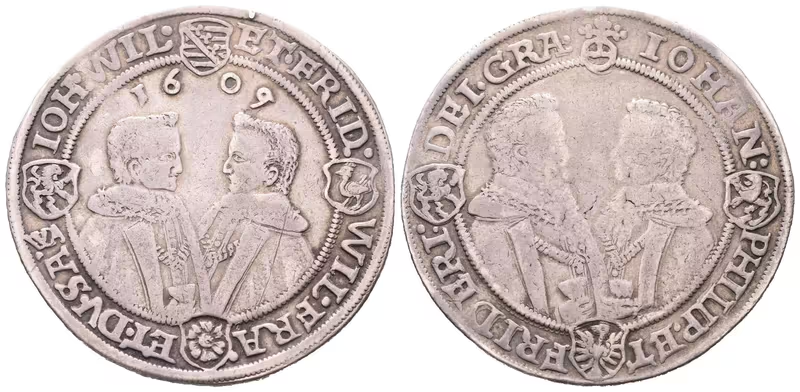
- Code: NASASALT-A1609
Sasko - Altenburg, Tolar 1609 WA
Sasko - Altenburg, Johann Philipp a bratři (1603 - 1625) Tolar 1609, Saalfeld, Dav.7361, tmavá patina, rysky, m.o.
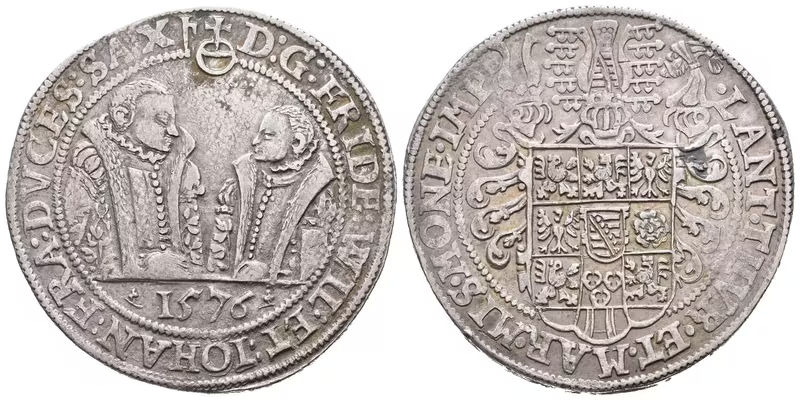
- Code: NASASWE-A1576
Sasko - Výmar, Tolar 1576
Sachsen - Weimar, Friedrich Wilhelm I. a Johann III. (1573 - 1603) Tolar 1576, Saalfeld, Dav. 9766; Schnee 231 (29,03 g), pěkná zachovalost, pěkně vyražený, patina, rysky a drobné hranky, nep. dvojráz
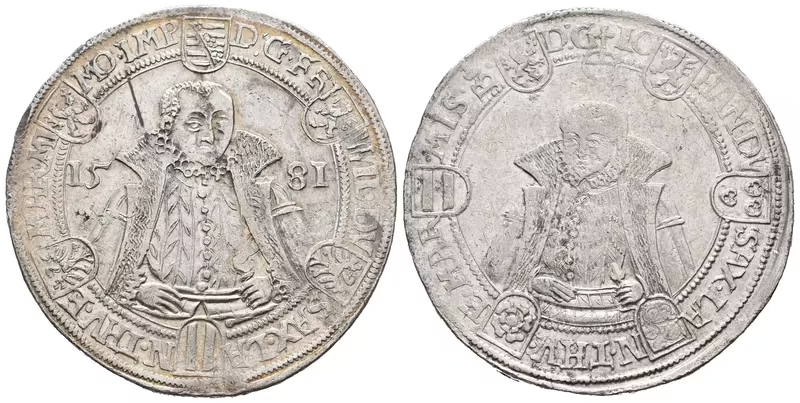
- Code: NASASWE-A1581
Sasko - Výmar, Tolar 1581
Sachsen - Weimar, Friedrich Wilhelm I. a Johann III. (1573 - 1603) Tolar 1581, Saalfeld, Dav. 9767, Schnee 234 (29,15 g), patina, zbytky lesku, škr. a hranky