Cheque
A cheque is a means of payment and at the same time a security by which the drawer instructs a bank to pay a specified sum of money to the entitled person. In practice it served mainly for non-cash payments and for cash withdrawals, and its use is tied to a bank account and precisely defined formal requirements.
The cheque arose from the need to transfer money more safely than by merely handing over coins and banknotes. Already in medieval trading centres written orders and receipts appeared which made it possible to draw a sum from a merchant or banker in another town. These instruments were not yet a "cheque" in the present-day legal sense, but they established the underlying principle: instead of physically transferring metal, a written authorisation for payment was transferred. The development of banking, bookkeeping and regular commercial ties then created the environment in which the cheque could become a common payment instrument.
The classic setting for the development of cheques is considered to be early modern Europe, especially regions with dense networks of banks and merchants. In England from the 17th century onwards the practice spread whereby a bank's client issued a written instruction to the bank to pay a certain sum to a person named on the document. The cheque thus became a natural "extension" of a current account: the money physically remained with the bank, but the holder could dispose of it through a paper order. With the gradual spread of current accounts cheques became familiar in the wider economy as well — in firms, among merchants and eventually in households.
A key step for mass use was the introduction of inter-bank clearing. Once cheques began to accumulate, it was impractical for each bank to physically pay out cash for other banks' cheques and then settle the funds in a complicated way. Clearing mechanisms therefore arose, which allowed cheques to be gathered, mutual claims of banks to be compared and settled without unnecessary movements of cash. The cheque thus strengthened non-cash payment traffic and for a long time became a standard tool of commercial life, particularly for larger sums and regular payments.
History
In continental Europe cheque law was gradually unified and gained a firmer legal framework. In the Czech context the cheque is traditionally interpreted in connection with the Act on Bills of Exchange and Cheques, which defines what a cheque is, what particulars it must contain, and how the rights and duties of the parties are exercised. Legal precision was essential for the cheque: it was a security whose effectiveness rested on being comprehensible and enforceable without complicated proof. Cheque law also addresses transferability (for example a cheque "to order"), liability in the event of non-payment, and the time limits within which a cheque must be presented for payment.
From the second half of the 20th century the role of the cheque gradually weakened. In many countries it was displaced by payment cards, electronic transfers and later internet banking, which offered faster and simpler means of payment. Cheques have not completely disappeared, however: in some jurisdictions they remain common in business transactions, in state payments, or where traditional payment habits change more slowly. Today the cheque is regarded rather as a historically significant non-cash payment instrument that vividly illustrates the transformation of money from metal and banknotes to accounts and electronic records.
A cheque is typically an unconditional order to a bank (the drawee) to pay a certain sum. In practice several forms exist: a cheque to the bearer, a cheque to a named person, and a cheque "to order" which may be transferred by endorsement. For increased security a crossed cheque is also used, which restricts payment and directs it rather towards non-cash settlement. A special category used to be the traveller's cheque, intended for safer payments when travelling, since it combined signature elements with the possibility of replacement in case of loss.
Types of cheques and required particulars
For the validity of a cheque the formal particulars are important — in particular the designation that it is a cheque, identification of the bank, the order to pay a specific sum, the place and date of issue and the signature of the drawer. In practice the cover on the account is also crucial: the bank usually pays the cheque only up to the available funds or up to an agreed limit. The cheque is then either paid out in cash (under the relevant conditions) or handed in for collection and cleared between banks. From a numismatic point of view the cheque stands on the borderline between a payment instrument and a document of financial history: it shows how trade and everyday payments rested on trust in banks, on standardised forms and on a legally enforceable "piece of paper" that represented money.
In our auction and shop
- Code: MCZS1999-SEKORA
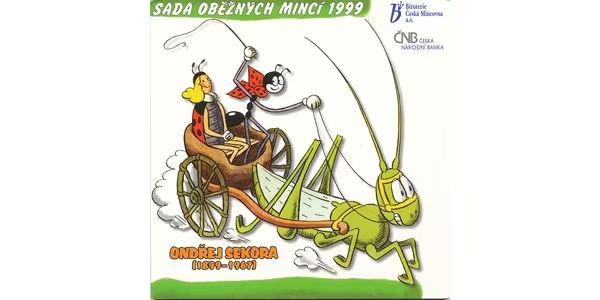
Ročníková sada mincí 1999 - Ondřej Sekora
Česká republika, 2001 Ročníková sada mincí 2001 - Ondřej Sekora (1899-1967) ilustrační foto, komisní prodej - obaly mohou být opotřebené
Skladem 3 ks - Code: MCZ024
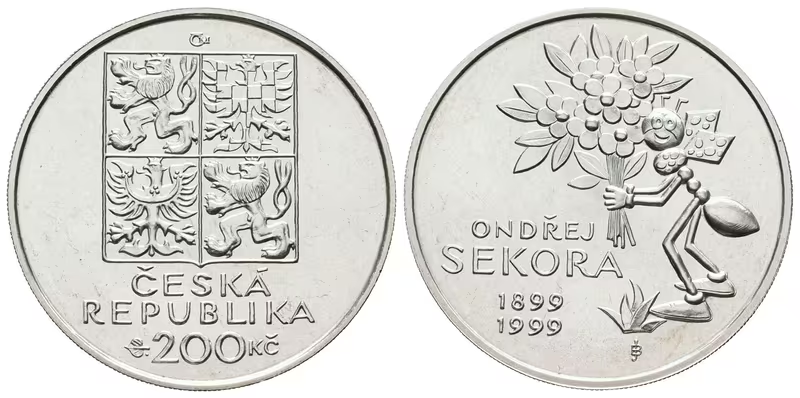
200 Kč 1999 - Ondřej Sekora
Česká republika (1993 - ) 200 Koruna 1999 - 100. výročí narození Ondřeje Sekory, autor Jaroslav Bejvl, Aurea C124, kapsle, certifikát, běžná kvalita Ag 0,900, 31 mm (13 g), raženo 14 727 ks (běžná kvalita), 2 882 ks (proof)
Skladem 3 ks - Code: MCZ024-PROOF
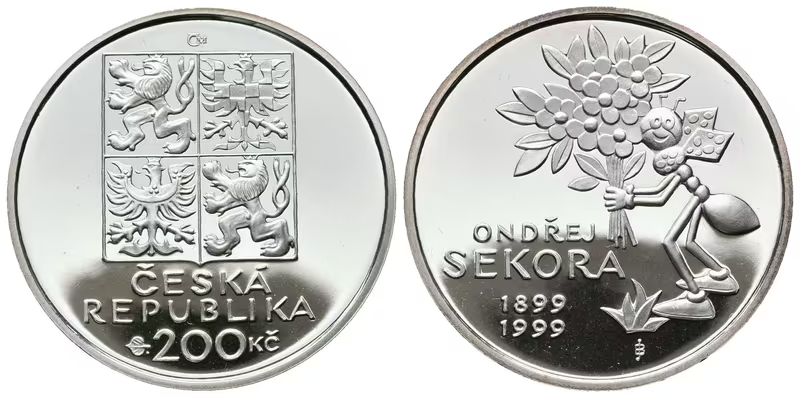
200 Kč 1999 - Ondřej Sekora, PROOF
Česká republika (1993 - ) 200 Koruna 1999 - 100. výročí narození Ondřeje Sekory, autor Jaroslav Bejvl, Aurea C124, etue, certifikát, PROOF Ag 0,900, 31 mm (13 g), raženo 14 727 ks (běžná kvalita), 2 882 ks (proof)
Skladem 1 ks - Code: SISR-G2011S
Israel, 2 New Sheqalim 2011 - Mrtvé moře
Israel (1948 - ) 2 New Sheqalim (Nové Šekely) 2011 (5771 židovského kalendáře) - Mrtvé moře. Ag 0,925, 38,7 mm (28,80 g), PROOF, kapsle, etue a certifikát
Skladem 1 ks