Seoul
Seoul is the capital of South Korea and one of the largest cities in East Asia, lying on the Han River in the north-west of the Korean Peninsula. It is the political, cultural and economic centre of the country and is famed for the contrast between the palaces of the Joseon dynasty and modern districts.
The territory of today's Seoul was already inhabited in ancient times thanks to its advantageous position by the Han River and in a relatively protected basin surrounded by hills. In early Korean state formations the area served as a strategic point, because it connected the interior with the coast and allowed control of transport routes. The real rise of the city, however, is associated above all with the period of the Joseon dynasty, which came to power in 1392 and soon afterwards chose as its seat the locality then known as Hanyang (later also Hanseong). The choice was not accidental: it was a place suitable for the administration of the state, for defence and for the symbolic anchoring of the new dynasty.
In the 15th and 16th centuries Seoul took shape as a carefully planned capital. Royal palaces, official quarters, marketplaces and city gates arose, while the surrounding ridges and city walls formed a defensive ring. City life was governed by Confucian rules of court and administration, with an emphasis on order, education and hierarchy. Even so, Seoul was not only a "city of officials" – thanks to its markets and crafts it became a magnet for merchants and inhabitants from various corners of the kingdom. The Japanese invasions at the end of the 16th century, which heavily marked the city and the entire kingdom and showed how fragile security could be even in a relatively well-fortified centre, also went down in history.
History
At the turn of the 19th and 20th centuries Korea entered a period of rapid change, pressure from the great powers and modernisation, which also affected Seoul. The beginnings of industry, new transport features and rebuilding altered the traditional face of the city. A turning point came with the period of Japanese rule in the first half of the 20th century, when Seoul expanded and modernised but was at the same time subjected to foreign administration, and some of its cultural layers suffered. After liberation, the formation of an independent South Korea followed, but soon afterwards came the Korean War, during which Seoul was repeatedly occupied and severely damaged. Reconstruction after the war eventually became one of the most rapid urban and economic transformations of modern times: the city grew into a metropolis with vast housing estates, transport networks and new commercial centres. From a former royal seat it became a symbol of the modern state, embodying both centuries-old heritage and contemporary energy.
Seoul is typified by the layering of historical and modern elements. In the centre, the precincts of royal palaces, traditional quarters with narrow lanes and gates recalling the former city defences have been preserved, while nearby office towers, department stores and residential complexes rise. A prominent landmark is the Han River, which not only divides the city but also unites it: along its course parks, promenades and traffic arteries have been laid out, and the river has become an important part of urban identity.
Monuments, urban structure and contemporary significance
For daily life, dense and well-organised transport is essential, especially the metro, which makes it possible to move quickly between distant districts. The metropolis is also a centre of education and culture – it concentrates universities, museums, theatres and major festivals. Alongside traditional values, contemporary popular culture, design and technology have a strong presence, attracting visitors and labour from around the world. The city long faces typical challenges of large agglomerations, such as density of building, housing costs and air quality, but at the same time it invests in green projects, the renewal of public space and smart administration.
For travellers it is attractive that Seoul can offer very different experiences within a short distance: the tranquillity of palace gardens, bustling markets, modern districts with a neon atmosphere and views from the surrounding hills. Historically the city is valuable in that, in one place, it allows one to read the story of Korea – from the royal dynasty through the dramatic 20th century to its current global metropolis.
In our auction and shop
- Code: SNIU-B1987
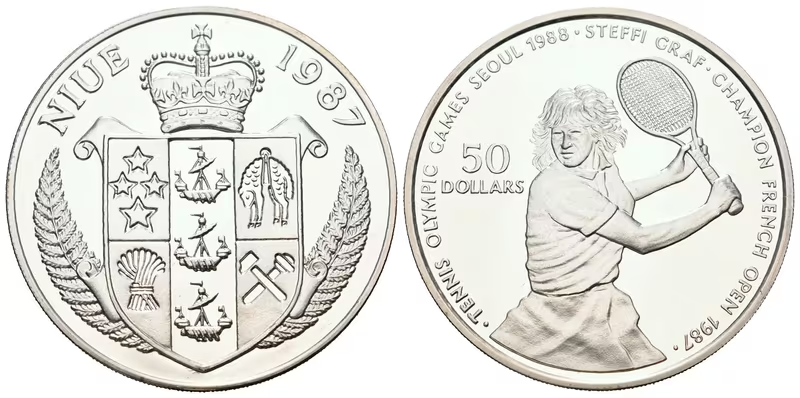
Niue, 50 Dollars 1987 - Steffi Graf (Olympijské hry v Soulu 1988)
Niue, Elizabeth II. (1952 - 2022) 50 Dollars 1987 - Steffi Graf, KM# 6 Ag (.925), 38,5 mm (27,1 g), proof, v kapsli. Emise: 20 000 ks. Stříbrná pamětní mince k olympijským hrám v Soulu 1988, kde Steffi Graf dosáhla historického milníku: jako jediná…
Skladem 1 ks - Code: ZSJIZK-1988
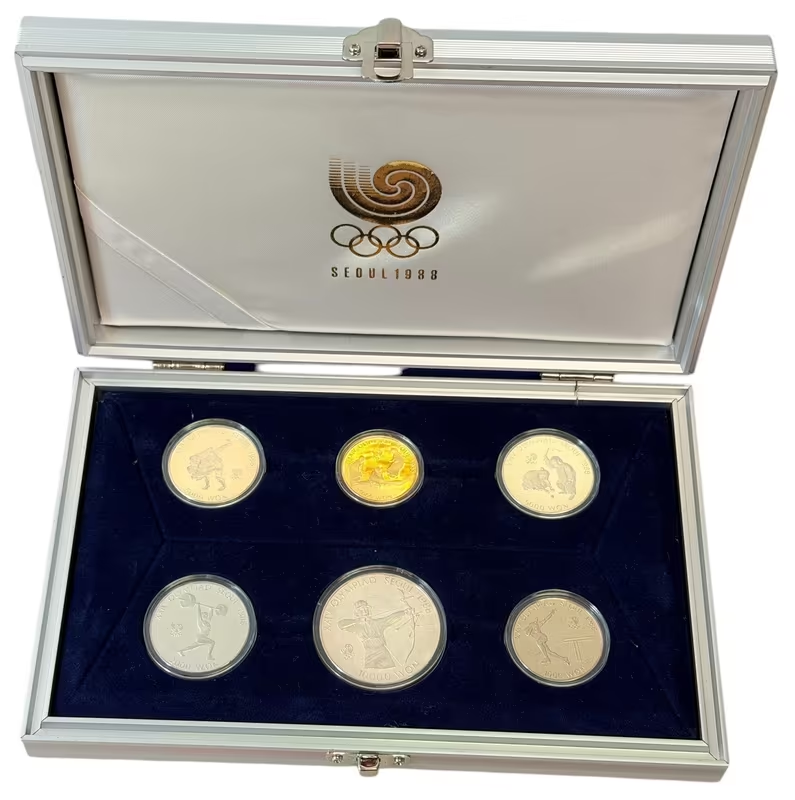
Jižní Korea, Olympijské hry Soul 1988
Jižní Korea (South Korea) Sada pamětních zlatých a stříbrných mincí k XXIV. olympijským hrám v Soulu v roce 1988 certifikát, uloženo v luxusní hliníkové etui v modrém kartonovém obalu se zlatým tiskem 25 000 Won 1988, Au 0,925, 27 mm (16,813 g), 1/2 Oz…
Skladem 1 ks - Code: XB1290-1New
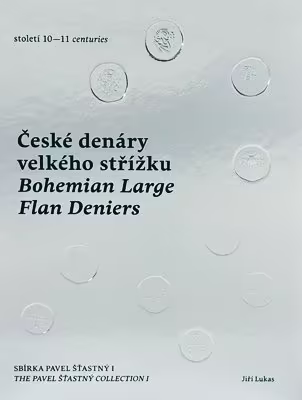
České denáry velkého střížku - Pavel Šťastný, I. díl
České denáry velkého střížku ze sbírky Pavla Šťastného - I. díl Nabízíme vám exkluzivně čtyřsvazkovou edici proslulé sbírky českých denárů a brakteátů Pavla Šťastného. Sbírka představuje nejúplnější komplet českých raně středověkých mincí 10. - 13.…
Skladem 2 ks - Code: MCZ116-PROOF
200 Kč 2018 - Klaudyánova mapa, PROOF
Česká republika (1993 - ) 200 Koruna 2018 - 500. výročí vydání Klaudyánovy (Klaudiánovy) mapy Čech, autor Zbyněk Fojtů, Aurea C216, etue, certifikát, PROOF Ag 0,925, 31 mm (13 g), raženo 5 800 ks (běžná kvalita), 10 200 ks (proof) Klaudiánova mapa (též…
Skladem (>5 ks)