South Korea
South Korea (officially the Republic of Korea) is a state in East Asia which occupies the southern part of the Korean Peninsula. The capital is Seoul and the currency is the South Korean won (KRW); the country is one of the most advanced economies in the world and is also known for modern commemorative coins and collectors' issues.
The history of South Korea follows on from a long Korean statehood, which took shape as early as the early Middle Ages in the kingdoms of Silla, Goguryeo and Baekje, and later under the Goryeo and Joseon dynasties. Korean society was distinguished by a strong tradition of learning, state administration and Confucian culture; during the Joseon dynasty the Korean phonetic system Hangul also came into being, which remains one of the important symbols of Korean identity. In the 19th century, however, Korea was increasingly affected by pressure from the powers in the region, particularly Japan, Russia and China, which gradually weakened its capacity to determine its political future independently.
A fundamental turning point came at the beginning of the 20th century. After a period of growing Japanese influence, Korea was annexed by Japan in 1910, and several decades of colonial administration followed. This period brought modernising measures but also harsh assimilation, repression and restrictions on Korean autonomy. Korean resistance manifested itself both politically and culturally; an important reference point for modern Korean identity is, for example, the mass protest movement of 1 March 1919, which became a symbol of the effort towards self-determination.
After the Second World War, Korea found itself at the centre of the rapidly forming Cold War order. The peninsula was divided along the 38th parallel into Soviet and American occupation zones, which soon transformed into a political division. In 1948 the Republic of Korea was established in the south and the Democratic People's Republic of Korea in the north. The subsequent Korean War (1950–1953) caused enormous human and material losses and ended in an armistice, not a peace treaty, so that the division of the peninsula has remained a permanent geopolitical fact.
History
Post-war South Korea underwent a dramatic transformation. Initially it was a poorer state struggling with post-war reconstruction, political instability and tension with the north. Gradually, however, economic growth and industrialisation took off, often referred to as the "Miracle on the Han River". The country built up an export-oriented industry, strengthened education and its technological base, and in the last third of the 20th century also changed politically: after periods of authoritarian rule, a democratic system and a civil society consolidated from the late 1980s onwards.
In the 21st century, South Korea is seen as an advanced democracy with a high technological level and strong cultural influence (film, music, design). At the same time, it remains a country that lives with a long-term security risk on the border with the DPRK, and therefore pays extraordinary attention to defence and to international cooperation. Modern South Korean identity thus rests on a combination of historical tradition, the experience of division and exceptionally rapid modernisation.
South Korea uses the currency of the South Korean won (₩), which is divided into 100 jeon (in practice the jeon is hardly used in circulation). The issue of banknotes and coins is handled by the central bank, and the circulating coins come in denominations from 10 to 500 won. On the coins there appear motifs that refer to Korean culture and history — for example national symbolism, traditional objects or notable figures. On the banknotes, portraits of scholars and motifs connected with the Confucian tradition and the arts are often used.
The State, the Currency and Numismatic Context
For collectors, South Korea is also interesting for its commemorative and investment-oriented issues, which are produced for important anniversaries and events. With modern strikes, the mintage, quality of finish (ordinary strike versus top collector finish), theme and surface condition are particularly decisive. For circulating coins, the year, possible varieties and state of preservation are important to collectors, since modern alloys are susceptible to scratches and dirt in circulation.
In a numismatic context, it is useful to distinguish whether a piece is ordinary circulating currency, a commemorative coin with the status of legal tender, or a medal intended purely for collectors. As a modern state, South Korea offers all of these categories, with ordinary circulating currency having the greatest practical importance, while commemorative issues add a collector dimension and often feature very high-quality artistic execution.
In our auction and shop
- Code: ZSJIZK-1988
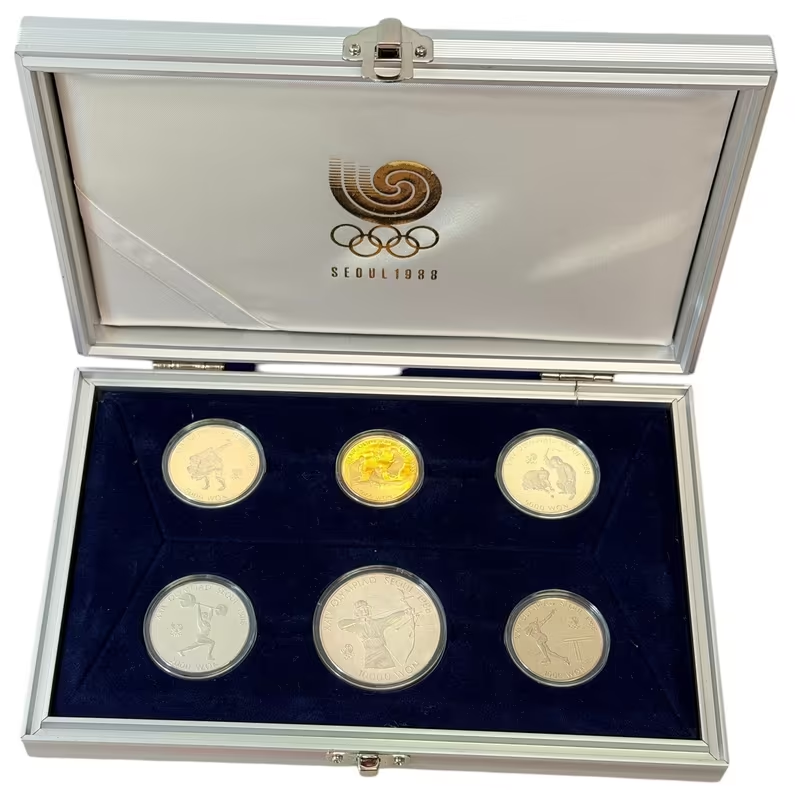
Jižní Korea, Olympijské hry Soul 1988
Jižní Korea (South Korea) Sada pamětních zlatých a stříbrných mincí k XXIV. olympijským hrám v Soulu v roce 1988 certifikát, uloženo v luxusní hliníkové etui v modrém kartonovém obalu se zlatým tiskem 25 000 Won 1988, Au 0,925, 27 mm (16,813 g), 1/2 Oz…
Skladem 1 ks - Code: BKOREJ044.0
Jižní Korea, 1000 Won (1975), P.44
Jižní Korea / South Korea 1000 Won (1975), P.44 0-/AU-
Skladem 1 ks - Code: BKOREJ010A.0
- Code: BKOREJ011A