Dry seal
A dry seal, also known as an embossed or relief seal, is a type of impression which, unlike a classic seal, uses neither ink nor wax. It creates a three-dimensional (relief) image on a document by compressing the paper between two opposed dies: a matrix (negative form) and a patrix (positive form).
Technique and use
Special pliers or a desktop press are used to produce a dry seal. This mechanism provides the sufficient and uniform pressure needed to imprint the motif into the structure of the paper. Dry seals are traditionally used by state institutions, notaries, universities and companies to authenticate important documents such as diplomas, certificates, contracts or official papers.
Their main advantage is that they become an inseparable part of the document and cannot be removed without visible damage. At the same time, imitating them without the original sealing device is very difficult, which enhances the security of the document.
Sigillographic and numismatic significance
From the point of view of sigillography, an auxiliary historical discipline dealing with seals, the dry seal represents a modern form of authentication that builds on historical sealing traditions. Its study can provide information about the institution that issued the document.
In numismatics and notaphily, dry seals are encountered mainly on certificates of authenticity that accompany rare coins, medals or banknotes. In the past, relief impressions were also used as one of the security features on certain types of paper currency or securities, where they supplemented printed elements and the watermark.
In our auction and shop
- Code: RAOPP-2010SEI
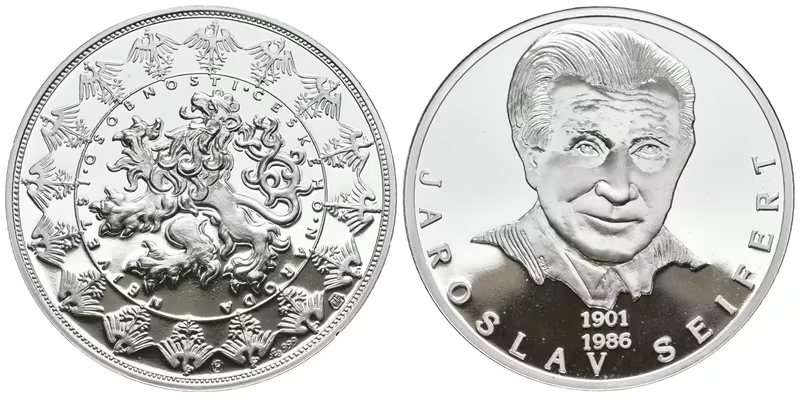
Oppl Vladimír - Jaroslav Seifert bez certifikátu
Oppl Vladimír (1953 - ) AR Medaile b.l. - Jaroslav Seifert, první český nositel Nobelovy ceny za literaturu. (23.9.1901 Praha – 10.1.1986 Praha) Jaroslav Seifert, český básník, v raném období významný představitel české proletářské poezie a později také…
Skladem 1 ks