Treaty of Versailles
The Treaty of Versailles is a peace agreement signed on 28 June 1919 at Versailles that officially ended the war between Germany and the Entente powers after the First World War. It established new borders, restrictions on the German army and reparations, and significantly influenced the post-war arrangement of Europe.
The Treaty of Versailles came into being as a key document of the post-war peace system after the First World War. The armistice concluded on 11 November 1918 stopped the fighting, but Europe and the world were left with a basic question: how to set up a new order to prevent the repetition of such a destructive conflict. Peace negotiations took place at the Paris Peace Conference, where the victorious powers — above all France, Great Britain and the United States — had the decisive voice. Already at that time it was clear that the goals of the allies were not identical: France sought as harsh a guarantee as possible of security against future German attack, Britain looked for a compromise that would maintain stability and trade balance, and the United States promoted principles linked to the vision of collective security and a new international order.
The treaty itself was signed on 28 June 1919 in the Hall of Mirrors of the palace at Versailles. Both date and place carried strong symbolism: exactly five years after the Sarajevo assassination that set off the chain of events leading to war, and at the same time in a space associated with German unification in 1871. In Germany the agreement was perceived as a 'dictate', because the German delegation had no opportunity to influence its form substantially and was placed before the choice of accepting it or risking the resumption of fighting and the continuation of the blockade. Internally, the treaty became one of the most explosive topics of the early Weimar Republic.
The Treaty of Versailles dealt with several layers of the post-war arrangement. Territorially, it confirmed the loss of part of German territories to neighbours and restored or created new states and borders in Europe. Germany lost Alsace-Lorraine, which returned to France, and further areas whose status was regulated by special regimes, plebiscites or international administration. At the same time the treaty established the demilitarisation of the Rhineland, which was to serve as a security zone for France. At the colonial level Germany lost its overseas possessions, which were transferred into the mandate system under the supervision of the new international organisation.
History
One of the most sensitive points was the question of responsibility for the war and the subsequent financial compensation. The treaty contained a provision usually summarised as 'war guilt', which became the legal basis for the demand for reparations. These were to cover the damage and costs connected with the war, but their amount and the manner of collection became the subject of sharp disputes and further agreements in the following years. In German society, reparations were often perceived as humiliating and economically ruinous, while the victorious states understood them as just compensation.
A significant element of the peace arrangement was also the founding of the League of Nations, which was to be an instrument of collective security and the resolution of disputes. This institution, however, faced weaknesses from the outset: some key powers did not engage with it to the intended extent, and the system of enforcement of decisions was limited. Even so, it was an important precedent for later international organisations.
The long-term impact of the Treaty of Versailles is still subject to interpretation today. Some historians emphasise that the treaty was both harsh and insufficiently enforceable, which created scope for revisionism. Others point out that a number of provisions were softened during the 1920s and that later crises were also contributed to by economic shocks and political radicalisation. What is certain is that the Treaty of Versailles became a symbol of post-war Europe: it at once defined borders and rules but also left behind points of conflict and disappointed expectations, which in subsequent decades were reflected in international politics.
Contents of the treaty and consequences
The Treaty of Versailles combined territorial, military, political and economic measures. Militarily, it limited the size and structure of the German armed forces, prohibited certain kinds of armaments and established a regime of control intended to prevent rapid rearmament. Part of the security framework was the demilitarisation of the Rhineland and selected restrictions intended to reduce the likelihood of further conflict in Central and Western Europe.
At the economic level, reparations were crucial. Their specific amount and payment regime were developed in follow-up negotiations, but the principle itself created long-term tension between the defeated state and the victors. The impacts manifested themselves not only in state finances but also in politics and public opinion. From the standpoint of international relations the treaty created a system in which some states felt safer, while other actors perceived the new borders as unjust or temporary.
For orientation in the material culture of the time, it is important that the post-war changes were also reflected in money: new states introduced their own currencies, old monetary unions disintegrated and in many countries the symbolism of coins and banknotes changed. The Versailles arrangement thus had effects not only 'on the map' but also in people's daily lives — in documents, borders, passports and in what money they had in hand. In this sense the treaty is one of the turning points of modern European history, because it combined diplomatic decision with long-term economic and social consequences.
In our auction and shop
- Code: RX-FRAN034
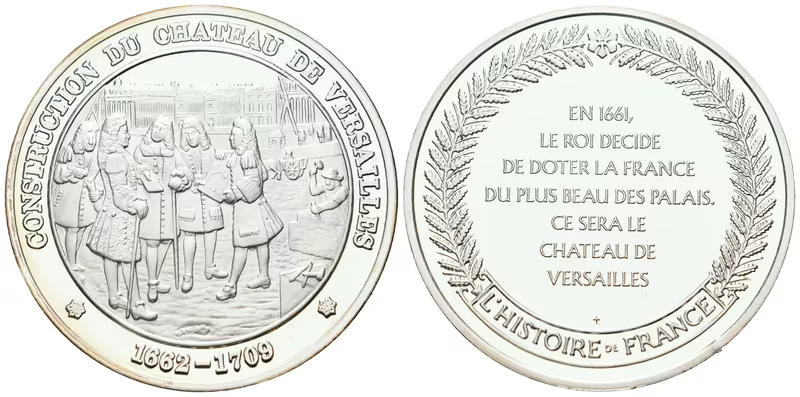
Francie - AR Medaile b.l. - Château de Versailles
Château de Versailles - 1662-1709 Ag 0,800, 44 mm (cca. 37 g) Na minci se nachází Francouzský punc ryzosti. V originální kapsli. Medaile je ze série 'Historie Francie v medailích' - Na některých mincích jsou viditelné stopy patiny aj. - Viz. obrázek.…
- Code: ZSFRA-96K2015.1
Francie, 50 Euro 2015 - Manufaktura v Sévres
Francie, V. republika (1958 - ) 50 Euro 2015 - Porcelánová manufaktura v Sévres Au 0,920, 22 mm (8,45 g), 1/4 Oz, limitovaná edice, náklad 1000 ks, certifikát, etue, kartonový přebal, PROOF Sèvreský porcelán – výrobky z porcelánu , produkované dodnes v…