
The rarest pieces
At the top stands the 5 heller 1924 — per the ČNB the rarest Czechoslovak circulation heller, whose exact production count is not reliably documented. Beside it the 25 heller 1932, an experimental strike that never entered circulation, and the 50 heller 1926, a catalogue R of the First Republic.
Documented low mintages
The figures in this table come directly from ČNB records. The set-only years were struck exclusively for the annual coin sets — some sets were later destroyed and the number of destroyed coins is not known today.
| Coin | Mintage (ČNB) | Note |
|---|---|---|
| 5 h 1980 | 50 600 low mintage | struck for the annual sets |
| 50 h 1980 | 50 600 low mintage | struck for the annual sets |
| 5 h 1981 | 66 160 low mintage | struck for the annual sets |
| 50 h 1981 | 66 160 low mintage | struck for the annual sets |
| 5 h 1982 | 53 847 low mintage | struck for the annual sets |
| 5 h 1983 | 60 000 low mintage | |
| 5 h 1984 | 39 957 low mintage | struck for the annual sets |
| 5 h 1985 | 39 791 low mintage | struck for the annual sets |
| 5 h 1987 | 520 000 low mintage | |
| 5 h 1989 | 110 000 low mintage | |
| 1 h 1991 | 55 000 low mintage | struck for the annual sets |
| 1 h 1992 | 49 500 low mintage | struck for the annual sets |
| 5 h 1992 | 49 500 low mintage | struck for the annual sets |
| 50 h 1998 | 27 600 low mintage | recorded production of that year |
| 20 h 2002 | 23 490 low mintage | recorded production of that year |
| 20 h 2003 | 25 000 low mintage | recorded production of that year |
| 10 h 2004 | 350 low mintage | production after the denomination left circulation |
| 20 h 2004 | 200 low mintage | production after the denomination left circulation |
| 50 h 2004 | 935 145 low mintage | |
| 50 h 2008 | 19 580 low mintage | the 50 h's final year of production |
Source: Czech National Bank — Czechoslovak circulation coin sets 1980–1992; Numbers of base-metal coins produced in individual years.
Rarities without a reliable exact count
A low mintage is not automatically the same as high rarity — nor the reverse. Where the primary source does not document an exact figure we say so plainly; we add no number from the internet.
| Coin | Count | What can safely be said |
|---|---|---|
| 5 h 1924 | exact count not documented | The ČNB calls it the rarest Czechoslovak circulation heller coin. |
| 25 h 1932 | exact count not documented | An experimental strike; it never entered circulation. |
| 50 h 1926 | exact count not documented | Catalogue R; 999,860 produced, with the caveat whether all carried the 1926 date. |
| 5 h 1955 | exact count not documented | Marked R in the catalogue table. |
| 10 h 1958 | exact count not documented | Marked R in the catalogue table. |
| 25 h 1954 | exact count not documented | Marked R in the catalogue table. |
| 10 h 1963 b | exact count not documented | A separately listed rare variety. |
| 50 h 1969 b | exact count not documented | The 10 h obverse motif used in error; the dots beside the date are missing. |
| 20 h 1990 v | exact count not documented | A different shape of the date. |
| 20 h 1994 v | exact count not documented | A different date style. |
| 50 h 1994 v | exact count not documented | A different date style and the Jablonec mintmark set at an angle. |
Die varieties
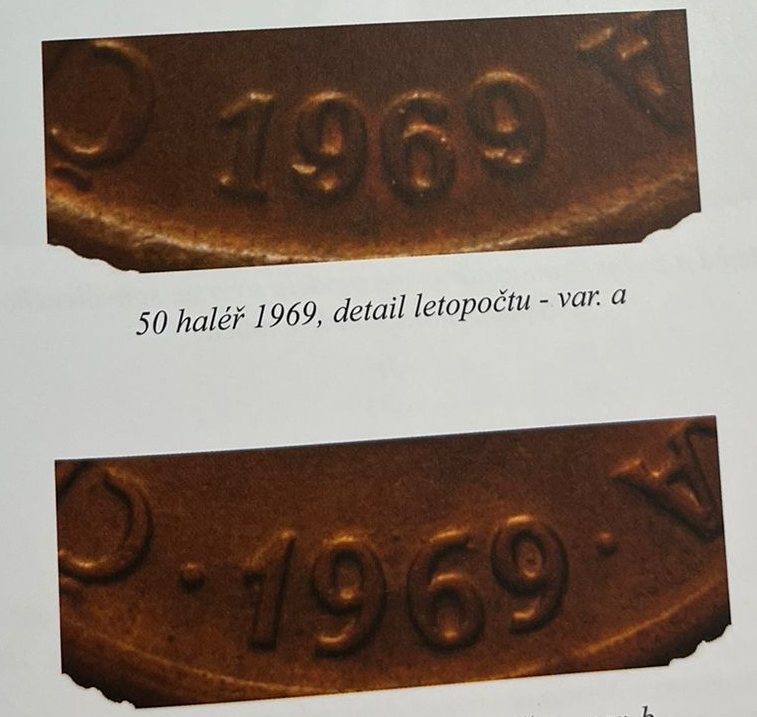
Beside the famous 1969 fifty-heller, catalogues separately list the 10 h 1963 b variety, a different date shape on the 20 h 1990, and 1994 varieties of both the 20 h and the 50 h — the latter with the Jablonec mintmark set at an angle.
How to read the tables
The biggest trap is mistaking the number produced in a given year for the mintage of the date on the coin. The ČNB itself warns that the year of production need not match the date on the coin.
The second trap: adding an exact figure to a legendary variety just because the internet quotes one. If a primary or internally verified source does not document the count, the honest answer on the site is “not documented”.
Continue with the Czechoslovak hellers and their full 1980–1992 table, or the Czech hellers with the 1993–2008 production.
Next step
Do you own a similar piece?
Send us a photo of the obverse and reverse. We are glad to help with identification, appraisal, and placing it in an auction.