20 Heller
The 20 heller (twenty-heller piece) is a small circulating coin which appeared on our territory with the introduction of the koruna currency at the end of the 19th century. During the 20th century its material and form repeatedly changed according to economic conditions, the availability of metals and the requirements for durability in circulation.
The 20 heller was first struck for our lands with the introduction of the koruna currency under the law of 2 August 1892. The first twenty-heller pieces were made of nickel, had a weight of 4 g and a diameter of 21 mm. They entered circulation on 1 May 1893 and in this original Austrian form they lasted until 17 February 1922. With small denominations the choice of nickel was practical: the coin was relatively hard, resistant to wear and had a clearly 'silvery' appearance which distinguished it from copper and brass values.
After the establishment of Czechoslovakia the 20 heller acquired a special symbolic significance. The year 1921 is given as the first coin struck by the Czechoslovak Republic, and its validity dates from 18 February 1922. In the Czechoslovak period the twenty-heller piece was struck from cupronickel and in this form it lasted until 1938 (the year 1933 is considered of collector interest). It is precisely the interwar twenty-heller pieces that today often form the basis of thematic collections, because they are relatively accessible, but at the same time offer year and condition differences which can be gradually filled in.
A further marked change came during the Second World War. In the years 1940–1944 the 20 heller as a Protectorate coin was struck from zinc. Zinc circulating coinage was a typical product of the war economy: better-quality metals were needed elsewhere and small coins were produced from materials that were more available. For collectors this means that zinc twenty-heller pieces often survive in poorer condition, because the metal is more sensitive to humidity and storage and the surface quickly loses its original appearance.
History
After the war the post-war renewal of circulating coinage followed. From 1947 to 1953 the 20 heller was struck first from copper (1947–1950) and later from aluminium (1951–1952). These changes capture well a time when a compromise was sought between price, availability and lifespan of the coin. Aluminium is light and cheap but soft, so dents and scratches quickly show on it; copper, on the other hand, is heavier and in circulation appears 'more honest', but may more markedly change colour and acquire a patina.
A further long period began in 1972, when the 20 heller was struck from a Cu–Zn–Ni alloy (that is, from a material close to cupronickel) and in this form it was produced until the demise of Czechoslovakia. Stable striking reflects the need to have a simple, durable and well-distinguishable small circulating coinage which can withstand intensive use in shops and in automatic systems.
In modern Czech currency the twenty-heller piece was maintained from 1993 as a Czech striking in aluminium (the author of the design is I. Bejvl). With small heller denominations this was mainly functional circulating coinage for small payments, but these coins also found their place in collecting – both as complete year series and as a document of how the new Czech currency took shape after 1993.
Material, distinguishing years and collector practice
The 20 heller is a typical 'textbook' coin for understanding how circulating coinage adapts to the times. From nickel and cupronickel there was a shift to zinc and aluminium in periods when the availability of metals and costs were decisive, while more stable times gave room for more durable alloys. For collectors it is therefore most transparent to classify twenty-heller pieces by period: Austria (nickel), First Republic (cupronickel), Protectorate (zinc), post-war issues (copper and aluminium), later Czechoslovak strikings (Cu–Zn–Ni) and Czech strikings from 1993 (aluminium).
In assessment, state of preservation and the typical 'weaknesses' of the metal play a role. With zinc pieces surface decay and greying are common, with aluminium scratches and dents, with cupronickel small grooves from circulation and sometimes a darker colouring. With common years state mainly decides, with more sought-after issues then the year and demand. From a practical point of view it is always an advantage with small coins if the details are well legible and the edge is not markedly dented, because it is precisely the edge with small denominations that most quickly reveals the intensity of circulation.
In our auction and shop
- Code: MA135-lot
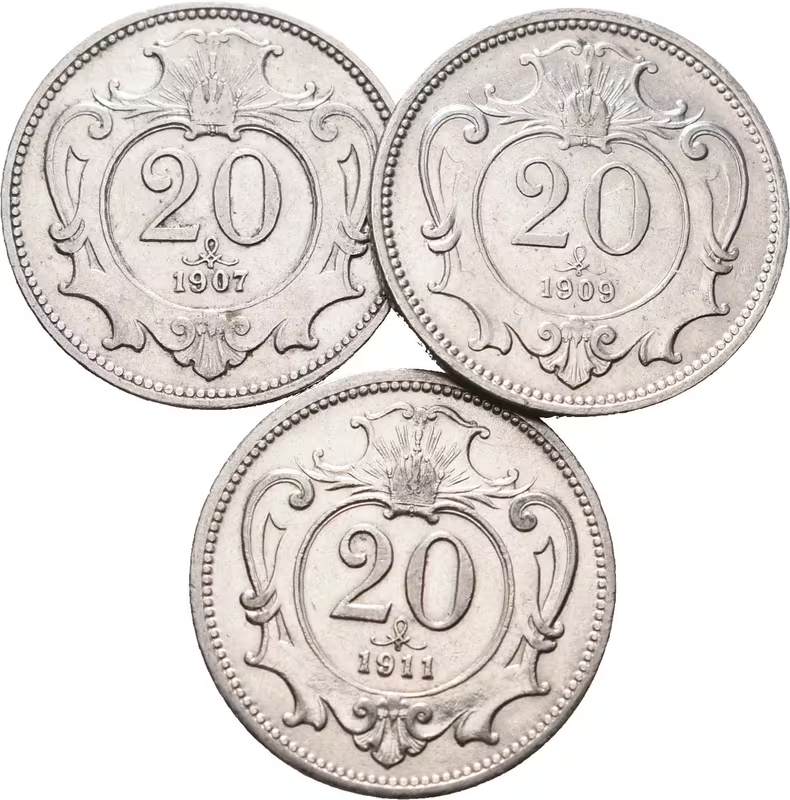
20 Haléř 1907-1909-1911 LOT
František Josef I. (1848 - 1916) 20 Haléř 1907-1909-1911, Ves. 135, Lot 3 ks
Skladem 1 ks - Code: MA136-1916
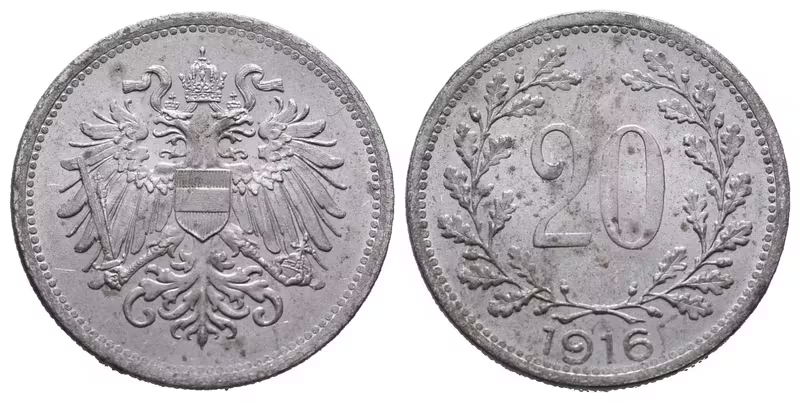
20 Haléř 1916
František Josef I. (1848 - 1916) 20 Haléř 1916, Ves. 136, krásná zachovalost
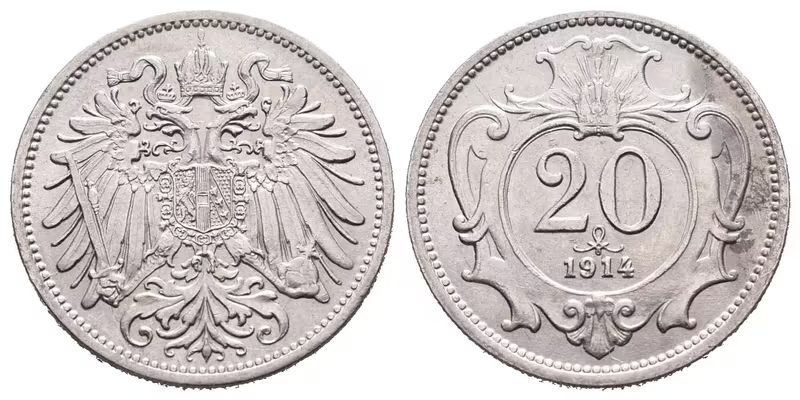
Skladem 1 ks - Code: MA135-1914
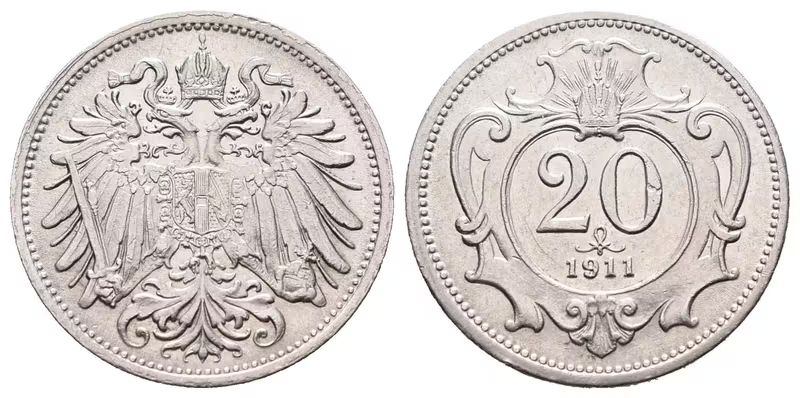
- Code: MA135-1911.1