20 Kreuzer
The 20 kreuzer (twenty-kreuzer piece) is a silver coin which asserted itself markedly in our lands from the middle of the 18th century as a practical middle denomination between the smaller kreuzer circulating coinage and higher silver coins. In the Czech lands it is connected mainly with the Prague mint and its long series of years up to the 19th century.
The 20 kreuzer was first struck in the Czech lands in Prague under the reign of Maria Theresa. From 1754 it was struck as a silver coin with a weight of 6.53 g and a diameter of 28.3 mm. It was precisely this type that became the 'working' denomination of ordinary circulation: it was not so small as to be lost in a quantity of small coins, but at the same time it was not so high as to be used only with large payments. For collectors it is important that the twenty-kreuzer piece has in the Czech lands a rich history of years and organisation, often tied to specific mintmasters.
Under Maria Theresa from the Prague mint we know continuous groups of years: 1754–1755 (mintmaster B. Schaumberger), 1756–1761 and 1763–1765 (P. Erdmann), 1768–1773 (P. Erdmann and A. Stöhr) and 1774–1780 (P. Erdmann and I. Kendler). A special chapter is represented by strikings with the name of her husband Francis I Stephen of Lorraine: from Prague the years 1754–1755 (B. Schaumberger), 1756–1760, 1763 (P. Erdmann) and then 1766–1768 (P. Erdmann and A. Stöhr) are cited. With these last three years the practice of 'posthumous' strikings is remarkable – the coins bear the year 1765, but on the obverse beneath the bust there is the letter A for the year 1766, B for 1767 and C for 1768. In practice there is thus a simple key for more precise determination, which collectors greatly appreciate.
The striking of twenty-kreuzer pieces of the same weight was continued also by Joseph II. The years 1766–1773 and further 1774–1784 are given, again with continuity with the Prague mintmasters (combinations of P. Erdmann, A. Stöhr and later I. Kendler are mentioned). The twenty-kreuzer piece thus became in the second half of the 18th century a stable part of circulating coinage, which corresponds well to a time when mint administration sought a clearer and long-term sustainable system of silver denominations.
History
After a certain pause Francis II (I) renewed the striking of this denomination. The years 1795–1797 (I. Kendler) are cited, further 1802–1809, 1814–1816 and 1818–1822 (A. Stöhr) and also individual later years 1823, 1827 and 1830–1835 (J. Hippmann). This series shows that the twenty-kreuzer piece remained a needed denomination also in the 19th century, even though technological and monetary conditions changed and the years no longer form such a unified block as in the time of Maria Theresa.
Under Ferdinand V the diameter of the coin was reduced to 26 mm while the weight remained the same. From his reign the years 1835, further 1837–1845 (J. Hippmann) and 1846–1848 (F. Leitner) are cited. The reduction of the diameter while preserving the weight is a detail that may also manifest itself in practice in the impression of the coin: the collector often perceives the difference 'on first touch' and thus more easily distinguishes the period.
The last great chapter in the Czech lands are twenty-kreuzer pieces under Francis Joseph I. In this stage their weight fell to 4.30 g and the diameter to 22 mm, which corresponds to shifts in monetary conditions and in the construction of silver circulating coinage. The Prague years 1852–1856 (A. Franc) are cited, and the twenty-kreuzer with the year 1856 is described as the last Czech government striking. In circulation on our territory, however, twenty-kreuzer pieces from other mints of the monarchy, for example from Vienna, Kremnica or Karlovský Bělehrad, continued commonly to circulate even afterwards. The striking of twenty-kreuzer pieces in all mints ended in 1872, which closes the long life of this denomination.
Appearance, determination and collector significance
The 20 kreuzer is rewarding for collectors in that it combines a long series of years with clear points of orientation: changes of diameter and weight, the rotation of mintmasters and the exceptional marking of 'posthumous' strikings with the name of Francis I Stephen of Lorraine. It is precisely the letters A, B and C beneath the bust with the uniform year 1765 that belong to the details which give even ordinary circulating coinage a strong collector story and at the same time enable precise classification.
When determining it is worth following three things: the year and type (including any letters or small marks), the parameters (weight and diameter, if you have a chance to verify them) and the mint context. With Prague twenty-kreuzer pieces the continuity with the specific period is important: heavier and larger 18th-century coins (6.53 g; 28.3 mm), the later reduction of diameter under Ferdinand V and the marked lightening and reduction under Francis Joseph I (4.30 g; 22 mm). Thanks to this, even without deep specialisation, one can often quickly estimate to which epoch the coin belongs.
The value of the twenty-kreuzer piece is determined primarily by the state of preservation and the legibility of the details. This is circulating silver, so worn legends, flat scratches and dented edges are common. By contrast, fine pieces with a natural surface and sharp details are sought after, particularly for years or variants which did not last long in circulation. The twenty-kreuzer piece can thus be both an accessible 'textbook' coin for building a year series and a specialised collector subject, where small marks, letters and mint contexts decide.
In our auction and shop
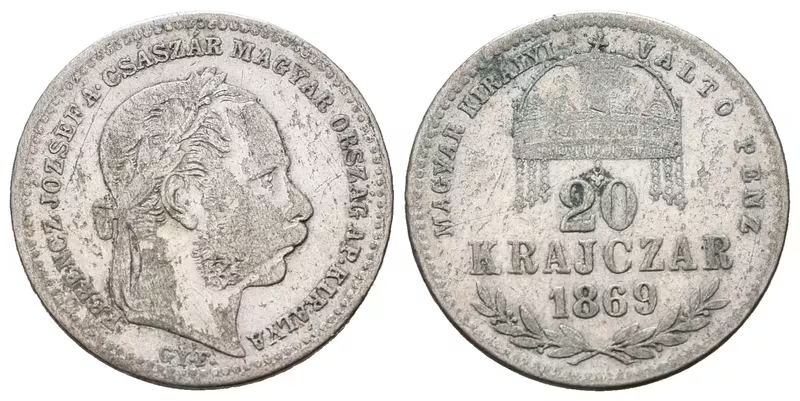
- Code: MA102-1869G.2
20 Krejcar 1869 GYF
František Josef I. (1848 - 1916) 20 Krejcar 1869 GYF, Ves. 102, špatná zachovalost
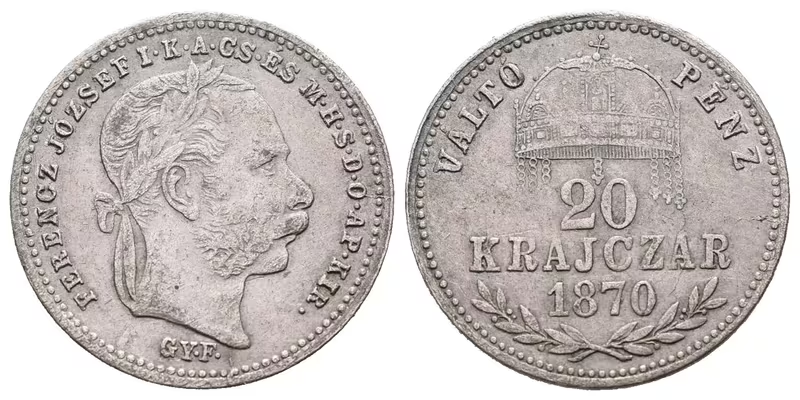
Skladem 1 ks - Code: MA103-1870G.1
20 Krejcar 1870 GYF
František Josef I. (1848 - 1916) 20 Krejcar 1870 GYF, Ves. 103, pěkná zachovalost, tmavá patina, rysky
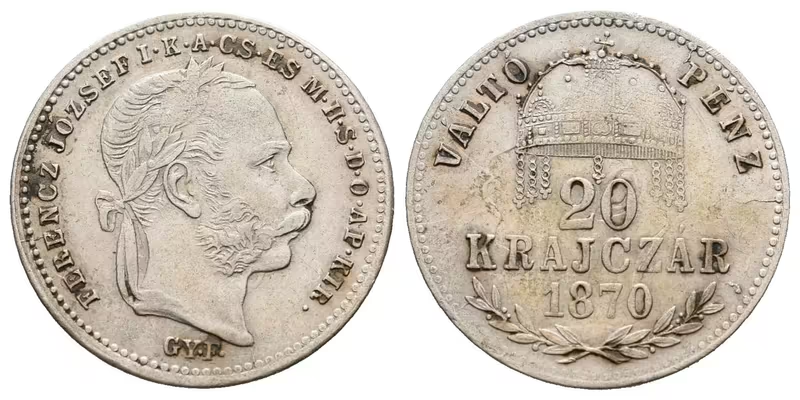
Skladem 1 ks - Code: MA103-1870G.2
20 Krejcar 1870 GYF
František Josef I. (1848 - 1916) 20 Krejcar 1870 GYF, Ves. 103, pěkná zachovalost, patina, rysky
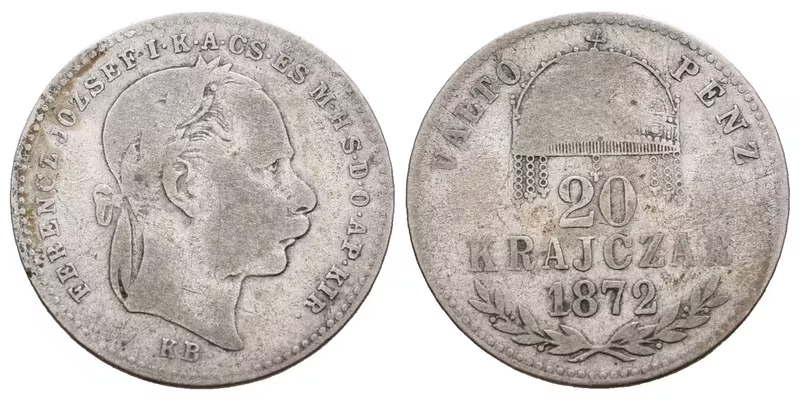
Skladem 1 ks - Code: MA103-1872K
20 Krejcar 1872 KB
František Josef I. (1848 - 1916) 20 Krejcar 1872 KB, Ves. 103, oběhová zachovalost_R!
Skladem 1 ks