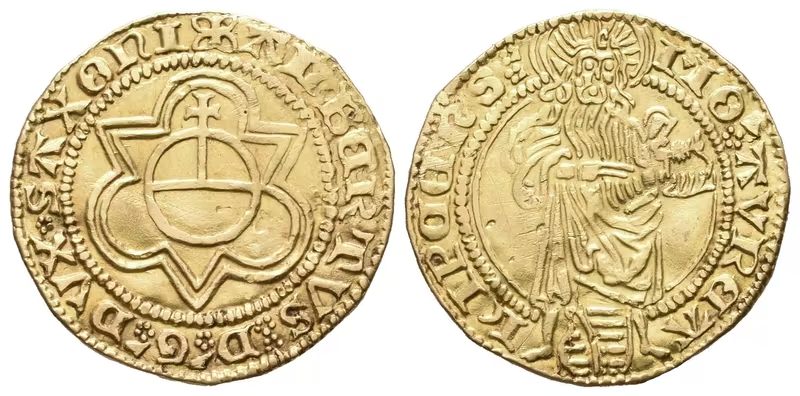
Albert of Brandenburg-Ansbach
Albert of Brandenburg-Ansbach (also Albert of Prussia) was the last Grand Master of the Teutonic Order in Prussia and the first secular Duke of Prussia. After adopting Lutheranism he transformed the monastic state into the hereditary Duchy of Prussia, thereby intervening significantly in the political and monetary history of the region.
Albert of Brandenburg-Ansbach was born in 1490 in Franconian Ansbach into the House of Hohenzollern. Family ties brought him into the centre of Central European politics: his mother was related to the Jagiellonian court, so Albert had a close relationship with the Polish king Sigismund I the Old, which later proved to be decisive. He had originally been intended for an ecclesiastical career, but he quickly emerged as a capable politician and organiser. When in 1510 he was elected Grand Master of the Teutonic Order in Prussia, he was taking up office at a time when the monastic state had long been weakened by conflicts, indebtedness and above all by strained relations with Poland. The Second Peace of Thorn of 1466 had indeed defined the position of the Order in the region, but the dispute over the actual extent of dependence on the Polish Crown and over rights in Prussia did not disappear.
Albert at first sought to strengthen the position of the Order and to obtain for it a better negotiating position. The reality, however, was harsh: the Order did not have the strength to stand for long against the Polish-Lithuanian composite state, and at the same time a reforming current was growing in Europe that was changing the relationship to the Church, to sovereign authority and to the property of ecclesiastical institutions. Albert's meeting with Martin Luther, whose ideas were already finding supporters in his lands, was decisive in importance. Luther advised him to take a radical but practical solution: to secularise the monastic state and turn it into a hereditary principality that had a chance of surviving in the new political reality.
Albert gradually prepared this step and at the same time negotiated with his uncle, the Polish king Sigismund I the Old. The outcome was an agreement that transformed the situation in the Baltic for centuries. In 1525 in Kraków he paid feudal homage to the Polish king and was recognised as hereditary Duke of Prussia. The monastic state thereby de facto ceased to exist and the Duchy of Prussia arose as a Polish fief. At the same time Albert adopted Lutheranism and in the new duchy promoted the Reformation as the basic religious and administrative framework. He thus became one of the first European sovereigns to make Lutheranism the official religion of his country.
History
His step provoked resistance from part of the imperial and Order circles. The Order tried to maintain continuity by electing a new Grand Master, and in the imperial milieu efforts arose to penalise Albert. In practice, however, other concerns of the great powers and the internal conflicts of the day prevailed, so the Duchy of Prussia remained a reality. Albert ruled in it until 1568 and laid the foundations of a dynastic tradition from which the power of the Brandenburg-Prussian state later grew. After his death his son Albert Frederick succeeded him, but the long-term significance of Albert's decision lay above all in the fact that, by secularisation, he created a new type of state body: a Lutheran, hereditary duchy that rested on a more modern administration, property arrangement and economic resources of the country.
For Central Europe this was not just a local change. It set a precedent that even a monastic state could be transformed into an "ordinary" principality, and opened the way for the later political rise of the Hohenzollerns. At the same time the symbolism of power was transformed: instead of the emblems of the Order and the idea of crusade, dynastic representation of the duke and the state began to dominate — and this is precisely what is well reflected in coinage too.
Albert of Brandenburg-Ansbach combined religious reform with the transformation of state administration and the economy. The secularisation of the monastic state did not mean merely a change of title; it was a transfer of power and property into the hands of a secular ruler. In practice this made it possible to organise more efficiently the collection of dues, the administration of towns and the use of resources, which was key to the stability of circulation and to the financing of state power. In a region where trade routes between the Baltic Sea and the interior met, a trustworthy currency played a significant role not only for the local market but also for long-distance trade.
Rule, reform and minting context
Numismatically his era is interesting above all because the coins and their inscriptions began to express the new political reality more clearly. While the Order's strikes bore traditional symbolism and titulature linked with the Order, the ducal strikes emphasised secular authority and dynastic identity. Coins thus become a direct testimony to the change of regime: who is the issuer, what titles he holds, what emblems he uses and what image of the state he wishes to spread. It is precisely at turning points that it is valuable for the collector to follow transitional types and minor differences in legends, because they show how quickly and how thoroughly the new order was being implemented.
In practice both the Prussian strikes associated with the duchy and the broader context find collector use: coins of neighbouring lands that circulated in the area, and also municipal or regional issues, where they reflect a change of political dominance. With 16th-century coins it is moreover important to assess preservation in light of contemporary technology: irregularity of the flan, shift of the striking or partially worn legends are not exceptional. The legibility of the name and titulature often substantially increases value, because precisely these allow secure identification of the type and assignment to a particular phase of the reign.
Albert's significance for the "history of money" therefore lies not just in the fact that he ruled in a particular period but in the fact that he changed the very nature of the state that issued coins. By secularisation he created a new political body that needed its own, trustworthy monetary practice and representation. Thanks to this the strikes of his era are valuable as historical sources: on a small metal disc one can see when monastic power became secular government and how the new legitimacy was inscribed into everyday circulation.
In our auction and shop
- Code: ZN-SAS1486
Sasko - vévodství, Goldgulden b.l.
Sasko, Albrecht jako vévoda (1486 - 1500) Goldgulden b.l., Leipzig, Fb. 2609; Slg. Merseb. 344; Keilitz 2 (3,46 g), zcela nep. zvlněn, pěkná zachovalost Albrecht Statečný byl zakladatelem albertinské linie, která vznikla lipským dělením v roce 1485,…
Skladem 1 ks - Code: SNIZSPA-F1612
Španělské Nizozemí, Escalin b.l. (1612 - 1621)
Španělské Nizozemí - Brabantsko, Albrecht V. a Isabella Španělská, 1598 - 1621 Escalin/Schelling b.l. (ražen 1612-1621), minc. Brusel, KM.47, Van.623 var., pěkná zachovalost a patina, dobově ořezaný
Skladem 1 ks - Code: SRAK83-FA6
Rakousko, Vídeňský fenik CNA Fa6
Rakousko, vévodství, Albrecht V., 1411 1439 Vídeňský fenik, minc. Vídeň, Rakouský znak v ozdobném trojpásu s literami. CNA I. F a 6 var., patina, pěkná zachovalost
Skladem 1 ks - Code: SRAK83-FA6.2
Rakousko, Vídeňský fenik CNA Fa6
Rakousko, vévodství, Albrecht V., 1411 1439 Wiener Pfennig, minc. Vídeň, Rakouský znak v ozdobném trojpásu s literami. CNA I. F a 6 var., patina, pěkná zachovalost, lehce napr.
Skladem 1 ks