Agio
Agio is a premium over the nominal (face) value, that is the positive difference between what is stated as the denomination on a coin or security and the price or rate at which it is actually sold. In practice it means paying "above par" (above pari).
The term agio entered Central European financial terminology from the environment of early European trade and banking. At a time when many kinds of coins of differing fineness and trustworthiness circulated across Europe simultaneously, the "value of money" was not merely a matter of the figure struck on the coin. It depended on the actual content of precious metal, on local customs and on whether a given coin was accepted without reservation in a particular place. It was precisely in this environment that the need arose to name the difference between the value "on the coin" and the value the coin gained in circulation or in exchange.
In the great commercial centres, typically in port cities and at long-distance markets, clearing and money-changing mechanisms gradually established themselves to simplify trade. Money-changers and bankers took account, when exchanging money, of which coins were of high quality and "circulated well" and which, on the contrary, aroused mistrust or were worn. If a particular coin or currency was considered stable and sought after, it could be exchanged with a premium. Conversely, for coins with a lower metal content or for currencies that suffered frequent debasement, a discount applied. This logic was later transferred to securities as well: here too the market price may exceed the nominal value if investors rate the given instrument more highly than the "paper" value stated on the document.
History
In modern economics the meaning of agio has settled as a general term for the positive difference between nominal value and actual price (rate). In specialist language the phrase issue agio is also often used, describing a situation where a security is issued at a price higher than its nominal value. The opposite is disagio, a negative difference, when something is sold "below par". Alongside this you will encounter in practice the expression al pari, which denotes the state where price and nominal value coincide.
For coins, agio typically arises when a coin is sold for more than its struck nominal value. The reasons may vary: precious-metal content (in gold or silver strikes), collector demand, low mintage, quality of execution, or also the costs of production and distribution. For commemorative and bullion coins a premium above the nominal is common, because the nominal value plays more of a legal role (issuer's guarantee and legal-tender status), while the market price reflects material and demand.
Practical meaning: coins, securities and "above par"
For securities, agio is used to describe the difference between nominal value and market (or issue) price. When a company issues shares or bonds and investors are willing to pay more, an issue agio arises. In accounting and law this difference has its specific meaning, because it is not "merely" a market phenomenon but also an item recorded separately from the share capital. In simplified practical terms, this means that part of the price paid by the investor does not represent the nominal but a premium for expected value, the issuer's reputation or other parameters of the issue.
In everyday speech the word agio is sometimes also used more loosely as a "premium" or "surcharge" on some basic value. For a precise expression, however, it is useful to stick to the core of the term: agio is the positive difference between nominal and price/rate. If the difference is negative, it is disagio; if there is none, it is al pari.
In our auction and shop
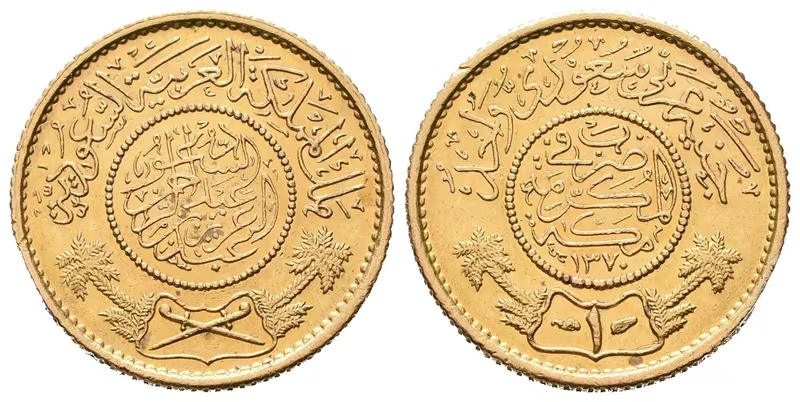
- Code: ZSSAU-1950
Saudská Arábie, Guinea AH 1370 (1950)
Saudská Arábie, Abd Al-Azis Bin Sa´ud (Ibn Sa´ud) AH1344 - 1373 (1926 - 1953 AD) Guinea AH 1370 (1950) Au 0,917, 22,5 mm (7,9881 g), KM. 36, m.o.
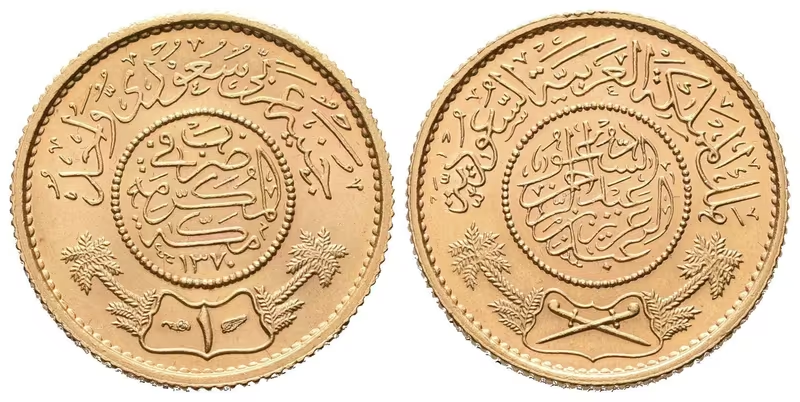
- Code: ZSSAU-51A1370
Saudská Arábie, Guinea AH 1370 (1950)
Saudská Arábie, Abd Al-Aziz Bin Sa´ud (Ibn Sa´ud), AH1344 - 1373 (1926 - 1953 AD) Guinea AH 1370 (1950), Fr. 1, KM. 36, luxusní zachovalost Au 0,917, 22 mm (7,9981 g)