Bank safekeeping
Bank safekeeping is a service in which a bank or other financial institution safely stores a client's valuables or documents under contractual conditions. Most often it takes the form of the rental of a safe-deposit box, or the safekeeping of selected items under a special regime.
The safekeeping of valuables is connected with the fact that money and valuable objects have always needed to be protected against theft, fire and loss. Already at a time when circulation rested on coins of precious metals, it made sense to deposit larger sums or family valuables in a place better secured than an ordinary dwelling. Moneyers, money-changers and later banks thus gradually provided, alongside financial operations, a physical setting for the safe deposit of value.
The development of banking and the urban economy brought a growth in the volume of valuables people needed to deposit: cash, documents, contracts, securities, jewellery, family papers. Bank vaults and subsequently individual safe-deposit boxes offered a standardised service with clear rules of access. Safekeeping thus separated from the account itself: while an account is an accounting entry, a box is a physical space to which the client has access under contract.
History
In the modern era bank safekeeping has been professionalised. Institutions build vault spaces with access control, records, surveillance features and fire protection. At the same time the contractual rules have been refined: who may open the box, how shared access by more than one person is handled, what happens on the death of the client and what the limits of liability are. In some cases safekeeping is also used as a procedural instrument, for example the safekeeping of documents or money until a condition is fulfilled; but this then usually has precise rules according to the type of contract and intermediation.
Bank safekeeping is today perceived as a supplementary service alongside accounts and investments. It still has its practical place, for documents that are to remain secure and for valuables which the client does not wish to keep at home. In a numismatic environment, the principle of safekeeping applies particularly where it is necessary to protect value over the long term from mechanical damage, moisture or accidental loss, not as "collector's advice" but as the general logic of protecting physical valuables.
Types of safekeeping and its parameters
The most common form is the safe-deposit box: the bank provides a lockable space in a vault room and the client has access at specified times and under a specified regime. The parameters of the service are the size of the box, the rental period, the method of access (key, code, combination) and the rules for authorised persons. Records of entry and the procedure for opening the vault room are also important, and these are usually multi-stage.
The contract usually specifies what may be stored in the box (for example a ban on hazardous substances), how the loss of a key is handled and what the limits of liability are. Safekeeping may also differ in whether the contents are insured automatically or whether additional insurance must be arranged. Technical security features include the construction of the vault, access control, CCTV surveillance, fire protection and a separate working regime for staff. For an expert description of the service, it is crucial to distinguish safekeeping as physical deposit from financial custody (for example the administration of securities), because these are different types of obligations and processes.
In our auction and shop
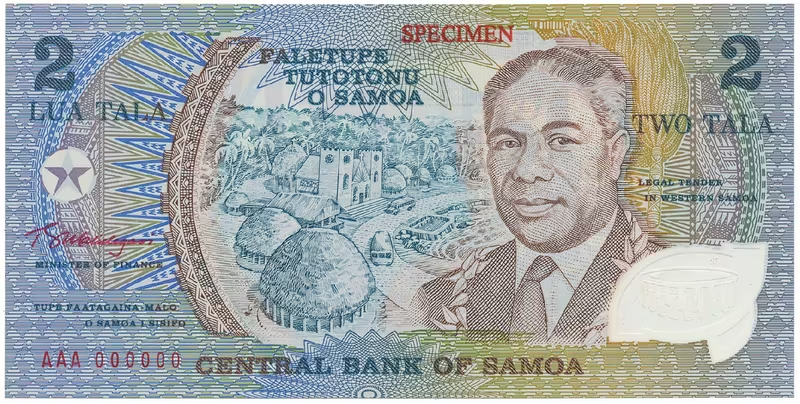
- Code: BSAMOA031AS
Samoa, 2 Tala (1990), bankovní vzor, AAA 000000, přetisk SPECIMEN, plastová, P.31as
Samoa 2 Tala (1990), bankovní vzor, AAA 000000, přetisk SPECIMEN, plastová, P.31as N/UNC
Skladem 1 ks - Code: BSAMOA031ES
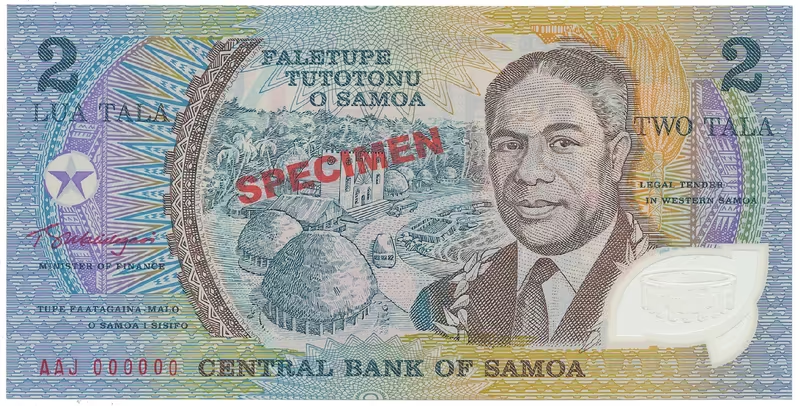
Samoa, 2 Tala (1990), bankovní vzor, AAJ 000000, přetisk SPECIMEN, plastová, P.31es
Samoa 2 Tala (1990), bankovní vzor, AAJ 000000, přetisk SPECIMEN, plastová, P.31es N/UNC
Skladem 1 ks - Code: BSAMOA034BS
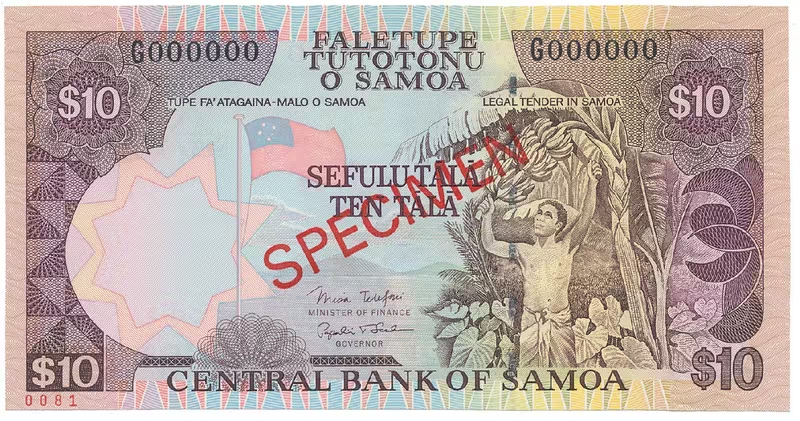
Samoa, 10 Tala (2002), bankovní vzor, G 000000, přetisk SPECIMEN, P.34bs
Samoa 10 Tala (2002), bankovní vzor, G 000000, přetisk SPECIMEN, P.34bs N/UNC
Skladem 1 ks - Code: BSAMOA035AS
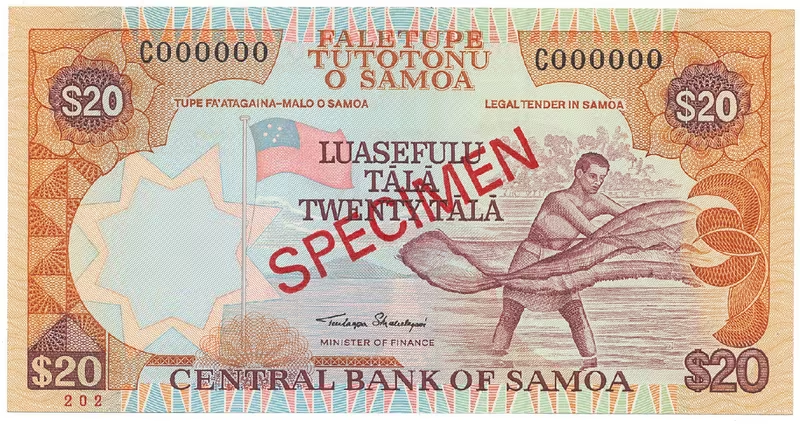
Samoa, 20 Tala (2002), bankovní vzor, C 000000, přetisk SPECIMEN, P.35as
Samoa 20 Tala (2002), bankovní vzor, C 000000, přetisk SPECIMEN, P.35as N/UNC
Skladem 1 ks