Battle of Mohács
The Battle of Mohács was the decisive defeat of the Hungarian-Bohemian army on 29 August 1526 near Mohács in Hungary, when the army of King Louis II Jagiellon succumbed to the Ottoman forces of Sultan Suleiman I the Magnificent. The death of the king after the battle accelerated the accession of the Habsburgs in the Bohemian lands and opened the way to th…
The clash at Mohács belongs to the most significant events of Central European history of the 16th century. In the first third of the century the Ottoman Empire systematically moved its frontier into the Danubian region, and the Balkan space became the staging ground for further expansion. The Hungarian Kingdom at that time struggled with internal disputes of the nobility, limited finances and difficulties in securing border fortresses. In 1526 Sultan Suleiman I the Magnificent personally set out for Hungary and advanced along the Danubian axis towards Buda, with the decision intended to come before the country's full defence could be assembled.
The Hungarian and Bohemian forces were led by King Louis II Jagiellon. The core of his army included the noble levy, mercenaries and detachments from the lands of the Bohemian Crown; at the same time, however, part of the allied forces was not concentrated on the battlefield in time at the decisive moment. On the Ottoman side stood a numerically stronger and better-coordinated army with a significant share of infantry and artillery. According to commonly cited estimates the Ottoman army numbered tens of thousands of men and held a pronounced superiority in the number of guns, while the Hungarian-Bohemian forces were smaller and their formations bore the pressure of the opponent less well.
The battle itself on 29 August 1526 took place on flat terrain near Mohács and ended in a swift collapse of the Christian line. An important role was played by the fire of the Ottoman artillery and by disciplined infantry that managed to halt the attacks and gradually break up the Hungarian ranks. The losses of the defeated were extraordinary; many magnates and commanders fell or were captured. Louis II Jagiellon perished during the retreat after the defeat: traditionally his drowning in a swollen watercourse is recounted (in contemporary memory associated with the Csele stream).
History
The consequences of the battle went beyond the framework of a single campaign. From the point of view of dynastic politics, the king's death without an heir meant a fundamental turning point: in Hungary a struggle for the throne flared up, and part of the estates elected John Zápolya as king, while others supported the Habsburg candidate Ferdinand I of Habsburg, Louis's brother-in-law. In the Bohemian lands the election of Ferdinand in 1526 then began the Habsburg period, which (with interruptions) shaped the politics of Central Europe up to 1918.
In the wider military-political sense, "Mohács" became a symbol of the extinction of a strong, unified Hungarian state. Although the Ottoman occupation of key centres took place gradually (Buda was definitively captured only in 1541), the battle opened space for the long-term division of the country into areas under Ottoman administration, Habsburg control and the semi-independent Transylvania. In European memory the event is therefore understood as one of the milestones of the Ottoman-Habsburg rivalry in the Danubian region.
It is useful to add that the expression "(Second) Battle of Mohács" is sometimes used also for the clash at Nagyharsány on 12 August 1687, which took place in the wider region and is interpreted as a symbolic "revenge" after 161 years. It is not, however, the same battle as that of 1526.
Course and significance for Central Europe
The Battle of Mohács is a typical example of a clash where not only bravery decided but also organisation, logistics and firepower. The Ottoman army managed to make better use of artillery and disciplined infantry, while the Hungarian-Bohemian army relied more on noble cavalry and a swift shock attack, which in an unfavourable development easily turned into retreat and disintegration. For this very reason Mohács is often cited as a warning example of how dangerous it is to underestimate preparation and coordination at the decisive moment.
In cultural and political memory Mohács has an exceptional place: for Hungary it represents the trauma associated with the long Ottoman presence in the Carpathian Basin; for the Bohemian lands, the moment that directly relates to the change of dynasty and to the redirection of foreign policy orientation towards the Habsburg composite monarchy. In historiography it is therefore interpreted not merely as "one defeat" but as an event that transformed the map of power in Central Europe for centuries.
In our auction and shop
- Code: RX-VEL2015
Velká británie - Bitva u Waterloo
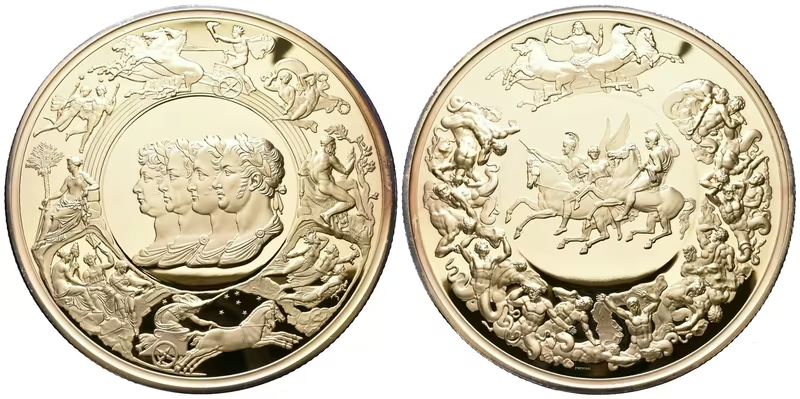
Velká Británie AE Medaile 1815 - 2015 (B. Pistrucci) - Medaile na památku bitvy u Waterloo Bronz zlacený ryzím zlatem 88,9 mm (cca 400 g), číslováno na hraně, brožura s certifikátem a popisem bitvy, vojevůdci, historie vzniku medaile, etue, papírový…
Skladem 1 ks - Code: ZSRAK-E1976
Rakousko, 1000 Schilling 1976 - Babenberg
Rakousko, II. republika (1945 - ) 1000 Schilling 1976 - Babenbergové, Au 0,900, 27 mm (13,5 g), pův. etue Rakouské národní banky Babenberkové ( německy Babenberger ) byl německo-rakouský šlechtický rod původem z Frank ( Bamberg ), v letech 976 až 1246…
- Code: ZSFRA-89F1852
Francie, 20 Frank 1852 A
Francie, Napoleon III. ( 1852 - 1870) 20 Frank 1852 A - jako president II. republiky, mincovna Paříž Au 0,900, 21 mm (6,4516 g), KM. 774 Charles Louis Napoleon Bonaparte jinak též Napoleon III. (20. dubna 1808 – 9. ledna 1873) byl syn krále Ludvíka…
- Code: ZSFRA-89F1855.1
Francie, 20 Frank 1855 A
Francie, Napoleon III. ( 1852 - 1870) 20 Frank 1855 A, mincovna Paříž Au 0,900, 21 mm (6,4516 g), KM. 781.1 Charles Louis Napoleon Bonaparte jinak též Napoleon III. (20. dubna 1808 – 9. ledna 1873) byl syn krále Ludvíka Bonaparta a královny Hortensie de…