John Zápolya
John Zápolya (1487–1540), Hungarian János Szapolyai, was the Hungarian king who ruled part of Hungary from 1526 until his death. His rivalry with Ferdinand I of Habsburg for the Hungarian crown led to the division of the country and the gradual Turkish conquest.
John Zápolya was born at Spiš Castle as the son of the Palatine Stephen Zápolya, the wealthiest Hungarian magnate. The Zápolya family originated in Slavonia and rose rapidly — they owned 72 castles and controlled northern Hungary. John received an excellent humanist education and was fluent in Latin, German and Polish. From 1510 he was Voivode of Transylvania, where in 1514 he successfully suppressed the peasant uprising of György Dózsa. As leader of the national party he rivalled the pro-Habsburg faction for influence over the weak king Louis II Jagiellon.
The catastrophe at Mohács on 29 August 1526, in which Louis II perished, opened Zápolya's way to the throne. The Hungarian nobility elected him king on 10 November in Székesfehérvár; he was crowned on 11 November with the Crown of Saint Stephen. But the pro-Habsburg party elected Ferdinand of Habsburg on 16 December. Civil war broke out. Ferdinand, with the help of German mercenaries, defeated Zápolya at Tokaj in 1527 and occupied most of the country. Zápolya fled to Poland and sought help from Sultan Suleiman. This step, regarded as a betrayal of Christendom, discredited him in Europe.
History
In 1529 Suleiman marched on Vienna and installed Zápolya as his vassal in Buda. There followed a decade of wars — Ferdinand held western Hungary and Croatia, Zápolya central Hungary under Turkish protection. The Peace of Várad in 1538 recognised both kings, with the provision that after Zápolya's death without an heir, Hungary would pass to Ferdinand. But when a son, John Sigismund, was born to Zápolya in 1540, the peace collapsed. Zápolya died at Szászsebes on 22 July 1540. His death led to the definitive division — the Turks occupied Buda in 1541, and an Ottoman pashalik was established. Transylvania under John Sigismund became an autonomous principality. The Kingdom of Hungary was torn apart for 150 years.
Zápolya struck coins at his mints in Kremnica and Košice, when he controlled them. His silver denarii and groschen bear the typical Hungarian iconography — the Virgin Mary with the infant Jesus as patroness of Hungary, on the reverse the Hungarian arms. The inscription IOHANNES REX VNGARIAE emphasised legitimacy. The quality of the coins fluctuated with the military situation — in periods of peace a high silver content, during fighting debased strikes. Gold forints with his portrait are very rare.
John Zápolya and Hungarian coinage
Interesting are the propagandist strikes of the two rivals. Ferdinand struck coins with the inscription "legitimate king", to which Zápolya responded "elected by the nation". After the alliance with the sultan, some of Zápolya's coins bear a crescent moon beside the cross — unique Christian-Islamic symbolism. Coins from the last years are often of poor quality, struck from copper coated with silver. After his death the widow Isabella struck coins in the name of the young John Sigismund. Zápolya's coins are today valued as documents of a dramatic epoch, in which Hungary fought for survival between the Habsburgs and the Turks. Numismatically they document the disintegration of the medieval Kingdom of Hungary.
In our auction and shop
- Code: SVAT-E1979
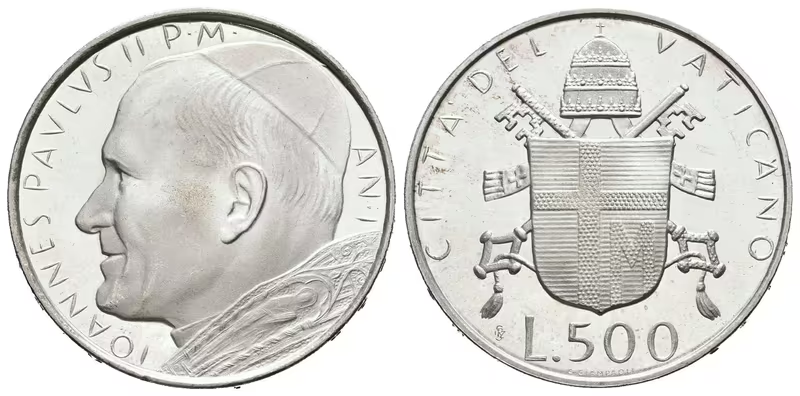
Vatikán, 500 Lire 1979 - Jan Pavel II., papežský erb, tiára, zkřížené klíče
Vatikánský městský stát - Jan Pavel II. (1978-2005) 500 Lire 1979 - Jan Pavel II., papežský erb, tiára, zkřížené klíče Ag (.835), 29,3 mm (11 g), BU, v kapsli. Stav mince odpovídá fotografii.
Skladem 1 ks - Code: RALUK-2003
Lukáš Jan - Tolar Marie Terezie 1758
Lukáš Jan (1944 - ) AR Medaile 2003 - Replika výtěžkového tolaru Marie Terezie z roku 1758 Ag 0,999, 40 mm (29 g), kapsle, etue, certifikát, ilustrační foto Výtěžkové ražby jsou mince ražené ze surovin vytěžených v určitých místech. Do Čech přišel zvyk…
Skladem 1 ks - Code: RALUK-1999
Lukáš Jan - 400 let ubránění Vídně před Turky
Lukáš Jan (1944 - ) AE Medaile b.l. (2009) - Ferdinand I., 400 let ubránění Vídně před Turky CuZn 50 mm (45 g), certifikát
Skladem 1 ks - Code: RALUK-2008
Lukáš Jan - 400 let korunovace Matyáše II.
Lukáš Jan (1944 - ) AE Medaile b.l. (2008) - 400 let korunovace Matyáše II. Ms 50 mm (56 g), certifikát
Skladem 1 ks