Mintmaster's lún (share)
The mintmaster's lún was a medieval term for a share in the revenues and remuneration from minting activity — that is, a "share" in the mint which determined how much fell to an individual co-shareholder. Lúns could be inherited and in practice could also be the object of sale, purchase or pledge.
The mintmaster's lún is connected with how mintage was organised in the Middle Ages. A mint was not merely a workshop with craftsmen but also an economic enterprise in which costs, risks and profits were shared. Alongside the sovereign or the holder of the right of coinage, mintmasters appeared here — entrepreneurs and specialists who participated in the running of the mint with capital, labour, know-how and also responsibility for the quality of the strike. In order to be able to divide the revenues fairly, a share system was used. The unit of such a share was precisely the "lún".
The basic idea was simple: whoever held a larger share in the mint also had a larger claim to a portion of the mintage's remuneration. These shares were not merely an accounting item but had the character of a property right. They were therefore handled like other property values — they could pass by inheritance, and they also appear in transactions, where a lún was sold, exchanged or pledged as security for a debt. In the context of the time this made sense: the right of coinage and the associated share in revenues was valuable, since the striking of coins ranked among activities with a significant financial potential.
In the Bohemian lands the term is strongly tied to the Kutná Hora coinage. After the reforms of Wenceslas II, which concentrated minting at Kutná Hora and the Italian Court (Vlašský dvůr), an environment arose in which it was necessary to define clearly the relationships between participants in the minting operation. At first the lúns may have represented shares tied to a specific mint workshop or group of mintmasters, but in the course of the 14th century their significance shifted towards purely financial shares. In other words: the lún gradually "detached itself" from a specific physical mint and began to function as an abstract share in the enterprise's revenues, which could be owned even by someone who did not directly work at the minting himself.
History
It is precisely this transformation that is typical of economic history: from the originally professional share of the mintmasters there arises a transferable property value. In some periods, owners of lúns could thus also be people from outside the original circle of mintmasters, because the shares passed by purchase or pledge. At the same time, this shows what an important financial and administrative centre Kutná Hora was — the mining of silver and the minting of coins created capital flows which attracted the interest of wider society.
In the sources, data also appear to the effect that the Kutná Hora mint was at a certain time divided into a fixed number of lúns, which suggests that this was a standardised "unit of share" used for precise accounting. The mintmaster's lún thus represents an important term for understanding how the financing and management of the minting operation worked in the Middle Ages — not only technically but also legally and economically.
The mintmaster's lún functioned as a measure of share in the mint's revenue and at the same time as a legal claim which could be disposed of. If a mintmaster or other holder possessed, for example, several lúns, this corresponded to his standing in the "shareholding collective" of the mint and his share in the remuneration. The transferability of lúns was practical: it made it possible to raise capital (by sale of a share), to secure a debt (by pledge) or to pass property within the family (by inheritance).
The share, its transferability and significance in practice
In numismatic and economic history the term is also useful because it helps to explain why in some charters persons appear who "held a share in the mint" without necessarily being craftsman-mintmasters. At the same time it reminds us that the striking of coins was not merely a question of metal and dies, but also of a complex economy: from the supply of silver, through the organisation of labour, to the division of profit among the participants. The mintmaster's lún is therefore a concept on the border of numismatics, law and medieval enterprise.
In our auction and shop
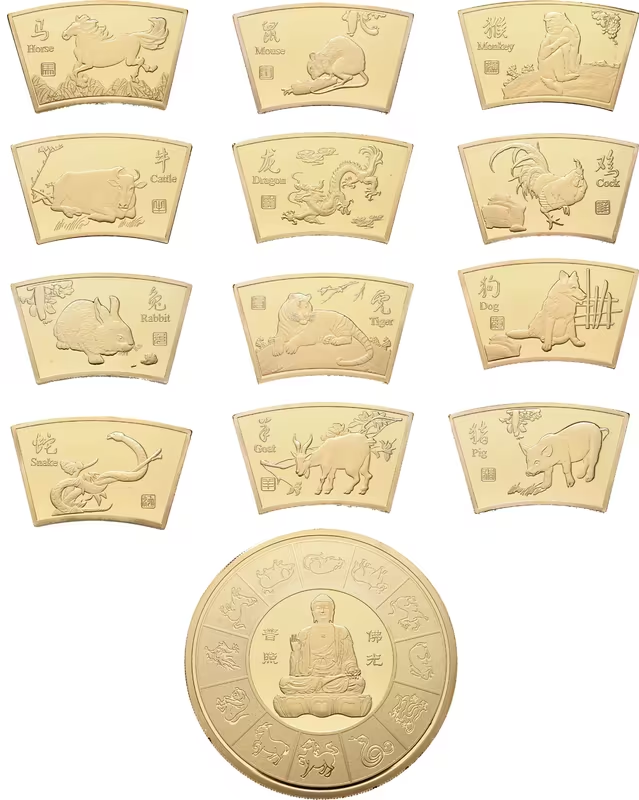
- Code: RX-CINA-LUNARRecommended
Čínský lunární kalendář - Budha - Proof
Čínský lunární kalendář Buddha Exkluzivní sada Proof
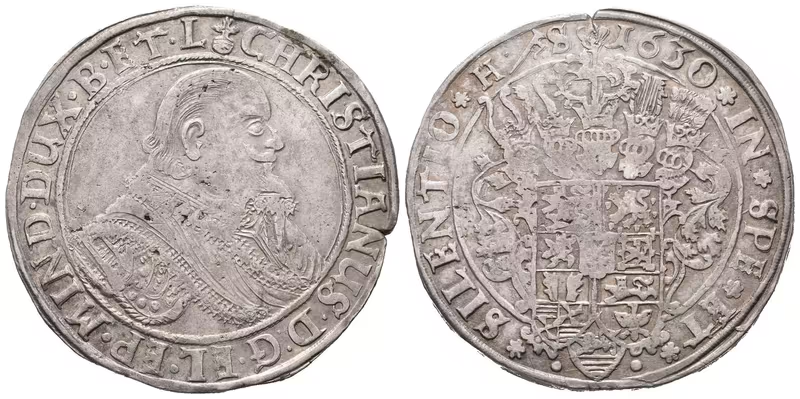
Skladem 1 ks - Code: NABRAUC-B1630
Brunšvick-Lüneburg, Tolar 1630 HS
Braunschweig - Wolfenbüttel-Celle, Christian von Minden (1611 - 1633) Reichsthaler 1630 HS, Clausthal, KM.90, Welt.924, Dav.6475, velmi pěkná zachovalost, patina, zbytky lesku, rysky a vady střížku (28,62 g)
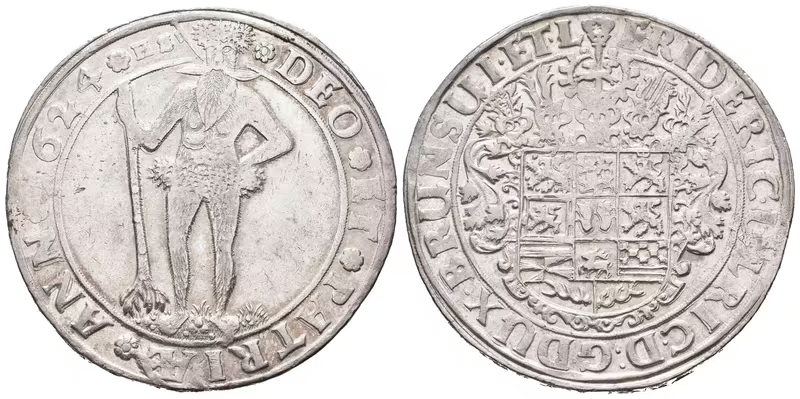
Skladem 1 ks - Code: NABRAUL-B1624
Brunšvick-Lüneburg, Tolar 1624 HS
Braunschweig - Wolfenbüttel, Friedrich Ulrich (1613 - 1634) Reichsthaler 1624 HS, Zellerfeld-Schluter, KM.52, Welt.1057a, Dav.6303, velmi pěkná zachovalost, patina, rysky a drobné vady střížku
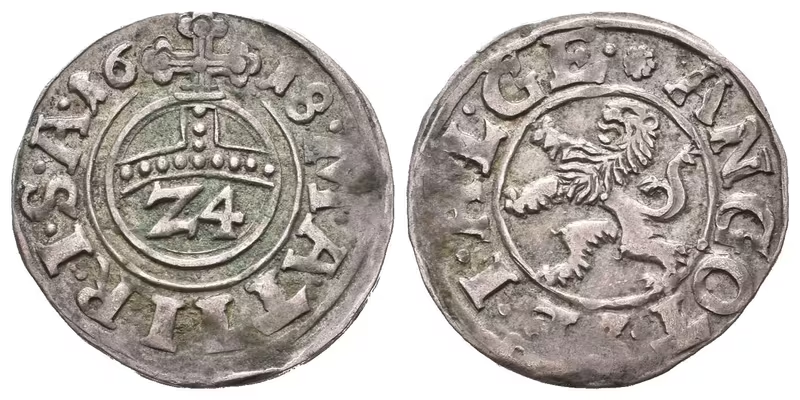
Skladem 1 ks - Code: NABRAUL-H1618
Brunšvick-Lüneburg, Groš 1618
Braunschweig - Wolfenbüttel, Friedrich Ulrich (1613 - 1634) 1/24 Taler 1618 , s tit. Matyáše, Welt.1237, pěkná zachovalost, patina
Skladem 1 ks