
Jan Čejka
Jan Čejka (1878–1925) was a Czech medallist and engraver, one of the notable Czech medallists of the first quarter of the 20th century. From 1919 he served as the first Czech engraver and medallist of the Kremnica Mint, where he stood at the beginning of Czechoslovak coin production.
Life and work
He was born on 30 January 1878 in Vienna to Czech parents. He attended a Czech school and trained as an engraver; after a short period of practice he studied at the Vienna School of Applied Arts and then under Professor Rudolf Marschall at the Vienna Academy of Fine Arts. He first exhibited in 1910 at the Mánes in Prague. On 1 September 1919 he joined the Kremnica Mint as its first Czech engraver and medallist, became head of the engraving workshop, and his family moved permanently from Vienna to Kremnica. From 1919 he was a full member of the Czechoslovak Numismatic Society and in 1924 took part in its exhibition Medals in the Czech Lands in Prague. He died after a serious illness on 27 July 1925 in Kremnica, aged 47; his obituary was written by his friend, the sculptor and medallist Josef Šejnost.
Coins and medals
Slovak numismatic literature recalls him in connection with the history of the Czechoslovak ducats, whose striking at Kremnica began while he headed the engraving workshop. Among his medals, an undated bronze medal for the 70th birthday of President T. G. Masaryk (around 1920) is documented. Beware of confusion: the Czech Wikipedia and Wikidata list under the same name the Jičín painter Jan Čejka (1888–1934).
From the work in the AUREA range
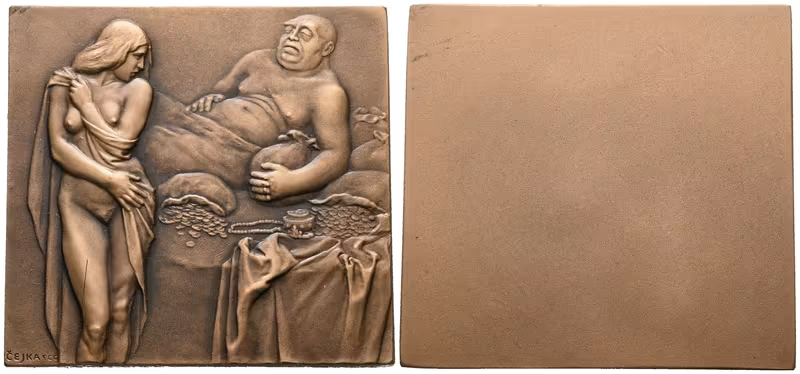
The AUREA range includes his undated one-sided plaquette The Miser in patinated bronze, 60 × 45 mm, in a case. The allegorical subject shows Čejka's work outside official mint commissions.
Related artefacts currently at auction
- Code: RACEJKA-1900
Čejka Jan - Chamtivec
Čejka Jan (1878 - 1925) AE Plaketa b.l. - "Chamtivec" Jednostranný patinovaný bronz 60x45 mm (97,88 g), etue
Further in the encyclopaedia
More entries in the category rytci. Continue browsing or return to the full encyclopaedia.