Czech Republic
The Czech Republic is a Central European state, which was established on 1 January 1993 by the dissolution of Czechoslovakia. The capital is Prague, the currency is the Czech koruna, and the issuance of banknotes and coins is provided by the Czech National Bank.
The territory of the present-day Czech Republic comprises the historical lands of Bohemia, Moravia and the Czech part of Silesia. Their history is closely tied to Central Europe: from the early medieval entities and the Přemyslid principality, through the emergence of the Czech kingdom, to the Luxembourg and Jagiellon period. In the 14th century, the Czech lands under Charles IV became one of the political and cultural centres of Europe, which was also reflected in the economy and in the emphasis on the symbolism of state power.
A turning point came in 1526, when the Czech crown entered into personal union with the Habsburg Monarchy. The Czech lands became part of a wider state entity in which various interests and cultural influences met. The long period of the modern era brought both the modernisation of administration and the economy and the gradual weakening of provincial autonomy. Alongside political changes, the form of public institutions and everyday life also changed, including methods of taxation, trade and payment customs.
In the 19th century the development of industrialisation accelerated social changes and strengthened the Czech national movement. Within Austria-Hungary, the Czech lands became one of the most developed parts of the monarchy, while at the same time demands for political and linguistic recognition grew. After the First World War, Czechoslovakia was established in 1918, drawing on the idea of a modern republic and on the political legacy of Tomáš Garrigue Masaryk.
History
The interwar period brought democratic institutions, but also tensions in international relations. The Second World War meant occupation and the dismantling of statehood; after 1945 the restoration of Czechoslovakia followed, which, however, was replaced in 1948 by the Communist takeover of power. The following decades were marked by centralisation, restriction of freedoms and also an effort at reforms, which culminated in 1968 and the subsequent normalisation.
In November 1989 the Communist regime fell and the democratic system was restored, often associated with the figure of Václav Havel. The federal Czechoslovakia, under the new conditions, struggled with the question of arranging relations between the Czech and Slovak parts. After a political agreement, two independent states emerged from 1 January 1993: the Czech Republic and the Slovak Republic.
From the 1990s, the Czech Republic gradually integrated into the Euro-Atlantic structures and continued the tradition of parliamentary democracy. Accession to NATO (1999) and to the European Union (2004) belong among the important milestones of its modern history. At the same time, modern state symbols, institutions and a legal framework were formed which define the functioning of the state and its international standing.
State, symbols and currency
The Czech Republic is a parliamentary democracy with a bicameral Parliament, a government headed by a prime minister and a directly elected president. Administratively it is divided into regions and municipalities, while the historical lands of Bohemia, Moravia and Silesia remain an important cultural and identity framework. The state symbols — in particular the flag, coat of arms and state colours — build on the traditions of Czech statehood and are often reflected in the artistic execution of official documents and representative objects.
The official currency is the Czech koruna (Kč). Monetary policy, the issuance of currency and commemorative programmes are administered by the Czech National Bank. In numismatics, the designation "Czech Republic" is used primarily for coins and banknotes issued since 1993, that is, after the end of the common state. When identifying collectors' items, it is therefore important to distinguish between the issues of Czechoslovakia, the Protectorate currency and modern Czech issues — they differ in inscriptions, state coats of arms, issue series and historical context.
The term is also used in the description of commemorative strikes and medals which commemorate significant personalities, anniversaries or cultural monuments. With modern pieces, the quality of execution, the mintage and the theme are key for value and collectors' attractiveness, while with circulation coins, the year-mark, variant and state of preservation play the chief role. In specialist catalogues and auction descriptions, therefore, "Czech Republic" functions as a clear temporal and constitutional definition of the origin of the means of payment.
In our auction and shop
- Code: BCSR2CZ002S
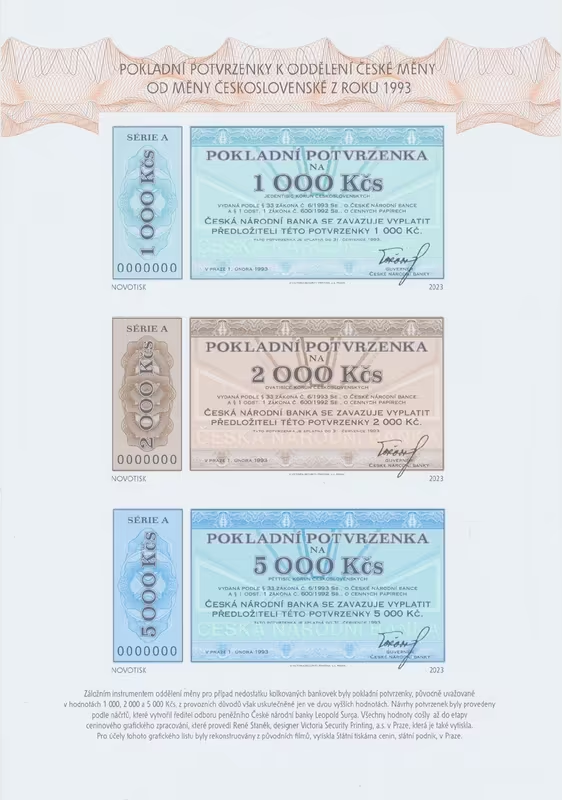
Česká republika, Sada pokladničních potvrzenek a bankovkových kolků k oddělení české měny z roku 1992, tisk STC Praha
Česká republika, 1993 - Novotisky pokladničních potvrzenek v hodnotách 1000, 2000 a 5000 Kčs s datem 1. února 1993 na samostatném listu, dále sada novotisků bankovkových kolků včetně později nepoužitých nízkých hodnot rovněž na samostatném listu. U…
Skladem 5 ks - Code: BCSR2CZ004BM
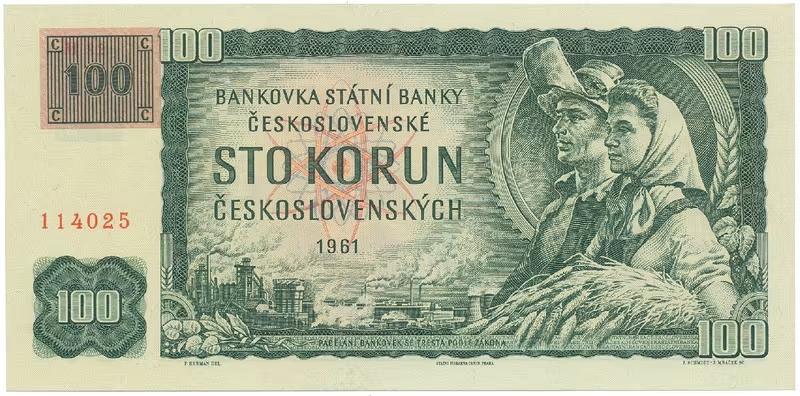
Česká republika, 100 Koruna 1961 + kolek (1993), II. vydání, série M, Hej.CZ4bM
Česká republika, 1993 - 100 Koruna 1961 + kolek (1993), II. vydání, série M, Hej.CZ4bM, v případě konkrétní série je foto pouze ilustrační N/UNC
Skladem 1 ks - Code: BCSR2CZ006BC
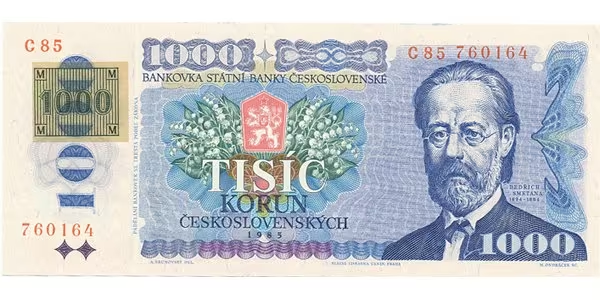
Česká republika, 1000 Koruna 1985 + lepený kolek (1993), Hej.CZ6bC
Česká republika, 1993 - 1000 Koruna 1985 + lepený kolek (1993), široká série, Hej.CZ6bC, v případě konkrétní série je foto pouze ilustrační N/UNC
Skladem (>5 ks) - Code: BCSR2CZ006CV
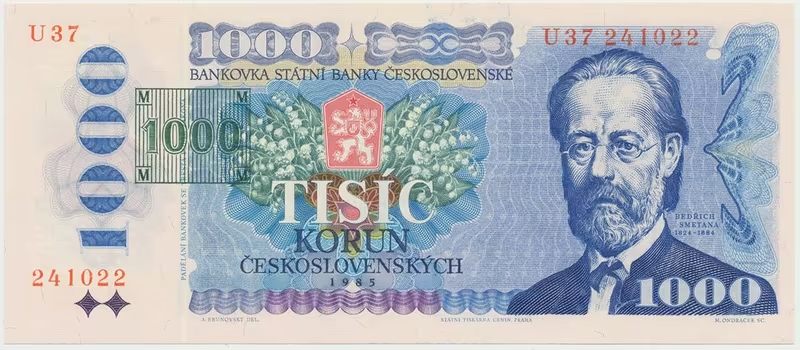
Česká republika, 1000 Koruna 1985 + tištěný kolek (1993),vysoká série U, Hej.CZ6c
Česká republika, 1993 - 1000 Koruna 1985 + tištěný kolek (1993), Hej.CZ6c, vysoká série U, v případě konkrétní série je foto pouze ilustrační N/UNC
Skladem (>5 ks)