Christoph Franz von Buseck
Christoph Franz von Buseck (1724-1805) was a Roman Catholic bishop and the last prince-bishop of Bamberg, that is, an ecclesiastical ruler who combined the spiritual office with secular power. He came to head the bishopric at the close of the 18th century, when Bamberg was struck by the Napoleonic Wars and subsequent secularisation of the church states.
Christoph Franz von Buseck was born on 28 December 1724 in Jagstberg (today part of the town of Mulfingen in Baden-Württemberg) into noble circles. About his early years the sources usually give fewer details, but the essential point is that he passed through an ecclesiastical career which in the German lands of the time often led to administrative and representative functions. The Prince-Bishopric of Bamberg belonged among the so-called ecclesiastical principalities of the Holy Roman Empire: here the bishop was not only the spiritual shepherd, but at the same time a ruler with state administration, revenues and his own legal institutions.
Von Buseck was elected to head Bamberg on 7 April 1794 (his activity is usually placed in practice in the years 1795-1802), in a time when the European continent found itself in a long period of revolutionary and Napoleonic conflicts. He received episcopal consecration on 16 August 1795; the personal family context is also significant, because he was consecrated by his relative Georg Karl von Fechenbach, then prince-bishop of Würzburg. For Bamberg this was an extraordinarily uncertain time: the fronts and movements of armies bore down on the economy, on supplies and on the safety of the inhabitants, and ecclesiastical states tended to be vulnerable both militarily and politically.
History
Sources describe von Buseck as rather a moderate and cautious ruler. In 1796, when French troops entered the area, he fled from Bamberg to Prague; even there, however, safety did not last long, and in 1799 he took refuge in Saalfeld. He returned to Bamberg around 1800, but it was clear that the independent existence of the ecclesiastical principalities was rapidly coming to an end. It was precisely at the turn of the century that the idea of redistribution and "mediatisation" of territories was gaining strength in the German area, so as to create a more unified system of secular states - usually at the expense of ecclesiastical lordships.
The decisive intervention came in the years 1802-1803 within the framework of the extensive secularisation of ecclesiastical holdings. Bavarian troops occupied the territory of the Bamberg prince-bishopric on 29 September 1802 and the region was subsequently annexed to Bavaria. Von Buseck thereby lost secular power, but remained bishop until his death on 28 September 1805 in Bamberg. After his passing, ecclesiastical administration gradually adapted to the new conditions and the former prince-bishopric in further developments transformed into a more modern ecclesiastical structure.
The role of the ruler and coins from the Bishopric of Bamberg
In the case of prince-bishops it is important to understand their dual position: as a spiritual authority they stood at the head of the diocese, as a secular ruler they administered territory, collected taxes and maintained an administrative apparatus. For this reason their name also appears on coins. In von Buseck's time silver and smaller denominations were struck in Bamberg, typically in the thaler and kreuzer logic of the German area of the time. Surviving pieces are usually dated especially to the turn of the century (for example the year 1800) and often bear the ruler's portrait or titulature, while the reverse may show the denomination and sometimes also a town motif or a stylised view of Bamberg.
These strikes also have a distinctly "transitional" character. They originated at a time when the old order of the Holy Roman Empire was rapidly crumbling, the regions were burdened by war contributions and soon afterwards came incorporation into larger states. For this reason Bamberg coins from the end of the 18th and the beginning of the 19th century are perceived not only as means of payment but also as a tangible record of the last years of the ecclesiastical principalities. With individual specimens it pays to follow the mint marks, variants of the portrait and the exact expression of value, because there are several types and small variations according to the issue and the minting workmanship.
In our auction and shop
- Code: NAHARZ-1680
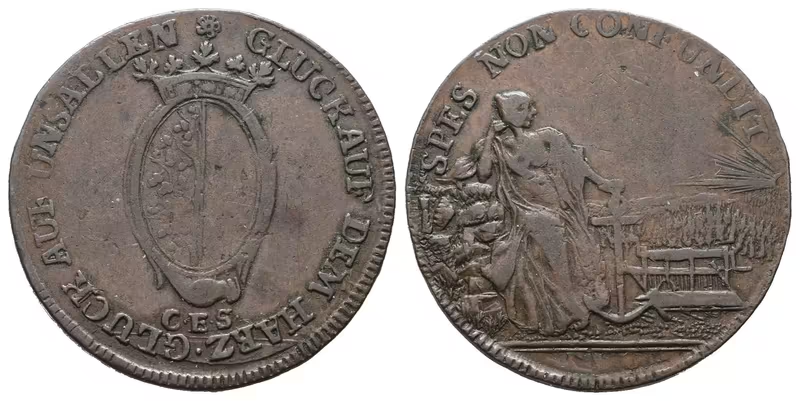
Harz, Početní peníz b.l. - C. E. Siedenstüker
Pohoří Harz, Zellerfeld AE Početní peníz b.l., Christoph Engelhard Siedenstüker, mincmistr 1680 - 1785, Neumann.31774
Skladem 1 ks