Constans
Constans was a Roman emperor of the Constantinian dynasty who ruled in the West from 337 to 350. As the youngest son of Constantine I the Great he received Italy, Africa and Illyricum, later gained control of the entire West, but perished in the coup of Magnentius.
Constans (Latin: Flavius Julius Constans) was born in 322 or 323 as the youngest son of Constantine I and Fausta. Already as a child he was included in dynastic planning: at the end of 333 he received the title of Caesar, which in the late Roman milieu designated a "junior" emperor and the designated successor. After the death of Constantine I in 337 the empire was divided among the three brothers — Constantine II, Constantius II and Constans. All of them assumed the title Augustus and Constans took over Italy, Africa and Illyricum — regions important both for supply (especially grain) and for control of strategic routes between the western Mediterranean and the Balkans.
The joint rule of the brothers was, however, fragile. The eldest, Constantine II, sought to assert a guardian-like position over his younger brother, which Constans had no intention of accepting. The dispute soon escalated into open conflict: in 340 Constantine II invaded Italy, but was defeated and perished. Constans thereby also took over his territories (especially Gaul, Hispania and Britain) and became the de facto ruler of most of the western part of the empire. For the young ruler this meant a rapid expansion of responsibility: he had to deal with the defence of the Rhine frontier, the stability of Gaul, and at the same time maintain ties to central administration in Italy.
History
In his time pressure on the frontiers continued, especially in the regions along the Rhine and Danube. The sources mention actions against the Franks and other military undertakings intended to consolidate the emperor's authority with the army and with the provinces. No less important were the religious disputes within Christianity, which continued to sharpen after the Council of Nicaea. Constans is associated with support for Nicene Christianity and with the idea of the emperor as protector of the "correct" faith, which had a political dimension too: religious unity was understood as a condition for the empire's stability.
The close of his reign was marked by the estrangement of part of the elites and the army. In January 350 the usurper Magnentius was proclaimed emperor in Gaul. Constans was at that time outside the main centre of power and tried to escape southward, but was caught at the foot of the Pyrenees at the place known as Castrum Helenae (modern Elne). There he was killed in January 350, which opened the way to a civil war between Magnentius and Constantius II that occupied the entire Roman state for several years. Constans's fate thus shows well how quickly legitimate rule in the late empire could be broken if a sovereign found himself without firm support from the army.
Mintages and typical coins from the time of Constans
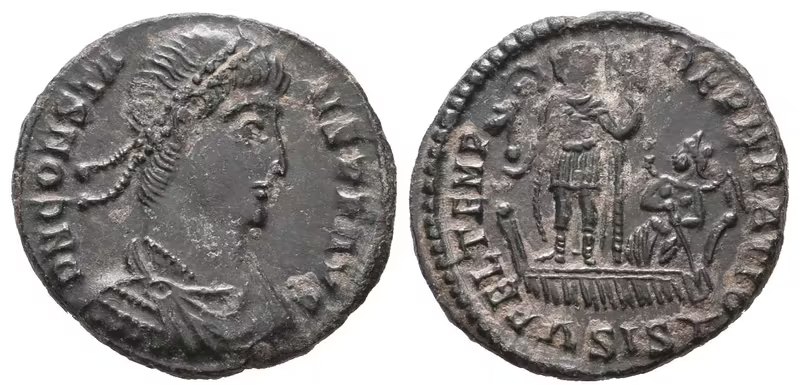
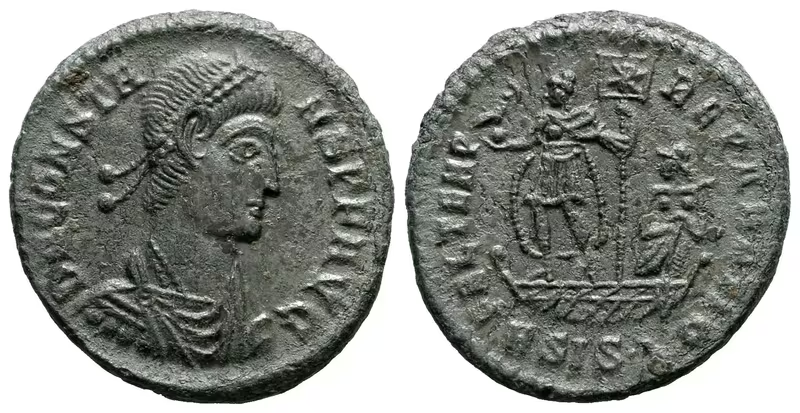
The time of Constans is attractive for numismatics primarily because of the extensive mintages of bronze coins and clearly readable programmatic types. On the obverse the emperor's diademed head or bust usually appears with legends such as D N CONSTANS P F AVG, which emphasise the ruler's legitimacy and piety. A key point is the monetary reform of 348, common to Constans and Constantius II, when the famous reverse legend FEL TEMP REPARATIO ("happy restoration of the times") appears in bronze. Under this legend a series of scenes was created: the best known is the motif of a soldier striking down a "fallen horseman", but other scenes also occur, intended to act as visual proof of victory, the restoration of order and the empire's ability to defend its frontiers.
These coins were struck in great quantity and in many mints, so for individual pieces the mint marks in the exergue and small workshop variants play a fundamental role. The combination of the "same" legend and a broad range of variants makes Constans's mintages good material for attribution by mint, annual run and type of scene. Alongside bronze there also exist gold solidi and their fractions, intended for state payments and representation, but the ordinary circulation and everyday economy of Constans's reign are today best documented by the bronze series of the second quarter of the 4th century.
In our auction and shop
- Code: BE146-0124.1Recommended
Constans, follis, Siscia, RIC VIII 124
Constans (333 - 350) mincovna Siscia, stojící císař s Christogramem na lodi se sedící Viktorií, RIC VIII 124
Skladem 1 ks - Code: BE146-0224
Constans, follis, Siscia, RIC 244
Constans (337 - 350) mincovna Siscia, císař na lodi s Viktorií, raženo 348 - 350, RIC 244
Skladem 1 ks - Code: BE146-AS124
Constans, follis
Constans (333 - 350), follis - mincovna Siscia, stojící císař s Christogramem na lodi se sedící Viktorií RIC VIII 124
Skladem 1 ks - Code: BE145-0236
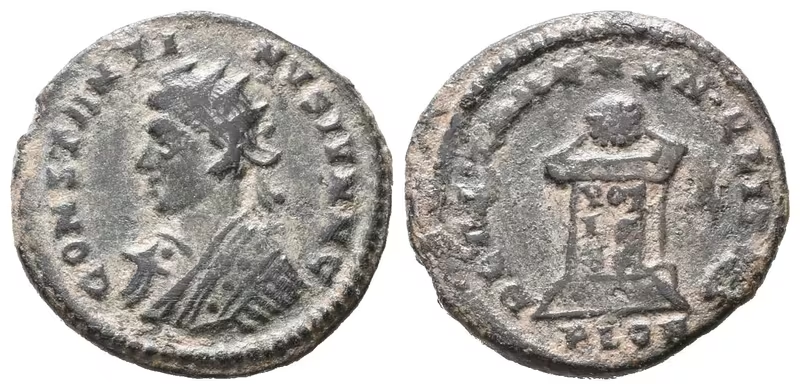
Constantine II. jako caesar, follis, Londinium, RIC VII 236
Constantine II. (337 - 340) jako caesar mincovna Londinium, raženo 321 - 322, globus na oltáři, RIC VII 236
Skladem 1 ks