Constantine II
Constantine II (316–340) was a Roman emperor ruling in the years 337–340, the eldest son of Constantine the Great, who after his father’s death co-ruled the empire with his brothers Constantius II and Constans I, but perished in a civil war while attempting to extend his power at the expense of his younger brother. Constantine II is significant in numisma…
Constantine II was born in February 316 in Arelate (Arles) as the eldest son of Emperor Constantine the Great and Fausta. From early childhood he was prepared for imperial power, and in 317, at the age of only one year, he was elevated to caesar. He grew up at a time when his father was transforming the Roman Empire by establishing Christianity as the state religion and founding the new capital of Constantinople.
His upbringing and education took place under the supervision of Christian teachers and military instructors, which made him the first emperor brought up from childhood in the Christian faith. Constantine II learned statesmanship, military arts and theology, while he gradually gained experience in imperial administration through the governance of smaller territorial units under his father’s oversight.
His elevation to augustus in 333 officially confirmed Constantine’s position as senior augustus among his brothers and the designated successor to his father’s throne. Constantine the Great divided the administration of the empire among his three sons – Constantine II received the west (Gaul, Britain and Spain), Constantius II the east (Asia, Syria and Egypt) and the youngest Constans the centre (Italy, Africa and Illyricum).
The death of Constantine the Great on 22 May 337 opened a dynastic crisis in which most of the male relatives of the Constantinian dynasty, apart from the three sons and two nephews, were murdered. Constantine II, as the eldest brother, claimed the position of senior augustus with authority over the younger brothers, which provoked tension above all with the energetic Constans.
The division of the empire (337) created three separate administrative units, but Constantine II was not satisfied with his share. He received the smallest and least prosperous part of the empire, while his brother Constans controlled wealthy Italy and Africa. Constantine demanded a revision of the paternal testament and a larger share of the imperial inheritance.
History
The conflict with Constans escalated during 339, when Constantine II refused to recognise his brother’s independence and insisted on his rights of seniority. Constans, however, proved to be a capable ruler with the support of the Italian legions and the Senate. Diplomatic negotiations failed and both brothers began to gather armies.
The invasion of Italy in 340 represented Constantine’s attempt at the forcible unification of the western empire under his rule. He crossed the Alps with a Gallic army and advanced towards Aquileia, where Constans’s forces awaited him. Constantine believed that his seniority and military experience would secure a swift victory.
The Battle of Aquileia in 340 ended with Constantine’s death and the collapse of his army. According to various sources he fell in direct combat or while fleeing the battlefield. His death at the age of 24 ended the first phase of the wars of succession among Constantine’s sons and enabled Constans to unify the western empire under his control.
The legacy of Constantine II is ambivalent – as a continuator of his father’s Christian policy he supported the Church and orthodoxy, but his ambition and inability to compromise drove the empire into civil war. His death weakened the Constantinian dynasty and contributed to the later instability of the 4th century.
The coins of Constantine II document his development from caesar to augustus and continue in the Constantinian minting tradition with Christian symbols and imperial propaganda. The early issues from his caesarate depict the young prince with a diadem, while the later augustan coins show more mature portraits with a crown and imperial attributes.
Constantine II in numismatics
The most common motifs are Christian symbols – the chi-rho monogram, crosses and inscriptions such as GLORIA EXERCITVS (glory of the army) or VIRTVS AVGGG (virtue of the augusti). The design follows the Constantinian models but gradually emancipates itself towards Constantine’s own iconography emphasising his seniority among the brothers.
Regional issues from the Gallic mints at Trier, Arelate and Lugdunum reflect the western orientation of Constantine’s rule and his support among the Gallic legions. These coins often contain military motifs reflecting Constantine’s reliance on the army in the conflict with his brothers. The quality of the western issues is high thanks to the prosperity of the Gallic provinces.
Rare are the commemorative coins for Constantine’s elevation to augustus in 333 and for various military campaigns. After his death in 340 Constans struck consecration coins with the motifs DIVVS CONSTANTINVS, but these issues are rare because of the strained relations between the brothers. Constantine’s coins are prized by collectors as documents of the first generation of Christian emperors.
In our auction and shop
- Code: SREC92-B1964.2
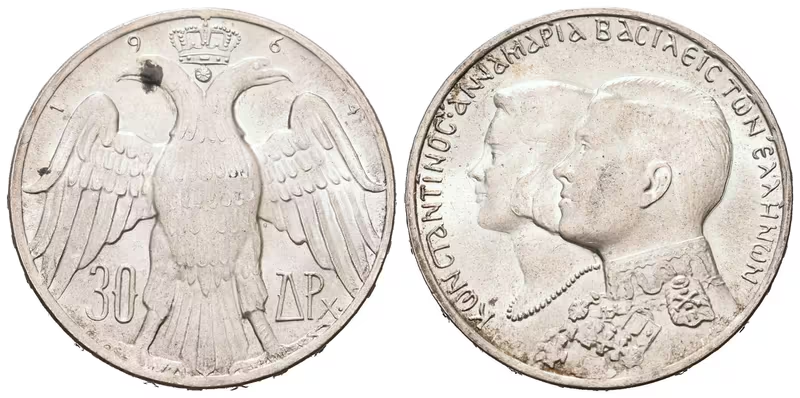
Řecko, 30 Drachma 1964
Řecké království, Konstantin II., 1964 - 1973 30 Drachmai 1964 - Královské svatba, Kongsberg, KM.87, krásná zachovalost, ražební lesk, drobné rysky, patina
Skladem 1 ks - Code: SREC92-B1964.3
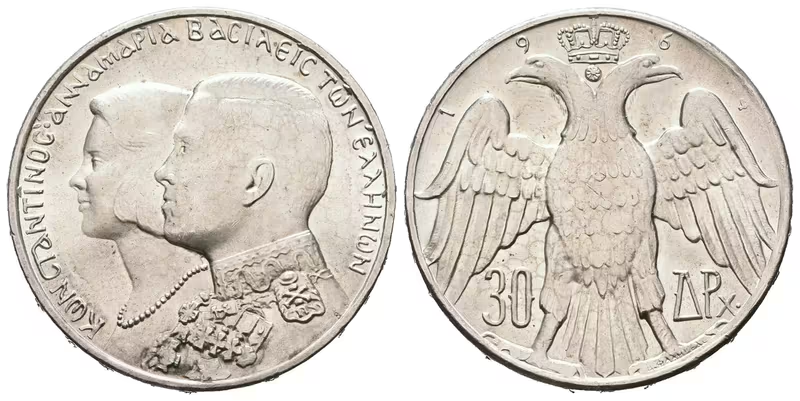
Řecko, 30 Drachmai 1964 - Královská svatba
Řecké království (1944–1973), Konstantin II. Řecký (1964-1973) 30 Drachmai 1964 - Královská svatba, KM# 87 Ag (.835), 30,3 mm (12 g). Mincovna: Norská mincovna, Kongsberg. Emise: 1 000 000 ks. Hrana: s nápisem "* ICXYC ΜΟΥ Η ΑΓΑΠΗ ΤΟΥ ΛΑΟΥ" (Mojí silou…
Skladem 1 ks - Code: SREC92-B1964
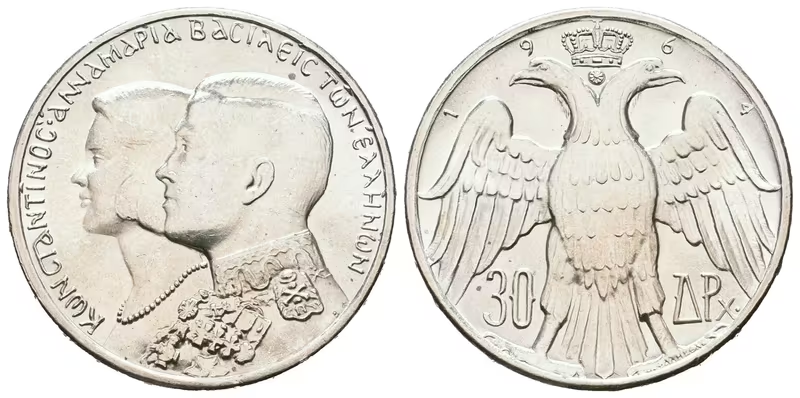
Řecko, 30 Drachma 1964
Řecké království, Konstantin II., 1964 - 1973 30 Drachmai 1964 - Královské svatba, Kongsberg, KM.87, krásná zachovalost, ražební lesk, drobné rysky
- Code: SREC92-B1964.1
Řecko, 30 Drachma 1964
Řecké království, Konstantin II., 1964 - 1973 30 Drachmai 1964 - Královské svatba, Kongsberg, KM.87, krásná zachovalost, ražební lesk, drobné rysky