European Monetary Union
The European Monetary Union is the economic and monetary integration of nineteen European Union member states which since 1999 have shared the common currency, the euro, thereby creating the world's second largest reserve currency after the US dollar. In numismatics, the European Monetary Union represents an unprecedented experiment in the voluntary relin…
The roots of monetary integration reach back to the Treaty of Rome of 1957, but specific plans did not emerge until the Werner Report of 1970, which proposed a monetary union by 1980. The first attempt — the European monetary snake — foundered on the oil shocks of the 1970s. The European Monetary System of 1979, with the ECU as a basket-based accounting unit, prepared the ground for actual integration. The Delors Report of 1989 outlined a three-stage plan for monetary union, realised by the Maastricht Treaty of 1992.
Convergence criteria — inflation, interest rates, deficit, debt — had to be met by the eleven founding members. Germany demanded a Stability Pact ensuring fiscal discipline. The European Monetary Union came into being on 1 January 1999 with the introduction of the euro in non-cash form; the European Central Bank took over monetary policy from the national banks. The conversion rates were irrevocably fixed — 1 euro = 1.95583 German marks = 6.55957 French francs. A three-year transitional period allowed for dual pricing and preparation for the cash euro.
History
The cash euro entered circulation on 1 January 2002 in the largest currency exchange in history — 14.25 billion banknotes and 56 billion coins worth 144 billion euros replaced the national currencies of 300 million Europeans. The logistical operation required 50,000 tonnes of coins struck in advance, distribution to 218,000 banks and 2.8 million retailers. National currencies were withdrawn at the rate of one billion banknotes a month. Another eight states subsequently joined the eurozone — Greece (2001), Slovenia (2007), Cyprus and Malta (2008), Slovakia (2009), Estonia (2011), Latvia (2014), Lithuania (2015), Croatia (2023).
The euro crisis of 2010–2012 tested the resilience of the monetary union. The Greek debt crisis and bailout programmes for Ireland, Portugal, Spain and Cyprus called into question the project's sustainability. The ECB responded with unconventional monetary policy — quantitative easing, negative interest rates, Draghi's "whatever it takes" saved the euro. The COVID-19 pandemic brought a fiscal revolution — the Next Generation EU fund represents the embryo of a fiscal union. The digital euro planned for 2026 is intended to maintain relevance in the era of cryptocurrencies.
Structure and Rules of Euro Coins
Euro coins have eight denominations — 1, 2, 5, 10, 20, 50 cents and 1, 2 euros. The common obverse depicts a map of Europe and the value, designed by Luc Luycx. The national reverses are unique to each country — German coins have varying motifs by denomination, Italian ones works of art, French ones national symbols. All euro coins are legal tender throughout the eurozone regardless of the country of minting.
The technical specifications are uniform — weight, diameter, composition, edge. The 1, 2 and 5 cent coins are of copper-plated steel, the 10, 20 and 50 cents of Nordic gold, the 1 and 2 euros bi-metallic. National quotas limit minting — Germany may strike 30% of all euro coins, Malta 0.07%. Commemorative two-euro coins (a maximum of 2 per year) celebrate national and European themes. Joint issues such as the 10th anniversary of the euro in 2012 are struck by all countries with the same motif.
In our auction and shop
- Code: SMAD-E1993E
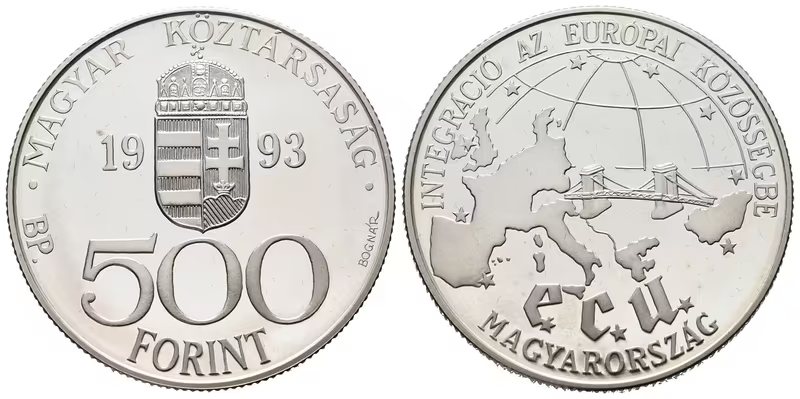
Maďarsko - 500 forintů 1993 - ECU
Maďarsko 500 forintů 1993 - Evropská měnová unie, KM.704 Ag 0,925, 38,6 mm (31,46 g), etue, certifikát, PROOF