Frederick II of Saxony
Frederick II of Saxony (1412-1464) was a Saxon Elector ruling from 1428 to 1464, who became famous as "the Gentle" thanks to his mild nature and diplomatic wisdom, but also as a patron of art and architecture, protector of miners, and moderniser of Saxon administration, thereby laying the foundations of later Saxon prosperity in the time of the Renaissanc…
Frederick was born on 22 August 1412 in Leipzig as the son of Elector Frederick I the Warlike and Catherine of Brunswick. He grew up during the Hussite Wars and the conciliar movement, which shaped his later diplomatic orientation and his effort to resolve conflicts peacefully through negotiation rather than military force.
His younger years he spent at the Burgundian court as a hostage for his father's debts, where he obtained a French courtly upbringing and became acquainted with Renaissance culture. This experience influenced his later patronage and interest in art, architecture, and humanist education according to Western European models.
His accession to the throne in 1428 brought the 16-year-old Frederick rule over a divided Saxony, which he had to unite and stabilise after his father's military adventures. The young elector quickly proved a capable administrator preferring diplomacy to military solutions of conflicts.
The Treaty of Altenburg in 1445 divided the Saxon territories between Frederick II and his younger brother William III, by which the Ernestine and Albertine lines of the Wettin dynasty arose. Frederick retained the electoral dignity and control over northern Saxony, including Wittenberg.
Mining policy represented the key to Saxon prosperity with the development of silver mines in the Ore Mountains, especially at Annaberg and Schneeberg. Frederick modernised mining law, introduced new technologies, and attracted German miners, thereby creating the foundation of the future Saxon wealth.
History
Religious policy characterised Frederick's tolerance during the preparations for the Council of Basel and the beginnings of the Hussite problems. He sought a compromise solution of religious disputes and supported reforms of the Church without radical changes causing unrest in the empire.
Cultural patronage included support for Gothic architecture with the construction of new churches, monasteries, and electoral residences. Frederick's court attracted artists, scholars, and craftsmen, who modernised Saxon culture according to Western European standards.
Imperial politics focused on supporting Emperor Frederick III against Hungarian and Turkish threats while maintaining Saxon autonomy. Frederick II avoided costly military campaigns and concentrated on internal development and economic prosperity.
His death on 7 September 1464 at Leipzig ended Frederick's 36-year reign, which transformed Saxony from a war-torn country into a prosperous electorate. His son Ernest inherited a stable and wealthy state, which became one of the most powerful German states.
The legacy of Frederick II lies in the foundation of Saxon prosperity through the mining revolution, diplomatic wisdom, and cultural patronage. His "gentle" reign showed an alternative to military expansion and created a model of a successful German territorial state.
In our auction and shop
- Code: NASA-1181
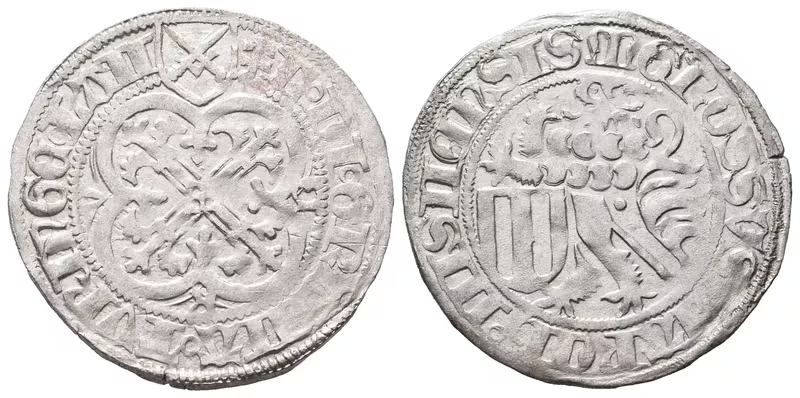
Sasko - Míšeň, Mečový groš, Colditz
Sasko - Míšeň, Friedrich II. a Margaretha (1456 - 1464) Schwertgroschen b.l. (1457 - 1464), Colditz, Krug.1181/77-78, stav 1/1, pěkná zachovalost, pěkně vyražený, drobné rysky
Skladem 1 ks - Code: NBBAD-BY1910
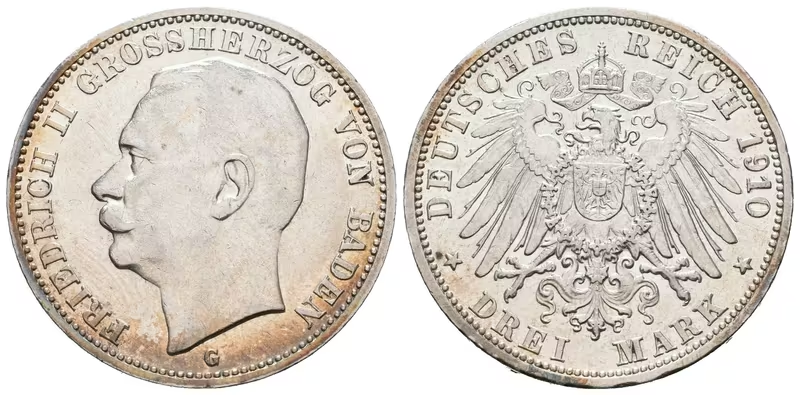
Baden, 3 Marka 1910 G
Baden, Friedrich II. (1907 - 1918) 3 Marka 1910 G, J. 39, KM.280, velmi pěkná zachovalost, patina, zbytky lesku, lesk na Rv., rysky a drobné hranky
Skladem 1 ks - Code: NBBAD-BY1912.3
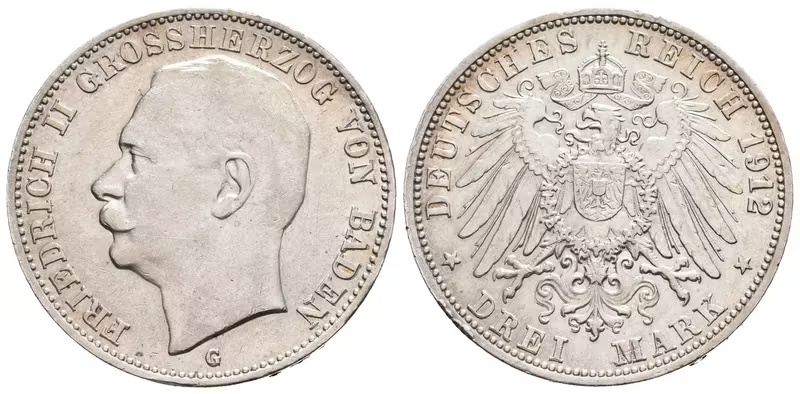
Baden, 3 Marka 1912 G
Baden, Friedrich II. (1907 - 1918) 3 Marka 1912 G, J. 39, KM.280, krásná zachovalost, jemná patina, zbytky lesku na Rv., drobné rysky a hranka
Skladem 1 ks - Code: NBBAD-BY1914.1
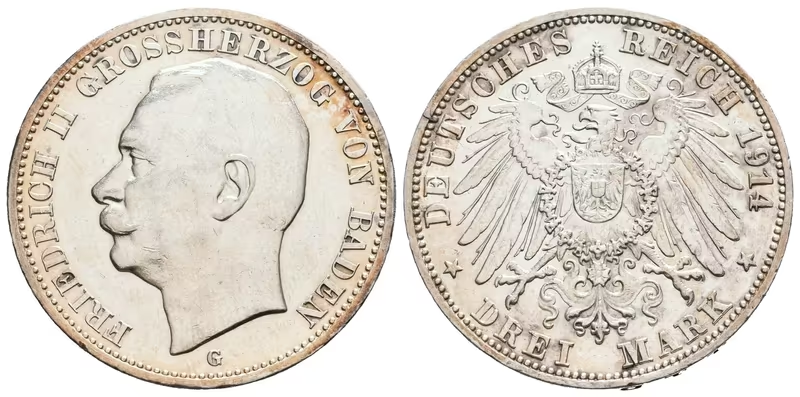
Baden, 3 Marka 1914 G
Baden, Friedrich II. (1907 - 1918) 3 Marka 1914 G, J. 39, KM.280, velmi pěkná zachovalost, jemná patina, lesk na Rv., rysky
Skladem 1 ks