Henry of Lipa
Henry of Lipa was one of the most powerful Czech magnates at the turn of the 13th and 14th centuries, a member of the Lords of Lipa (a branch of the Ronovec family). He held the offices of high marshal and royal chamberlain, and during the reign of John of Luxembourg he also became the life partner of the dowager queen Elizabeth Richeza.
Henry of Lipa (Henry I) came from an ancient noble family that derived its name from Lipý Castle in present-day Česká Lípa. In the sources, his family is classed among the Ronovecs, an extensive kinship network that held numerous estates and castles in northern Bohemia and the borderlands. Some debate surrounds Henry's precise origins, since older tradition lists him as the son of Chval of Lipa, while more recent research also considers the possibility of a "missing generation". What is certain is that by the end of the 13th century he was already entering high politics: around 1296 he appeared at the royal court in Prague together with his brother Čeněk of Ojvín.
He began his career in the service of the last Přemyslids, particularly King Wenceslas II, and soon proved himself a capable military and political actor. In 1304 he distinguished himself in the defence of Kutná Hora, the key centre of silver mining, and his name appeared among the leading men of the kingdom. After the Přemyslids died out (1306), he was among the nobles who decided on the succession and on the form of government. During the second reign of Henry of Carinthia, in 1308 he became high marshal and at the same time royal chamberlain, holder of exceptionally influential land offices.
Tensions between the nobility, the towns and a weaker royal power led to dramatic confrontations. In 1309 Henry, together with several other magnates, was ambushed and imprisoned in the Sedlec Monastery, which shows how acute the disputes of the time were. After the change of conditions in 1310, when John of Luxembourg came to the country, Henry of Lipa became one of the leading figures of domestic politics. At the same time, his informal relationship with the dowager queen Elizabeth Richeza deepened, a relationship that had not only a personal but also a political dimension: the queen possessed dower towns and her own power base.
History
The conflict between part of the nobility and the young king culminated in the autumn of 1315, when Henry of Lipa was arrested and imprisoned at Týřov Castle. His arrest provoked the resistance of his supporters and contributed to the further deepening of the domestic crisis. In the spring of 1316 he was released and his estates and influence were gradually returned to him; the dispute was only settled by an agreement at Domažlice in 1318. A year later, Henry gave up part of his northern Bohemian estates in exchange for compensation in Moravia, where the circle around Elizabeth Richeza also moved. It was the Moravian stage of his life that became connected with Brno and Staré Brno, where after his death on 26 August 1329 he was buried in the Basilica of the Assumption of the Virgin Mary.
Henry's exceptional status is also attested by the fact that in 1321 he obtained permission from King John to strike his own coin, which was not a matter of course in the Czech setting even for important lords. Alongside his political influence, he thus left a mark in the economic and representative sphere as well — at a time when the power of both ruler and magnates was very often manifested precisely through control of offices, estates and symbols of authority.
In the sources, Henry of Lipa appears above all as the holder of the highest land offices. The office of high marshal was among the most prestigious functions in the kingdom and ensured not only standing at court but also real influence over the administration of the country and over noble politics. The second pillar was the function of royal chamberlain, traditionally associated with royal revenues and with oversight of part of the economic administration, which made Henry an exceptionally strong player in an environment where power rested on finance as well as on control of key areas.
Offices, Power and Numismatic Context
His long-term partnership with Elizabeth Richeza reinforced his social prestige and at the same time created an independent centre of power outside the king's immediate court. His move to Moravia after 1319 can be read as a calculated step: Henry built a stable base there, while sensitive negotiations between ruler and nobility were taking place in Bohemia. In the last years of his life he remained the "first man of the kingdom" in politics even without a crown — as a magnate whose authority derived from offices, allies and property.
From the numismatic point of view, the most important matter is the aforementioned permission to strike coin (1321). Such a privilege had practical significance for the economy and the circulation of money, but it also represented a symbol: the coin bore signs of power, titulature or heraldry and publicly reminded the viewer who was the holder of right and authority. If you encounter Henry's name in numismatics, it is usually in connection with this exceptional licence and with the contemporary milieu of the Luxembourg era, when the political standing of magnates was reflected in their rights and representation.
In our auction and shop
- Code: RAZEM-1981A
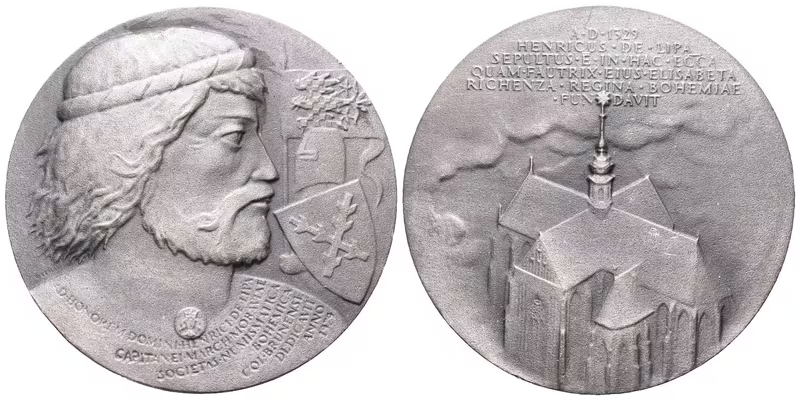
Zeman Karel - Jindřich z Lipé
Zeman Karel (1949 - ) AE Medaile b.l. (1981) - 650. výročí úmrtí Jinřicha z Lipé. Poprsí zprava, vpravo rytíř se štítem a praporem, nápisy / Pohled na starobrněnský chrám z ptačí perspektivy, nápisy. Postř. bronz 41,5 mm
- Code: RAZEM-1978
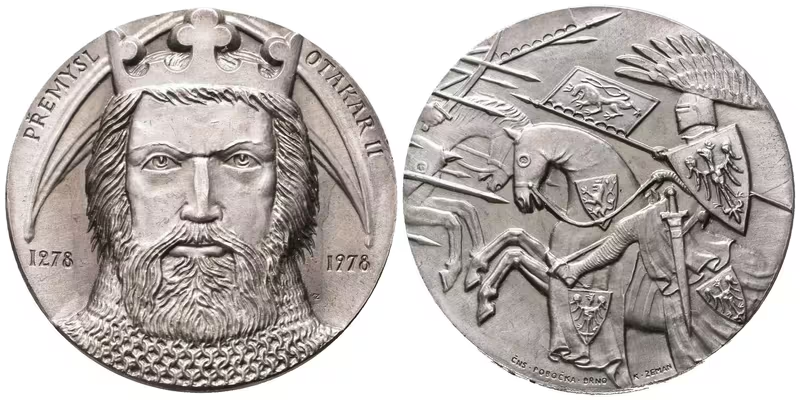
Zeman Karel - Přemysl Otakar II.
Zeman Karel (1949 - ) AR Medaile (1978) - k 700. výročí úmrtí krále Přemysla Otakara II. AG 0,900, 40 mm (50g), raženo 400 ks
- Code: RAZEM-1998Photo coming soon

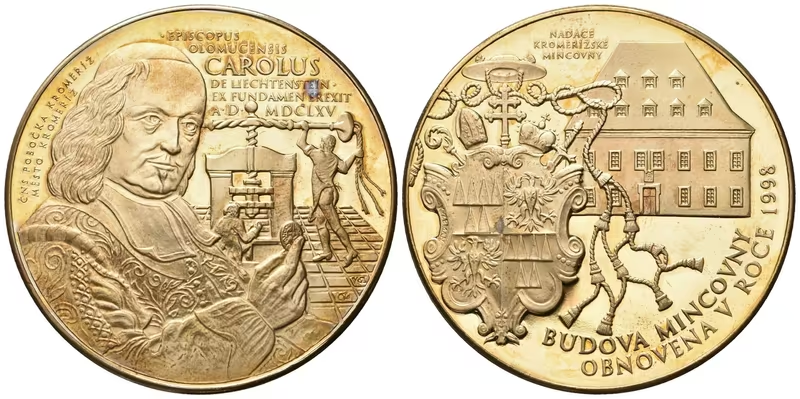
Zeman Karel - Obnovení mincovny v Kroměříži
Zeman Karel (1949 - ) AR Medaile (1998) - k obnovení budovy mincovny v Kroměříži AG 0,900, 50 mm (50g), PROOF, etue, kapsle, počet ks: 500
- Code: RAZEM-1998AE
Zeman Karel - Obnovení mincovny v Kroměříži
Zeman Karel (1949 - ) AE Medaile (1998) - k obnovení budovy mincovny v Kroměříži Mosaz, 50 mm (47g), PROOF, etue, kapsle, počet ks: 450