Johann Ernst von Thun
Johann Ernst of Thun-Hohenstein (1643–1709) was an Austrian nobleman and church dignitary, Bishop of Seckau (1679–1687) and Prince-Archbishop of Salzburg (1687–1709), who became renowned as an important Baroque patron, a hard-line opponent of Protestantism and a politician who supported Bavaria against Habsburg rule. In numismatics, Johann Ernst is signif…
Johann Ernst was born on 3 June 1643 in Prague as the son of Johann Sigismund of Thun-Hohenstein of the Czech line of this important noble house originally from South Tyrol. The Thun family attained an important position in the Habsburg Monarchy in the 17th century, and its members held important ecclesiastical and secular functions. Johann Ernst was destined from his youth for an ecclesiastical career as the younger son of a noble family.
He completed his education on a Grand Tour through Europe, which took him to Italy, France, the Netherlands, England, Spain and even Africa. This unusually extensive journey broadened his horizons and acquainted him with the latest trends in Baroque art and architecture. After his return he completed his theological studies and was ordained priest in 1677.
His episcopal career began in 1679 with his appointment as Bishop of Seckau in Styria. In this office he proved himself a capable administrator and an ardent defender of Catholic reform. He promoted the Tridentine reforms, fought against Protestant influences and modernised diocesan administration according to Baroque ecclesiastical standards.
Elevation to Prince-Archbishop of Salzburg in 1687 represented the peak of his ecclesiastical career. The Archbishopric of Salzburg was one of the most powerful ecclesiastical principalities of the Holy Roman Empire, with extensive territories and considerable revenues from the mining of salt. Johann Ernst became both secular and spiritual ruler of a prosperous Alpine state.
Building and artistic activity characterised his Salzburg reign. Johann Ernst had the archiepiscopal residence rebuilt as Mirabell Palace on Italian Baroque models and called in important architects including Johann Bernhard Fischer von Erlach. He patronised Italian artists and craftsmen, thereby making Salzburg a centre of Baroque art in the Alpine region.
History
The policy of re-Catholicisation was the most controversial aspect of Johann Ernst's reign. The archbishop harshly persecuted crypto-Protestants in his principality and demanded strict observance of Catholic orthodoxy. In 1697 he imposed an obligation on all graduates of the University of Salzburg to swear an oath of allegiance to the dogma of the Immaculate Conception.
Political conflicts with Habsburg power arose from Johann Ernst's support for the Bavarian uprising against Emperor Joseph I. The archbishop supported the representatives of the Braunau Parliament and sided with the Bavarian Elector Max Emanuel against the Vienna centralising policy. This opposition created tension with the imperial court.
The founding of the Order of St Rupert in 1701 was intended to honour the patron saint of the Archbishopric of Salzburg and to strengthen the prestige of Johann Ernst's reign. The order was intended for outstanding services to the archbishopric and became a symbol of Salzburg's independence from Austrian central power.
The death of Johann Ernst on 20 April 1709 in Salzburg ended the 22-year reign of one of the most controversial Salzburg archbishops. His legacy includes the Baroque rebuilding of Salzburg, the harsh re-Catholicisation and the political conflict with the Habsburgs, which influenced relations between Church and state in the following decades.
The Salzburg coins of Johann Ernst of Thun-Hohenstein represent the high point of Baroque ecclesiastical coinage in the Alpine region. The thalers and ducats depict the archbishop in full pontifical vestments with mitre, sceptre and archiepiscopal crown, emphasising his dual position as spiritual and secular prince. The portraits correspond to the Baroque artistic style with an emphasis on majesty and ecclesiastical dignity.
Johann Ernst in Numismatics
Characteristic motifs are St Rupert as patron of Salzburg, the archiepiscopal coat of arms combining Thun and Salzburg symbols, and allegories of Faith or of the Church fighting against heresy. The design often contains complex iconography reflecting Johann Ernst's re-Catholicisation efforts and ecclesiastical reforms. The quality of the engraving art reaches a high level corresponding to the prestige of the archbishopric.
Commemorative issues celebrate the founding of the Order of St Rupert in 1701 and various anniversaries of the archbishop's reign. These rarer coins contain richer symbolism, including the badges of the order, the patron saints and references to Salzburg ecclesiastical traditions. Some issues emphasise the disputes with Protestantism through allegorical motifs.
The technical quality of the Salzburg coins from Johann Ernst's time is high thanks to the prosperity of the archbishopric from the salt trade and to skilled mintmasters. The use of local silver from the Alpine mines and Austrian gold sources allowed the striking of coins to standards equal to those of the most important German ecclesiastical principalities.
In our auction and shop
- Code: NASASCO-A1609
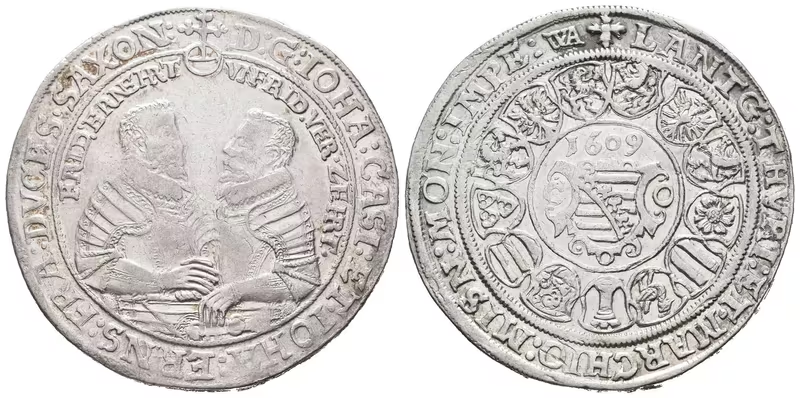
Sasko - Coburg, Tolar 1609
Sachsen - Coburg - Eisenach, Johann Casimir und Johann Ernst (1572-1633) Tolar 1609, Coburg, Dav. 7426, Schnee 185 (28,97 g), pěkná zachovalost, patina, rysky, zbytky lesku na Rv.