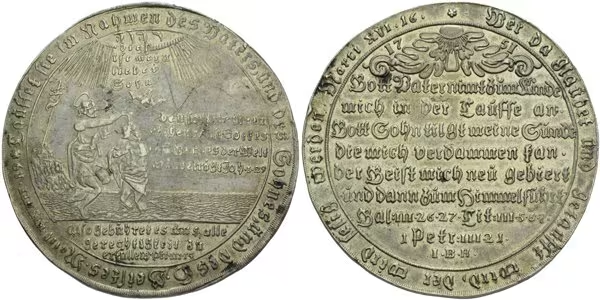
Baptismal medals
Baptismal medals are commemorative strikes with religious motifs that have been given at a child's baptism since the 17th century as a keepsake of this significant Christian sacrament. These medals, widespread chiefly in German-speaking countries and Central Europe, bear biblical scenes related to baptism and are often personalised with the name of the ba…
The tradition of baptismal medals developed during the Baroque era at the beginning of the 17th century, when both Protestant and Catholic regions of Central Europe began to emphasise the material expression of religious rites. The first documented baptismal medals come from German cities such as Nuremberg, Augsburg, and Dresden, where prominent medallists' workshops operated. These workshops produced not only official strikes for the nobility and ecclesiastical dignitaries, but gradually also more accessible variants for burgher strata.
During the 17th century the production of baptismal medals spread to Bohemia, Moravia, Silesia, and other Habsburg lands. Baroque piety and the emphasis on the visual representation of faith led the medals to become a common part of the baptismal rite. At first these objects were a privilege of the wealthier strata of society, which could afford to commission individually struck pieces with names and dates.
Baptismal medals reached their greatest flourishing in the 18th century during the Enlightenment, when religious traditions paradoxically sought to hold their own against rationalist thinking. Medals became more accessible thanks to the development of manufactory production and the use of cheaper materials such as tin, brass, or lead alongside traditional silver. At this time, mass-produced medals with blank fields for the subsequent stamping or engraving of names and dates also appeared.
History
A popular motif on baptismal medals was the scene of the baptism of Jesus Christ in the River Jordan by St John the Baptist, often supplemented by the dove of the Holy Spirit and the inscription from the Gospel of Matthew: This is my beloved son, in whom I am well pleased. Other frequent motifs were Jesus blessing the children, the guardian angel protecting the child, or symbols of faith, hope, and love. Protestant medals usually contained more biblical quotations in the vernacular, whereas Catholic versions preferred Latin inscriptions and Marian motifs.
The 19th century saw the industrialisation of the manufacture of baptismal medals, which led to their mass spread across all social strata. Specialised firms arose in Berlin, Vienna, Prague, and other cities, offering catalogues of standardised motifs. At the same time, the tradition of luxury bespoke medals for the aristocracy and wealthy burghers continued, often created by leading medallists of their day.
After the First World War the significance of baptismal medals gradually declined in connection with the secularisation of society. In the communist countries, including Czechoslovakia, their production was significantly restricted after 1948. The tradition was partly revived after 1989, when some mints began once again to offer commemorative baptismal strikes, although no longer on the scale of the past.
Materials, manufacture, and iconography
Baptismal medals were manufactured from various materials according to the social standing and financial means of the recipient. The most luxurious pieces were struck from gold or silver; more common were medals of gilded or silvered copper, brass, tin, or lead. The diameter of the medals most commonly ranged between 25 and 45 millimetres, and the weight depended on the material used.
The manufacturing technique involved striking with dies, which allowed serial production of the basic motif. Personalisation was carried out by additional stamping or hand engraving of names, dates, and sometimes coats of arms or initials of the godparents. Some luxury pieces were entirely hand-engraved, which significantly increased their value. Medals could be fitted with a loop for hanging on a chain or attaching to a cradle.
The iconographic programme of baptismal medals drew on Christian symbolism. The obverse most often depicted the biblical scene of baptism or Christ with the children, while the reverse provided space for personal data, often framed by a wreath or ornamental border. Inscriptions were in Latin, German, or the vernacular according to the region and confession.
In our auction and shop
- Code: NAHARZ-1751
Harz, AR Křestní medaile 1751
AR Křestní medaile 1751 - Křest Krista v Jordánu / 9-řádkový text. Ag 50 mm (28,80 g)