Liri
Liri is the plural of the Maltese lira, the national currency of Malta from the gaining of independence in 1964 until the adoption of the euro in 2008. The Maltese lira (singular lira, plural liri) was one of the world's highest-valued currencies and a symbol of Maltese national identity.
Malta used various currencies depending on who controlled the island: Sicilian coins under the Normans, Spanish reales under the knights of the Maltese Order, French francs under Napoleon. British rule from 1800 brought a complicated system, with British pounds, local scudi and various Mediterranean currencies circulating simultaneously. In 1825 Britain introduced the pound sterling as the official currency, but local currencies persisted. Only in 1886 was the pound definitively established as the sole legal currency.
The path to a currency of its own began in 1949, when the Malta currency board was created. After gaining independence on 21 September 1964, Malta quickly introduced its own currency. The Maltese lira was introduced in May 1972, replacing the British pound at a rate of 1:1. It was divided into 100 cents and 1,000 mils. The first banknotes and coins bore the likeness of the first Maltese president and symbols of island culture: the Maltese cross, ships, historical monuments. The Central Bank of Malta took over responsibility for monetary policy in 1974.
History
The Maltese lira was initially pegged to the British pound, later to a basket of currencies, and from 1971 freely floating. Thanks to a conservative monetary policy, it retained a high value, often exceeding 3 US dollars. Malta joined the EU in 2004 and immediately joined the ERM II mechanism. On 1 January 2008 it adopted the euro at the fixed rate of 0.429300 lira to the euro. The exchange of liri for euros continued until 2012; the physical coins and banknotes retain their collectors' value.
The Maltese lira was a decimal currency divided uniquely both into 100 cents and into 1,000 mils, which allowed very precise accounting. There existed coins of 2, 3 and 5 mils (in aluminium), 1, 2, 5, 10, 25 and 50 cents (in cupronickel) and 1 lira (bimetallic). Banknotes were in denominations of 2, 5, 10 and 20 liri. The design of Maltese means of payment reflected the island's rich history: megalithic temples, the baroque architecture of Valletta, traditional ships.
The lira in the Maltese monetary system
Technically the Maltese liri were of high quality with advanced security features. Banknotes were printed by the British De La Rue; coins were struck by the Royal Mint. Of interest were the motifs: the neolithic temple of Mnajdra, the Maltese falcon, the dghajsa (traditional boat). The Maltese lira was popular among collectors for its artistic execution and small mintages. The Central Bank of Malta also issued gold and silver commemorative coins, often with a maritime theme or featuring Maltese knights. The high value of the lira meant that even small coins had considerable purchasing power: 5 cents was enough for a newspaper, 1 lira for lunch in a restaurant. The transition to the euro was controversial: many Maltese perceived the loss of the lira as a loss of sovereignty.
In our auction and shop
- Code: SMAL-H1994
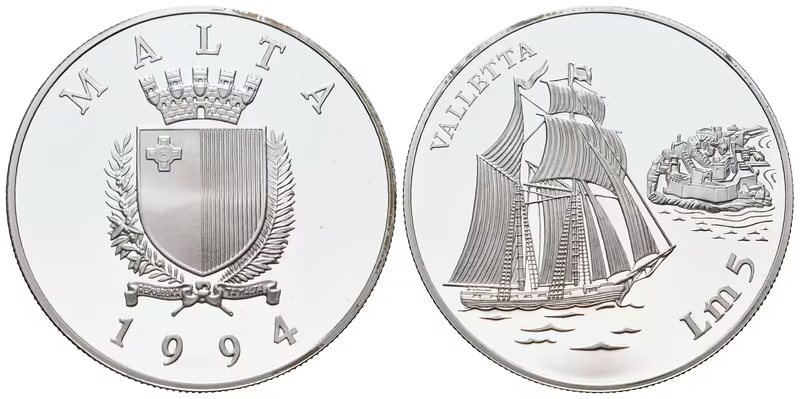
Malta, 5 Liri 1994 - Valletta
Maltská republika (1972-2007) 5 Liri 1994 - Plachetnice Valletta, KM# 108 Ag (.925), 38,61 mm (31,47 g), proof, v kapsli. Emise: 20 000 ks. Série "Historie mořeplavby - Lotyšské lodě". Mincovna: Royal Mint, Llantrisant - Velká Británie.
Skladem 1 ks - Code: SZ-NEJ-TOS-1860
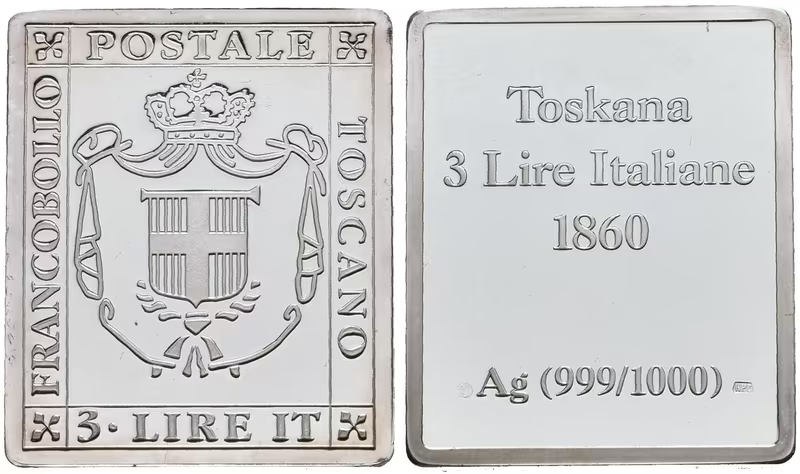
Stříbrná známka - Toskánsko 3 italské liry 1860
Stříbrná známka - Toskánsko 3 italské liry 1860 Ag 0,999 (8 g)
Skladem 1 ks - Code: BTUREC185
- Code: BTUREC187A