Oslo
Oslo is the capital of Norway and its largest economic and cultural centre, lying at the end of the Oslofjord. The town has medieval origins; in the early modern period it underwent a great rebuilding after a devastating fire, and today it is a key Nordic hub of administration, trade and learning.
Oslo belongs to the oldest towns of Scandinavia, and its history reaches into the Middle Ages. It arose as a trade and administrative centre in an area where routes from the interior converged towards the fjord and on to the sea. Owing to its location it gradually became a natural place for markets, crafts and ecclesiastical institutions, and in the Norwegian context it acquired a significance that surpassed that of an ordinary regional town. Medieval Oslo was linked with the world of the Norwegian kings, with ecclesiastical administration and with trade in the North Sea area, where the interests of the Scandinavian countries and urban trade networks met.
The town also played a key role at a time when Norwegian history was increasingly interwoven with Denmark and later with Sweden. In long periods of personal unions, the centre of power was often located outside Norway, which also affected Oslo's standing. Even so, the town retained its significance as a regional administrative hub and as a support of trade. In the early modern period, at the same time, the emphasis on defence and the control of the coast increased, because the Nordic area was sensitive to conflicts and to naval power. Precisely from this need grows the significance of fortress and military buildings around the town.
History
A turning point was the great fire of 1624. After it, the Dano-Norwegian king Christian IV had the town rebuilt and at the same time moved closer to the Akershus fortress. The new town received the name Christiania and had a more "modern" urban form corresponding to contemporary ideas of a planned town. This step meant a fundamental transformation: the original medieval Oslo remained on the margin as older built-up area, while Christiania became the main administrative and commercial core.
In the 19th century the town developed alongside the transformations of Norwegian society. After 1814 Norway found itself in a new political situation and gradually strengthened its own institutions, which naturally increased the significance of the capital. Infrastructure, industry and learning expanded, and the town grew into the form of a modern metropolis. The symbolic dimension was also important: with national awareness the need grew to emphasise Norwegian identity, and therefore the town gradually returned to its historical name. In 1925 it was officially renamed back to Oslo, which completed the long development from a medieval settlement through Christiania to a modern capital.
The town, trade and connections with coins
Oslo was for centuries an important point of exchange and administration, and therefore also a place where monetary circulation naturally concentrated. In the Nordic area, currency and coins often changed according to the political arrangement - differently in the time of an independent Norwegian royal power, differently in the period of the Dano-Norwegian union and differently in the modern era, when a more unified state framework began to form. Payments connected with trade, the collection of fees and administration flowed through the town, which made it a natural centre for the functioning of money in practice.
From the numismatic point of view, Oslo is also interesting as a "backdrop" of the history of Scandinavian coins: it reminds us that currency is not just a system of denominations, but a reflection of politics, trade and state power. In the Norwegian environment, both silver coins and later modern circulating coinage, which corresponded to the needs of industrial society, played important roles. For the collector, Oslo is a typical example of a town whose significance does not derive from one particular coin, but from a long-term role in the economic and administrative life of the country.
In our auction and shop
- Code: RC-VIKY1893
Vikýřovice u Šumperka - Památka na oslavy 25-letého založení sboru dobrovolných hasičů
Hasičské dekorace AE Medaile 1893 - Památka na oslavy 25-letého založení sboru dobrovolných hasičů. 4-řádkový nápis a datum v dubovém věnci / Přilba, žebřík, sekyrka, hák, a provaz, opis. Ms 33 mm, pův. ouško, Šil.450
Skladem 1 ks - Code: ZC431-CERT
5000 Kč 2012 - Karta k minci Barokní most v Náměšti nad Oslavou
Česká republika (1993 - ) 5000 Kč 2012 - Karta k minci - Barokní most Náměšt nad Oslavou, perfektní stav
Skladem 1 ks - Code: MC107
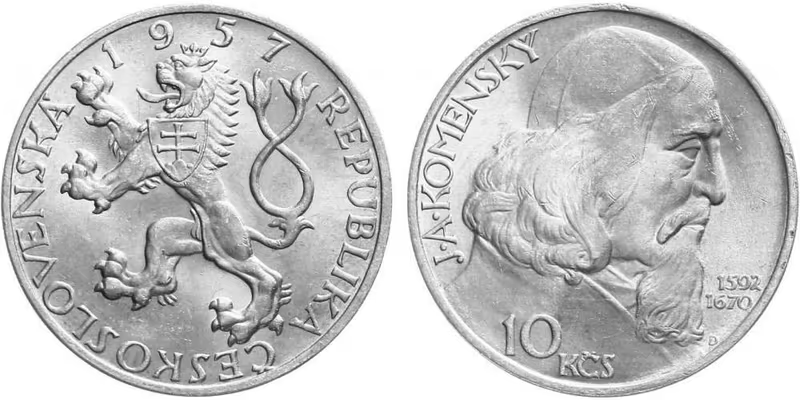
10 Kčs 1957 - Jan Ámos Komenský
Československo (1953 - 1993) 10 Koruna 1957 - Oslavy Jana Ámose Komenského, autor František David, Aurea 107, běžná kvalita, ilustrační foto Ag 0,500, 30 mm (12 g), raženo 141 378 ks (běžná kvalita), 4 742 ks (proof)
Skladem (>5 ks) - Code: MC107-PROOF
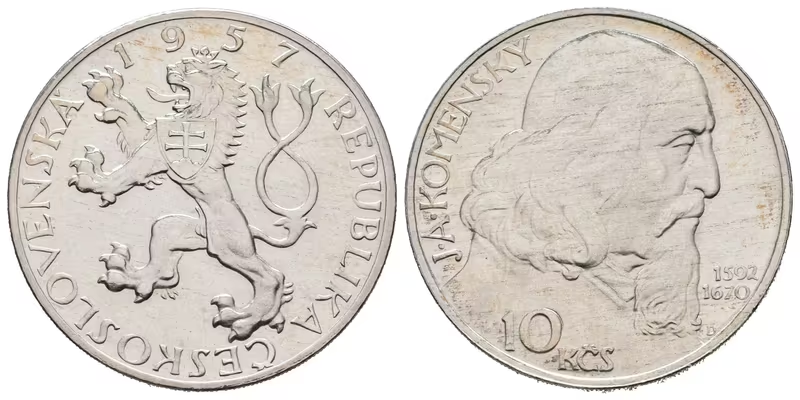
10 Kčs 1957 - Jan Ámos Komenský, PROOF
Československo (1953 - 1993) 10 Koruna 1957 - Oslavy Jana Ámose Komenského, autor František David, Aurea 107, PROOF Ag 0,500, 30 mm (12 g), raženo 141 378 ks (běžná kvalita), 4 742 ks (proof) původní plastová kapsle, patina v ploše - viz foto
Skladem 1 ks