Writing
Writing is a system of conventional graphic signs designed to record language in such a way that it can be read again at any later point. From the perspective of cultural and economic development, the invention of writing is one of the most significant moments in human history — it marks the transition from prehistory to the historical age and opens up an…
The earliest attested writing in the world arose in southern Mesopotamia in the city of Uruk at the end of the 4th millennium BC, roughly between 3400 and 3200 BC. Scholars refer to it as proto-cuneiform writing. It is attested on clay tablets from the Uruk IV and Uruk III periods, which contain hundreds of pictographic signs — schematic images of goods, animals and persons — combined with numerical signs. The overwhelming majority of the earliest tablets consist of economic records: tallies of grain, cattle, oil, beer, labour days and the warehouse management of temples. The actual language — Sumerian — appears in writing only with the consolidation of phonetic components around 2900 BC, when pictograms gradually transformed into stylised cuneiform signs impressed into wet clay with a reed stylus with a bevelled tip (Latin cuneus).
The origin of writing and its economic beginnings
Classical Sumerian cuneiform developed in the Early Dynastic period (c. 2900–2334 BC), when cuneiform signs gradually replaced pictograms and the system acquired both logographic and syllabic components. Cuneiform became the lingua franca of all ancient Mesopotamia and was adapted to Akkadian, Hittite, Elamite, Hurrian, Urartian and other languages. The economic texts of this era — the Code of Hammurabi (c. 1754 BC), credit contracts from Babylon, warehouse inventories from Mari — are the first attested written documents of commercial and financial character. Cuneiform survived for more than three thousand years; the last surviving cuneiform texts come from Babylon in the 1st century AD, specifically an astronomical almanac dated to AD 75. By then it had been definitively replaced by the Aramaic and Greek alphabets.
Sumerian cuneiform
The second independent — or at least clearly autonomous — invention of writing was Egyptian hieroglyphs. The earliest evidence comes from the Naqada III period, approximately 3400–3100 BC, and consists mainly of labels from tomb U-j at Abydos, where small bone and ivory labels with early hieroglyphic signs were found among the funerary goods. The first complete sentence in hieroglyphic writing was found on a clay sealing from the tomb of king Seth-Peribsen (c. 2660–2650 BC) of the 2nd Dynasty. Hieroglyphic writing was used continuously in Egypt for more than three and a half thousand years; the last known hieroglyphic inscription comes from the temple on the island of Philae and is dated to AD 394. The key to their decipherment was provided by the Rosetta Stone, found in 1799 by Napoleon's Egyptian expedition; Jean-François Champollion announced its successful decipherment in 1822.
Egyptian hieroglyphs
The story of the invention of writing is more complex than a mere dual origin in Mesopotamia and Egypt. The current state of scholarship recognises at least four independent inventions of writing: Mesopotamia (c. 3400–3100 BC), Egypt (c. 3250 BC), China (the oracle bones of the Shang dynasty, attested before 1250 BC) and pre-Columbian Mesoamerica (Zapotec, later Olmec and Maya signs before AD 1). In the case of other regions — Cretan Linear A, the Harappan signs of the Indus Valley, rongorongo of Easter Island — there is still dispute as to whether these are fully-fledged scripts or merely proto-sign systems. From the standpoint of monetary history, it is important that the Phoenician alphabet — which the Phoenician merchants created around 1050 BC for commercial records in the Levant — stood at the origin of the Greek, Hebrew, Aramaic, Latin and Cyrillic alphabets, and thereby of most of today's European, Near Eastern and Slavic scripts.
Other independent inventions
For numismatics, the invention of writing is fundamental for several reasons. Without writing it would not be possible to inscribe on a coin the name of the ruler, the mint, the date or the nominal value — that is, the information that forms the core of identifying every collectable coin. The ancient Greek drachms bore inscriptions from the 6th century BC, Roman republican denarii from the 3rd century BC, and Roman imperial coins from 27 BC continuously bore the emperor's name, his titulature and gradually also pictorial expressions of victory, the pantheon and political events. In medieval Europe the coin legend became the key to the authentication of strikes — the ruler took responsibility for the purity of the coin by visibly stating his name and the mint. Without the invention of writing at the end of the 4th millennium BC, today's world of standardised currencies, named issues and collectors' catalogues would therefore not be possible — its emergence is thus one of the invisible but utterly fundamental preconditions of all numismatics.
Significance for numismatics and trade
In our auction and shop
- Code: Z96C-1848
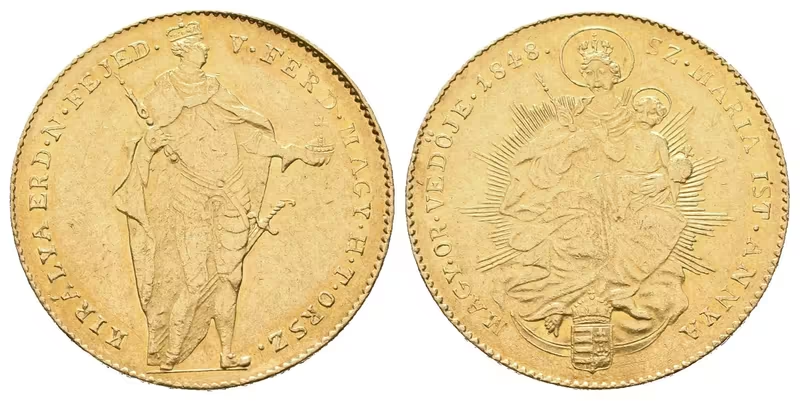
Revoluce, Dukát 1848, Kremnica
Revoluce (1848 - 1849) Dukát 1848, Kremnica, menší písmo, užší a vyšší znak pod Madonou, Ves. 3 var., vzácný ex sbírka Kokolus, aukce Macho&Chlapovič #19/291 (1680 Euro), ex Macho&Chlapovič #29/182 (2160 Euro)
Skladem 1 ks - Code: 55288
Písmo na mincích a medailích
Michal Vitanovský Přední český medailér a sochař Vitanovský je autorem např. Řádu T.G.Masaryka, českého Řádu bílého lva a dalších pamětních mincí. Kniha volně navazuje na první díl Heraldika na mincích a medailích. nakladatelství Libri Praha 2020
- Code: BPOLS149.0
Polsko, 20 Zlotych 1982, P.149, 1 sériové písmeno
Polsko / Poland 20 Zlotych 1982, P.149, 1 sériové písmeno 0/AU
Skladem 1 ks - Code: BNEME343A.3
Německo - NDR, 10 DM 1948, tisk SSSR, 1 písmeno + 6-místný číslovač, Ros.343a
Německo - NDR / Germany - DDR 10 DM 1948, tisk SSSR, 1 písmeno + 6-místný číslovač, drobné pošk. okraje, Ros.343a 3/VG
Skladem 1 ks