Rio de Janeiro
Rio de Janeiro is a metropolis on the south-eastern coast of Brazil, famed for Guanabara Bay, the Copacabana and Ipanema beaches and the dominant Sugarloaf Mountain. In the country's history it played a key role as its long-time capital and remains today one of the most distinctive cultural symbols of Brazil.
Rio de Janeiro arose in the colonial period as a strategic port city, intended to protect Portuguese interests on the Atlantic coast of South America. Its location at a sheltered bay and its proximity to important routes meant that it soon became an important point of trade and administration. In the 18th century, Rio's significance increased further in connection with gold mining in the interior: the port was the natural gateway through which raw materials and goods flowed, and the city gradually transformed into the economic centre of a vast region.
A fundamental turning point came at the beginning of the 19th century, when the Portuguese royal court moved to Rio. This extraordinary event transformed the city into the political centre of the empire and significantly accelerated its urban and social development. Rio became the seat of institutions hitherto reserved for the European metropolis and acquired a status that far exceeded the framework of an ordinary colonial town. In the following decades, after the proclamation of Brazilian independence, it functioned as the capital of the Empire of Brazil and later of the republic as well, which consolidated its role in the political and cultural life of the country.
History
During the 19th and 20th centuries Rio de Janeiro grew rapidly. The city attracted inhabitants from various parts of Brazil and from abroad, and at the same time grappled with the typical problems of large metropolises: inequality, housing shortages and pressures on infrastructure. During this period, distinctive architectural and urban projects also arose, intended to modernise and represent the metropolis. The cultural identity of Rio was at the same time more and more associated with music, carnival, beach culture and the image of a "city beneath the mountains", which became part of Brazil's presentation abroad.
In 1960, Rio lost its position as capital, when this role was taken over by the newly built Brasília. Even so, it remained one of the most important centres of Brazil – not only economically and touristically, but also culturally. In modern times Rio de Janeiro is perceived as a city with a unique landscape and a strong brand, but at the same time also as a space where social dynamics intensely clash with challenges of security, social cohesion and sustainable development.
Geography, culture and practical considerations
Rio de Janeiro is distinguished by an exceptional combination of sea, mountains and urban development. The natural scenery is formed by both iconic peaks (for example Sugarloaf Mountain) and an extensive coastline with urban beaches, which influence everyday life as well as the touristic character of the city. Guanabara Bay historically provided a safe anchorage and a natural harbour, which was key for the city's emergence and growth. The climate is predominantly tropical, with warmth for most of the year, which supports an outdoor lifestyle and the development of tourism.
Culturally, Rio is associated above all with carnival, samba and a distinctive urban identity, which is reflected in music, sport and the public space. The city is an important centre of media, entertainment and the creative industries. For visitors it is practically important to bear in mind that Rio is a vast metropolis with great differences between individual districts: some parts are highly touristic and well-equipped, others require greater caution. In everyday life the Brazilian real is used here, and the city functions as one of the main hubs of domestic and international transport in Brazil.
In our auction and shop
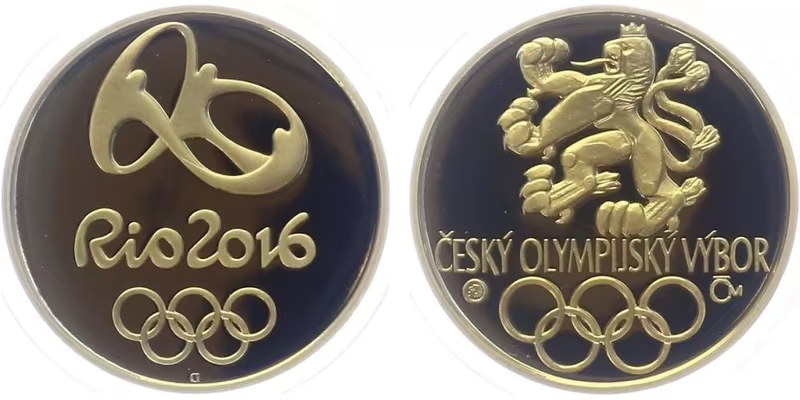
- Code: ZD-2016RIO
Medaile 2016 - XXXI. Olympiáda Rio de Janeiro
Česká republika (1993 - ) Medaile 2016 (Vojtěch Dostál) - XXXI. Letní olympijské hry Rio de Janeiro 2016, Au 0,9999, 22 mm (7,78 g), 1/4 Oz, etue, certifikát, raženo pouze 35 kusů, PROOF
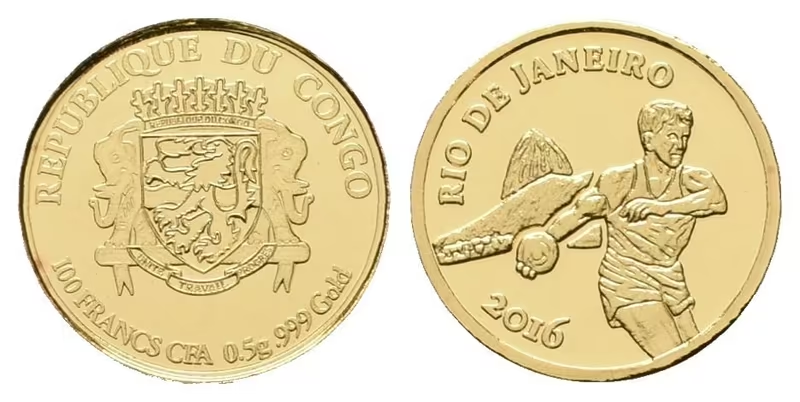
- Code: ZSKON-2016A
Kongo, 100 Franků 2016 - Olympijské hry Rio de Janeiro
100 Franků 2016 - Olympijské hry Rio de Janeiro, Au 0,999, 11 mm (0,5 g), kapsle, PROOF Z cyklu Nejmenší zlaté mince světa
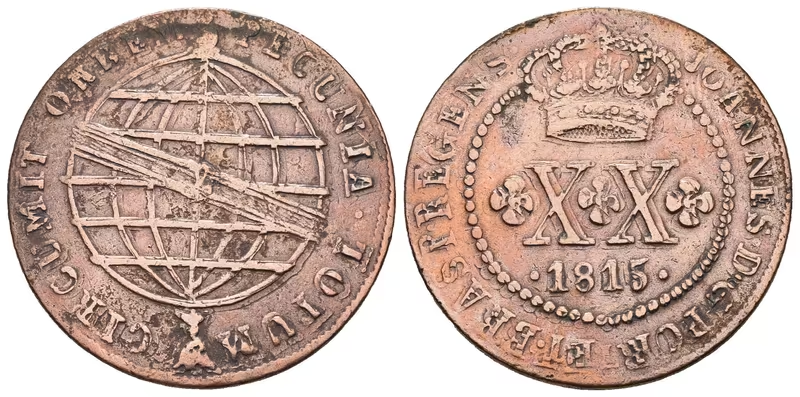
- Code: SBRAZ87-G1815
Brazílie, 20 Reis 1815
Brazílie, João VI. jako princ Regent (1799 - 1816) XX Réis 1815 R, Rio de Janeiro, KM.233, patina, dvojráz