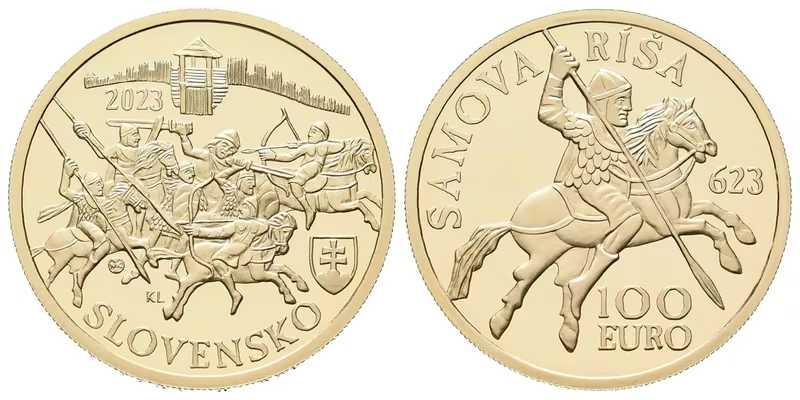
Samo's Empire
Samo's Empire was an early medieval tribal union of Western Slavs from the 7th century, associated with the name of Samo. It arose as a defensive community against the Avars and later also the Franks, and after Samo's death it disintegrated.
We know surprisingly little about Samo's Empire, because it rests mainly on a few brief reports in early medieval Latin sources, in particular on the account of the so-called Fredegar Chronicle. For this reason a number of things remain uncertain — from precise dating to the delimitation of the territory and internal organisation. The basic framework, however, is reasonably clear: around the 620s part of the Slavic groups in Central Europe rose against the Avars, and at the head of the rebels appeared Samo, whom the sources portray as a Frankish merchant.
The dating of the founding differs in the literature — the years 623/624 are often given, or slightly later, because the sources are brief and modern interpretations try to reconcile events with the wider context of Avar power. More certain is that Samo stood at the head of the union for about 35 years, that is until approximately 658–661, when he died and the community disintegrated without his authority. This implies an important characteristic of Samo's Empire: it was not an "empire" in the later sense of the word, but rather a temporary political-military confederation whose cohesion rested on common interests and on the personal authority of the ruler.
History
The best-known event associated with Samo's Empire is the clash with the Franks. According to the sources the Frankish king Dagobert I set out against the Slavs, and there was a three-day battle at a place called Wogastisburg (the exact location of which is still disputed). The Slavs, led by Samo, are said to have defeated the Franks and subsequently made raids into neighbouring areas. The success in this conflict apparently raised the prestige of the union and may have brought further groups in the more northerly areas into alliance, which shows how flexibly such early medieval communities could expand or contract according to the current pressure of power.
The question of "exactly where" Samo's Empire lay is a complex one. The sources do not delimit its borders, and archaeology can offer only indirect clues. In the Czech and Slovak environment it is most often considered to have been in the area between Bohemia, Moravia and western Slovakia, possibly extending into present-day Lower Austria or other neighbouring areas, but this is a working hypothesis rather than a firmly demonstrable map. From a historical point of view the significance is more important: Samo's Empire shows that the Slavic groups in Central Europe were capable of creating a supra-tribal political structure and successfully dealing and fighting with the great-power players of the time.
Character of the union, material sources and relation to coinage
Samo's Empire was not a state with firm administration, written institutions and a uniform law as we know it from the high Middle Ages. It was rather a union that could rapidly form and disintegrate: key were personal ties, military cooperation and the ability of the leader to keep the respect of the individual groups. Precisely this explains why disintegration followed after Samo's death — there was no stable mechanism of succession and no central institutions that would have kept the union together.
From the numismatic point of view it is essential that Samo's Empire is not associated with any own, securely documented minting output. In the 7th century barter, payment in kind and also the use of foreign coins as metal or as prestigious objects rather than as a "state currency" in the modern sense were customary in Central Europe. Archaeological finds from this period therefore more often testify to contacts and exchange networks (for example through the presence of foreign strikes) than to domestic minting production. An interesting supplement for collectors, on the contrary, are modern commemorative issues inspired by Samo's Empire, which recall its place in history but obviously do not belong to the period circulation of the 7th century.
In our auction and shop
- Code: ZE314.E
100 Euro 2023 - Sámova říše
Slovenská Republika (1993 - ) 100 Euro 2023 - Vznik Sámovy říše, autor Karol Ličko, Aurea S314 , etue, certifikát, PROOF Au 0,900, 26 mm (9,5 g), raženo 5 000 ks , etue, certifikát, papírový přebal, informační karta, PROOF