The Thun-Hohensteins
The Thun-Hohensteins are a prominent noble family originally from the Tyrol-Trentino region, who from the 17th century onwards became significantly established in the Czech lands as well. In the Czech context, the family is associated above all with northern Bohemia, large estates, state service in the Habsburg Monarchy and patronage.
The Thun-Hohensteins (German Thun und Hohenstein) are an ancient aristocratic family whose roots reach into the Alpine region. The family name is tied to the Thun (Ton) estate in the Val di Non and to a noble tradition that branched out into several lines over the centuries. Within the Habsburg lands, the Thuns gradually rose to prominence through property acquisitions, court service and administrative and military careers, which was typical for the aristocracy of the early modern period.
In the Czech lands, the family established itself more prominently after the Thirty Years' War, when, as a consequence of the post-White Mountain changes, extensive property transfers were taking place. The Thun-Hohensteins at that time acquired estates which became the foundation of their position in Bohemia. From a long-term perspective, their activity is most associated with northern Bohemia, where the family participated in the administration of large estates, in the development of residences, and in the shaping of the landscape character through economic interventions and representative modifications of residences.
In the 18th and 19th centuries the Thun-Hohensteins ranked among the elite of the Habsburg Monarchy, not only in property but also in service to the state. Members of the family held high offices, diplomatic and military posts, and also gained position in the ecclesiastical hierarchy. The importance of the family at this time was connected with the fact that the aristocracy functioned as a key personnel base for the running of the state: nobles occupied positions where decisions were made on the administration of the lands, on finances, on crisis management and on the representation of the monarchy abroad.
History
At the turn of the 19th and 20th centuries, the family is remembered in Czech history, among other things, thanks to figures who intervened in the politics and administration of Bohemia. Moreover, the position of the nobility in society was changing at this time: alongside the traditional role of landowners grew the importance of modern institutions, industry and civil society. The Thun-Hohensteins, like other great families, had to adapt to the transformations of the economy and to a new conception of public life, without losing the social prestige associated with their name and inheritance.
After the establishment of Czechoslovakia in 1918, the legal and social position of the nobility changed, but the large estates and cultural backgrounds of some families endured. A turning point was brought by the end of the Second World War and the subsequent property interventions by the state, which led to the nationalisation of a number of noble seats and economic complexes. In the Czech environment, the Thun-Hohensteins thus remained primarily as a historical trace, in the form of castles, parks, archival collections and art collections, which today help to reconstruct the everyday life and representation of the aristocracy of Central Europe.
The Thun-Hohensteins are most easily "read" in the Czech lands through their residences and estates, especially in northern Bohemia. Castles, agricultural backgrounds and landscape modifications are a reminder that a noble large estate was not only a residence but also an administrative and economic organism: it included forests, fields, industrial plants, transport and social care for employees. Connected with this are also surviving documents, which document management, building activities, the administration of property and contacts with the authorities.
Family seats, culture and numismatic context
The numismatic link of the family is indirect, but nonetheless significant. With the aristocracy, coins and medals often appear as part of representation and memory: family and jubilee medals, commemorative tokens, decorations or insignia of orders commemorated marriages, anniversaries, appointments to office, or important events. Such objects were often deposited in family collections and cabinets of curiosities, where alongside coins they functioned as a visual "archive" of family identity. For the historian, it is interesting that these small strikes can connect a personal story with the official language of symbols: coat of arms, titulature and pictorial motif create a compact message about the standing and ambitions of the family.
In a broader cultural context, the Thun-Hohensteins are also remembered as patrons and collectors. The support of art, the care of libraries, archival order and the preservation of objects of artistic craftsmanship help to explain why we still encounter the family in museums and heritage sites today. From this perspective, the "Thuns" are not just a chapter of genealogy, but also an important element of the history of the landscape, of administration and of culture in the Czech lands.
In our auction and shop
- Code: RC-PRAH1892M
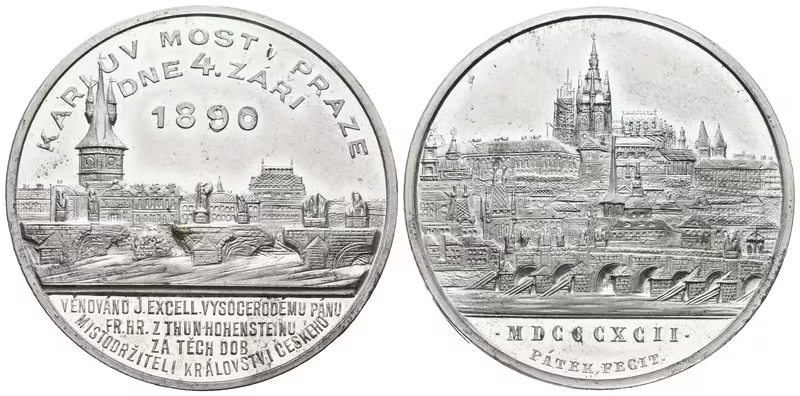
Praha - Karlův Most
Praha AE Medaile 1892 (Karel Pátek) - K opravě Karlova mostu po jeho protržení roku 1890, věnováno místodržícímu král. Českého Františku hraběti Thun-Hohenstein. Cín 41 mm_R!
Skladem 1 ks