Trans-Siberian Railway
The Trans-Siberian Railway is the longest continuous railway line in the world, connecting the European part of Russia with Siberia and the Russian Far East. It came into being at the turn of the 19th and 20th centuries and fundamentally influenced the settlement, economy and military logistics of an enormous territory.
The Trans-Siberian Railway arose as a response to an extraordinary problem of the Russian Empire: how to administer and economically exploit a territory stretching thousands of kilometres from the Urals to the Pacific Ocean. Siberia was rich in raw materials, had a strategic position, and at the same time represented a space of sparse settlement and difficult transport. Until the end of the 19th century, most transport relied on rivers, winter routes and slow caravan tracks. For a state that wished to strengthen control, facilitate the movement of people and goods, and at the same time react to the international situation in Asia, a railway was the logical solution.
Construction of the line got under way in the 1890s and proceeded in several large sections simultaneously. It was a project that was exceptional both technically and organisationally: the line had to overcome immense distances, extensive forests and bogs, large rivers and regions with extreme winters. An important chapter was the area around Lake Baikal, where the crossing of the lake was initially handled by ferries, and only later did a demanding shoreline route with tunnels and retaining walls arise. A further challenge were the bridges over the great Siberian rivers, which became one of the most visible symbols of the "technical conquest of space".
From the outset the line had several functions. Economically, it enabled faster export of raw materials and import of industrial goods, opened up space for the rise of new towns, and substantially changed the internal market. Socially and demographically it supported migration and colonisation: people could move in greater numbers and relatively more safely than before, which transformed the map of Siberian settlement. Politically and militarily, it became an instrument of state power — the ability to move troops and supplies quickly was crucial in modern conflicts, and the railway became the backbone of communication between the centre and remote regions.
History
In the 20th century the importance of the Trans-Siberian Railway grew still further. Wars and revolutions impinged upon it: the railway was crucial for supply, for the movement of populations, and in years of crisis also for the control of territory. In the Soviet era, its role became linked with industrialisation and with the development of mining and production in Siberia. Infrastructure was progressively modernised, capacity was increased, deviations and extensions were built, and part of the line was electrified. The line also became a symbol of the "connection" of an enormous state: physically and mentally it shortened distances that had previously seemed insurmountable.
Alongside the main route, important branch lines and parallel projects also arose, which expanded the transport network of Eastern Europe and Asia. It is precisely thanks to this that the Trans-Siberian Railway ceased to be understood as a single "line on a map" and became an entire system that linked ports, industrial regions, mining areas and border crossings. In cultural memory it acquired a special position: the travel tradition, photographs of trains in an endless landscape and the image of a long journey across continents transformed the railway into one of the best-known symbols of modern Eurasia.
The Trans-Siberian Railway is perceived chiefly as the link between Moscow and Vladivostok, but in practice it is a system of a main route and connecting branches. The railway fulfils two basic tasks: internal transport in Russia and transit transport between Europe and Asia. For freight, what is important is capacity, reliability and the ability to transport large volumes of raw materials and industrial goods. For passenger transport, the characteristic feature is the long journey time and great distances between hubs, which make the Trans-Siberian "a journey as an experience", not merely a transfer from point A to point B.
Route, operation and significance in practice
Technically, the line had to adapt to various climates and geological conditions. The resilience of track superstructure, bridges and signalling in an environment of frosts and large temperature swings is essential. An important role is also played by electrification and the increase of capacity, since the line is at the same time the backbone of regional transport — in many places it is used not only by long-distance trains, but also by suburban and freight services serving the local economy.
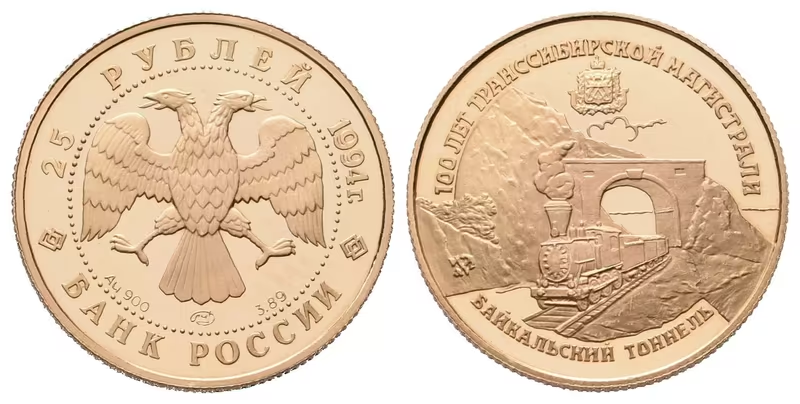
From a historical point of view, the importance of the railway is reflected also in commemorative objects: for major anniversaries of the railway, plaques, medals and sometimes thematic coins have been produced, which commemorate the technical and social transformation of Eurasia. The Trans-Siberian Railway is thus not only a transport structure, but also a source for the history of modernisation — it shows how infrastructure is able to change settlement, trade and the very conception of space itself.
In our auction and shop
- Code: ZSRUS-95PJ1994
Rusko, 25 Rubl 1994 - Bajkalský tunel
Rusko (1991 - ) 25 Rubl 1994 - 100 let transsibiřské magistrály - Bajkalský tunel Au 0,900, 19 mm (4,46 g), 1/8 Oz, KM. 534