Władysław I the Elbow-high
Władysław I the Elbow-high was a Polish king reigning in the years 1320 to 1333, who after years of fragmentation restored the Polish kingdom and the royal crown. His nickname Łokietek in Polish means 'elbow' and referred to his small stature, which contrasted with his great political ambitions and successes in unifying the Polish principalities.
Władysław I the Elbow-high was born around 1260 as the son of the Kuyavian duke Casimir I and Euphrosyne of Opole. He came from the Kuyavian branch of the Piast dynasty, which ruled only a small principality in central Poland. After his father's death in 1267 he inherited together with his brothers part of Kuyavia, specifically Brześć Kujawski. The young Władysław grew up in a period of the greatest fragmentation of Poland, when the former kingdom was divided into more than twenty separate principalities. His youth was marked by constant struggles among Piast princes over individual territories and influence.
Władysław's political career began in 1289, when after the death of his brother Leszek the Black he obtained the Sandomierz region and part of the Kraków region. Kraków, the former capital and seat of Polish kings, became the main goal of his ambitions. In 1291 he seized Kraków for the first time, and the Greater Poland duke Przemysł II recognised him as his successor in Lesser Poland. When Przemysł II was crowned the first Polish king after nearly two centuries of fragmentation in 1295, Władysław became his chief ally. After the murder of Przemysł in 1296 Władysław attempted to take over his inheritance but met with the resistance of the Czech king Wenceslas II, who also laid claim to the Polish crown.
Wenceslas II Přemyslid used the support of part of the Polish nobility and German townsmen and in 1300 had himself crowned king of Poland. Władysław had to flee to Hungary, where he sought support from King Andrew III. He spent the next five years in exile, from where he organised resistance against Czech supremacy. After the death of Wenceslas II in 1305 and the murder of his son Wenceslas III in 1306, the Přemyslid dynasty died out and Władysław returned to Poland. He gradually conquered individual principalities — first the Sandomierz region, then Kraków and finally part of Greater Poland. His success lay in winning the support of the lesser nobility and clergy against the German patricians in the towns and the magnates supporting foreign candidates.
History
The decisive moment came in 1318, when Pope John XXII confirmed Władysław's claim to the Polish crown. Papal support was crucial for the legitimacy of his rule. On 20 January 1320 Władysław was solemnly crowned in the cathedral at Wawel by the Gniezno archbishop Janisław. The coronation took place with the participation of most Polish princes and prelates, which symbolised the restoration of the Polish kingdom 44 years after the coronation of Przemysł II. At the age of sixty Władysław finally became king, but his kingdom included only Lesser Poland, Kuyavia, Sieradz and Łęczyca. Greater Poland, Mazovia and Silesia remained outside his control.
Władysław's reign as king was marked by constant wars for the retention and extension of territory. The greatest threat was represented by the Teutonic Order, which controlled Pomerania and Prussia. In 1327 the crusaders invaded Poland and devastated Kuyavia and Mazovia. Władysław defeated them at the Battle of Płowce, which became a symbol of Polish resistance to German expansion. He waged a further conflict with the Czech king John of Luxembourg, who claimed the Polish crown as heir of the Přemyslids. John of Luxembourg obtained feudal oaths from most of the Silesian dukes, by which Silesia in effect fell away from Poland. In 1329 John attacked Poland, but Władysław defended Kraków.
Władysław I the Elbow-high died on 2 March 1333 in Kraków at the age of approximately 73. Although he did not rule over the entire historic Polish territory, he left to his son Casimir III the Great a consolidated and internationally recognised kingdom. His greatest achievement was the restoration of the Polish royal crown and the creation of the foundations for the renewal of Polish statehood. He was buried in the cathedral at Wawel, where his Gothic tomb belongs among the most important monuments of Polish medieval art. The Elbow-high's perseverance and political skill in adverse conditions earned him the admiration of contemporaries and later generations.
Minting under Władysław the Elbow-high
Władysław I the Elbow-high carried out an important monetary reform that restored the minting of Polish royal coins after a long interruption. Until his reign there had been only regional ducal mintages of various quality and value, which complicated trade. The Elbow-high introduced a unified royal denarius, which became the basic coin of the restored kingdom. These denarii were struck at Kraków and bore on the obverse the royal crown with the inscription WLADISLAVS REX, on the reverse the Polish eagle with outstretched wings. The quality of these coins was higher than that of the preceding ducal mintages; they contained more silver and had a standardised weight of around 0.3 grams.
The Elbow-high's coins reflected the political situation of his reign. Unlike the richly decorated coins of his successor Casimir the Great, the Elbow-high's denarii were simple, with minimalist design. This corresponded to the economic situation of a country exhausted by war. Even so, their introduction had great symbolic significance — after decades of fragmentation, a unified Polish royal currency again existed. Alongside the denarii, half-groschen called kwartniki were also struck, which contained more silver and served for larger payments. The Elbow-high also attempted to mint groschen on the model of the Czech Prague groschen, but shortage of silver and technical problems led to limited production. His monetary policy laid the foundations for the extensive coinage reform of his son Casimir III, who introduced the Kraków groschen as the main Polish trade coin.
In our auction and shop
- Code: GN-B01A7.1
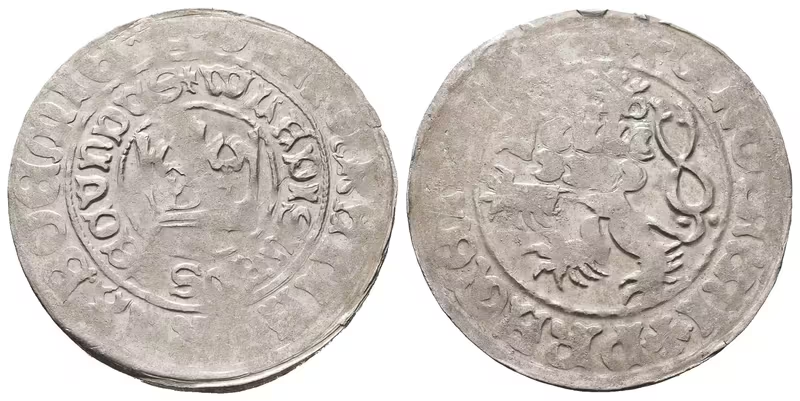
Vladislav II. Jagellonský, Pražský groš, Hásková I.a/7
Vladislav II. Jagellonský (1471 - 1516) Pražský groš, Hásková I.a/7, krásná zachovalost s ražebním leskem v plochách
Skladem 1 ks - Code: GN-B01A7.2
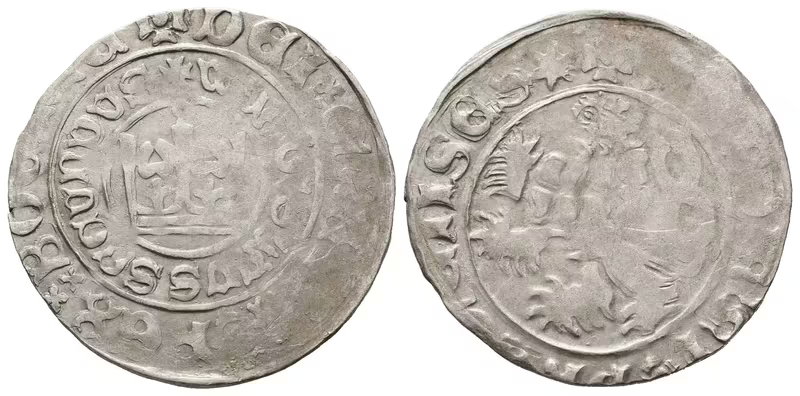
Vladislav II. Jagellonský, Pražský groš, Hásková I.a/7
Vladislav II. Jagellonský (1471 - 1516) Pražský groš, Hásková I.a/7
Skladem 1 ks - Code: GN-B01A3
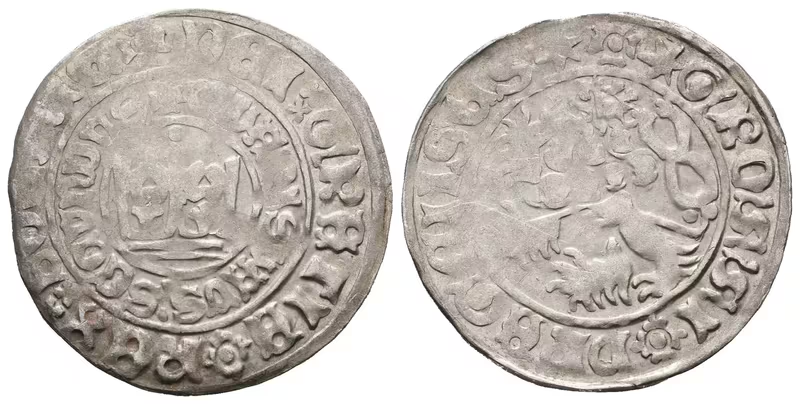
Vladislav II. Jagellonský, Pražský groš, Hásková I.a/3
Vladislav II. Jagellonský (1471 - 1516) Pražský groš, Hásková I.a/3, krásná zachovalost
- Code: GN-B01A8
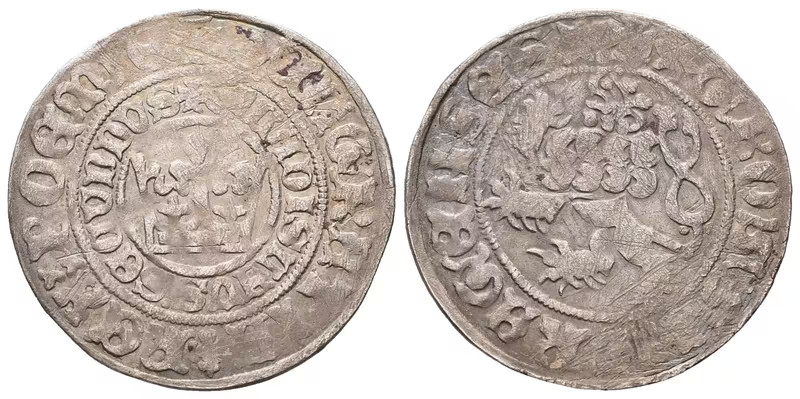
Vladislav II. Jagellonský, Pražský groš, Hásková I.a/8
Vladislav II. Jagellonský (1471 - 1516) Pražský groš, Hásková I.a/8 (2,71 g)