3 Kreuzer
The 3 kreuzer (three-kreuzer piece) is a small coin originally struck from silver, which spread markedly in the Czech lands particularly in the 17th–18th centuries. It belonged among the most-used kreuzer denominations and its form and weight changed according to monetary ordinances and the quality of the circulating coinage of the time.
The 3 kreuzer is a denomination which shows well how sensitively small circulating coinage adapted to monetary policy and the actual situation in the economy. In Austria three-kreuzer pieces were struck in larger quantities already from the middle of the 16th century, but in the Czech lands they assert themselves more markedly only at the beginning of the estates period. On our territory the 3 kreuzer was first struck on the basis of the coinage ordinance of the estates of 28 June 1619. Specific parameters were set for this denomination (the sources give a weight of 1.438 g), which was important for confidence in the currency: with a small coin it must be clear that the 'piece of silver' corresponds to the declared value.
The estate three-kreuzer pieces of the years 1619–1620 originated in several mints at once: Kutná Hora, Jáchymov, Brno, Olomouc and Wrocław are cited. The spread of striking over several centres indicates that this was a denomination intended for real circulation and in large quantities. By contrast, Frederick of the Palatinate (1619–1620) did not strike this denomination in the lands of the Bohemian Crown, so the three-kreuzer piece did not in his short period become a means by which the regime sought to quickly 'fill' the market.
Under the reign of Ferdinand II (1619–1637) the situation changes. The 3 kreuzer was struck in abundance in practically all government mints and strikings also appear in private mints – typically Wallenstein's mints in Jičín and Żagań are recalled. This is very interesting for collectors: the same designation of the denomination, but a different framework of striking (state versus private), often also different quality and variable supervision over compliance with the standard. The period of the so-called kipper coinage also reaches into this time, when debased strikings entered circulation. With the three-kreuzer piece in this stage a marked decline of weight to approximately 0.8–0.9 g is given. For circulation of the time this meant a problem: the denomination formally existed but its actual 'silver substance' was weaker, which undermines confidence and leads to price confusion.
After the monetary calming associated with the 'kaláda' of 1623, the weight of the three-kreuzer piece was again adjusted (a return to 1.6 g is cited). At the same time in this weight three-kreuzer pieces were struck in a great number of variants, which corresponds to the high number of dies used: with small circulating coinage it is typical that they wear out quickly, dies are changed more often and a number of small typological deviations arise. Under Ferdinand III (1637–1657) three-kreuzer pieces were struck in all government mints (with the cited exception of Brno), which confirms that the denomination remained a basic link of everyday payment traffic.
History
A further significant point was brought by the reform of Leopold I (1657–1705), who on 28 March 1659 adjusted the coinage system. In this adjustment the 3 kreuzer was to have a weight of 1.741 g and the denomination became one of the most numerously struck in the government mints of Bohemia, Moravia and Silesia. This line was followed also by Joseph I (1705–1711) and Charles VI (1711–1740), under whom three-kreuzer pieces were struck by all active government mints.
Under Maria Theresa (1740–1780) only a single mint in Prague was already operating in Bohemia, and it struck silver three-kreuzer pieces (the sources give a weight of 1.701 g) with the name of the ruler and her husband Francis I Stephen of Lorraine. The Prague striking was then continued also by Joseph II as co-ruler until 1779; in 1784 the Prague mint was temporarily closed. Its activity was renewed in 1795 by Francis II (1792–1835), and in the years 1799–1800 and 1812 copper three-kreuzer pieces in two types were also struck in Prague (weights of 17.07 g and 8.75 g are given). In the 1830s Prague again renewed the striking of silver three-kreuzer pieces (1833–1834; weight 1.68 g), in which Ferdinand V (1835–1848) also continued. The year 1848 (mintmaster F. Leitner) is recalled as the last three-kreuzer piece struck from silver.
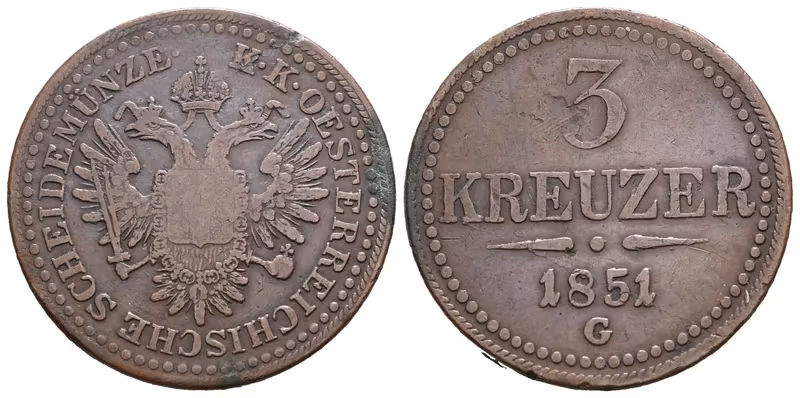
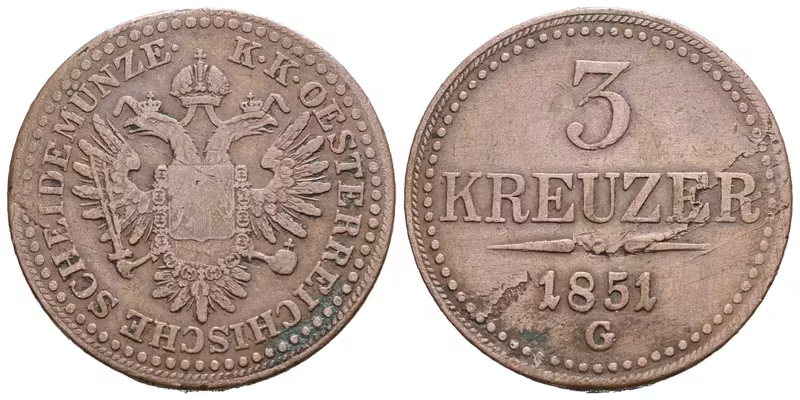
Francis Joseph I (1848–1916) by a decree of 7 April 1851 introduced the three-kreuzer piece again, but now in copper (16.4 g is cited). In Prague only one – and at the same time the last – year was struck, 1851 (mintmaster A. Franc), and it is usually rated as evidently a trial striking. From the 17th century, moreover, the name groschen (of the land or imperial) was also commonly used for the silver 3 kreuzer, which is good to bear in mind when reading contemporary texts and catalogues.
The 3 kreuzer is a typical 'working' denomination: a coin which in everyday life circulated in huge quantities and therefore had to be practical, legible and stable in value. It is precisely for this reason that the weight standard is so often addressed with it – a small coin cannot afford large deviations, otherwise distrust manifests itself immediately in circulation. In the Czech lands clear 'parametric milestones' appear in the sources: the estate norm of 1619 (1.438 g), the debasement in the time of the kipper coinage (approximately 0.8–0.9 g) and the return to more honest circulating coinage after 1623 (1.6 g). The reform of Leopold I then sets the three-kreuzer piece as a firm point in the system (1.741 g) and in the Theresian stage of Prague striking 1.701 g is cited. In the 19th century the return of silver (1.68 g) and the subsequent transition to copper with the last trial issues are important.
Parameters, circulation and collector points of interest
For collectors the three-kreuzer piece is attractive mainly thanks to the breadth of mints and the enormous number of variants. With early estate strikings a collection can be built by mint location (Kutná Hora, Jáchymov, Brno, Olomouc, Wrocław), with later periods then by rulers and reforms. Particularly captivating are strikings from private mints (for example Wallenstein's), because with them it is often important to verify the typological classification and the contemporary context – it is precisely in such strikings that differences in the quality of metal and in execution may manifest themselves more markedly. With crisis issues from the beginning of the 17th century, moreover, the 'collector value' is created not only by rarity but also by the story: the coin may be a direct document of monetary disruption and subsequent renewal.
In assessing a specific piece, state of preservation has great weight. With small silver, legends and fine details tend to be quickly worn, edges dented and the surface marked by long circulation. A natural patina is usually more prized than a lustre after aggressive cleaning, which can 'kill' the surface and reduce collector attractiveness. With later copper three-kreuzer pieces it is in turn important to watch for corrosion and unprofessional interventions, because copper easily changes colour and the surface may be damaged by cleaning or unsuitable storage.
The three-kreuzer piece is, in short, a coin which can connect the everyday with great history. In a collection it can function as a basic 'circulation' denomination of one epoch, but also as detailed study material for understanding monetary reforms, mint administration and the variable quality of circulating coinage in the crisis years of the 17th century.
In our auction and shop
- Code: MA012-1851G.1
3 Krejcar 1851 G
František Josef I. (1848 - 1916) 3 Krejcar 1851 G - Velká Baňa, Ves. 12, patina, oběhový stav
Skladem 1 ks - Code: MA012-1851G.2
3 Krejcar 1851 G
František Josef I. (1848 - 1916) 3 Krejcar 1851 G - Velká Baňa, Ves. 12, patina, vady střížku
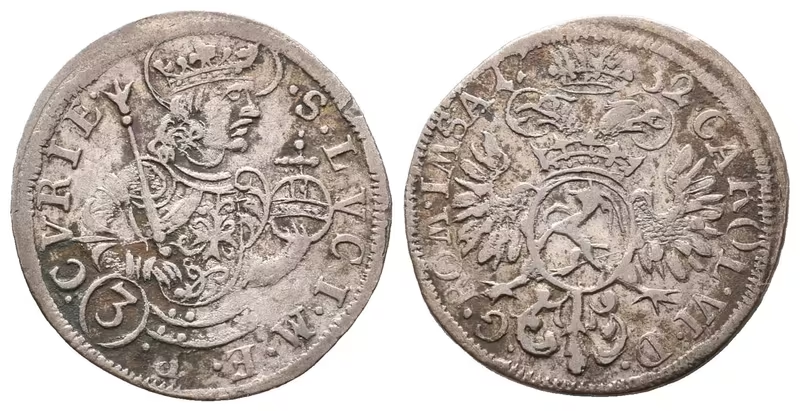
Skladem 1 ks - Code: SSVY-CHUR1732
Švýcarsko - Chur, 3 Krejcar 1732
Švýcarsko, město Chur 3 Kreuzer 1732 (Groš), s tit. císaře Karla VI., KM.271
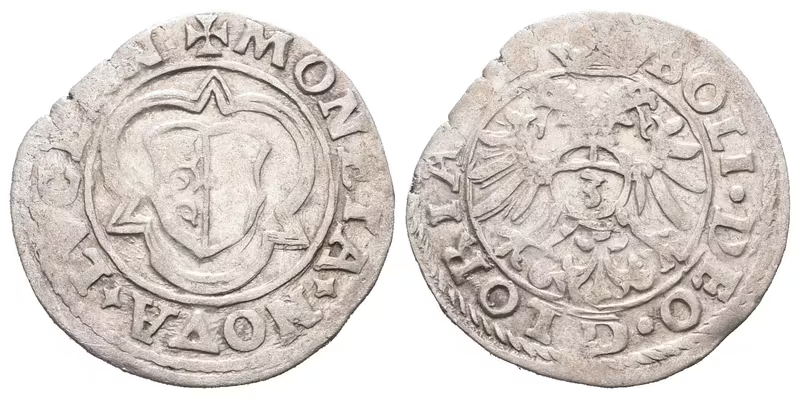
Skladem 1 ks - Code: SSVY-LUZ1586
Švýcarsko-Luzern, 3 Krejcar b.l.
Švýcarsko, Luzern 3 Krejcar b.l., KM.-, patina, koncový střížek
Skladem 1 ks