Abacus
The abacus is a counting aid that was used in Europe particularly during the Middle Ages and the early modern period for working with money and accounts. It took the form of a board or table with marked fields onto which counting pieces (tokens) were placed, allowing calculations to be carried out quickly.
The abacus is among the oldest tools that enabled people to count more reliably than merely "in their head" or on their fingers. The name itself derives from the Latin abacus (literally "table top") and in European practice it most often refers to the board abacus — a wooden or bone tablet with laid-out fields into which pebbles were moved or tokens were placed. In an environment where dozens of items in various currencies were counted daily and where sums were entered into account books, such an aid was essential: it speeded up the work and reduced errors.
In the Middle Ages and long thereafter, accounting relied on complex monetary systems with numerous denominations, conversions and local customs. For that reason the abacus became standard equipment for estate administrators, merchants and officials. In the offices of towns, noble estates and financial bureaux it was not unusual for part of the calculations first to be "set up" on the abacus before the result was transcribed into the books. The tool thus served as an intermediate step between actual cash and the written record.
The abacus had particular significance in the period when counting tokens spread across Europe — metal pieces intended not for payment but for counting. These tokens, often of brass or copper, were used much like today's "counting stones": they were moved along the board and represented values in different orders. In the 16th and 17th centuries, when administration and trade dealt with extensive accounts, abaci and tokens appear very frequently. They were not a luxury rarity but a practical instrument capable of handling a broad range of tasks — from simple addition to conversions between units or work with fractions.
History
The form of the board abacus was carefully considered. The fields or rows were usually divided according to orders (units, tens, hundreds, thousands and so on), and their arrangement corresponded to the decimal logic of counting at the time. Tokens were placed on the board and their number in individual fields produced the value with which one then worked "mechanically": adding, removing, shifting and converting. For the user this was clear, because the result was literally visible — and errors could be readily detected if the tokens did not "fit" into the correct orders.
Gradually the abacus receded from administrative use as written arithmetic methods spread and the teaching of arithmetic became standardised. Nevertheless it remains an important witness to how numbers and money were handled in the past. In the numismatic context it is valuable above all because it stands on the borderline between coin and non-coin: it uses metal objects similar to coins, but their purpose is purely accounting. It is precisely this boundary — when something looks like a coin yet serves as an aid — that is exceptionally interesting for collectors and historians alike.
The abacus in its board form functions as a "workspace" for calculations. The basis is a board or tablet with marked fields representing individual orders. Tokens (counting pieces) are placed in these fields and their arrangement corresponds to the sum currently being calculated. When adding, tokens are added; when subtracting, they are removed; for multiplication and division, repeated shifts and conversions between fields are used. If too many tokens "accumulate" in one field, part is converted into the higher order — similar to how today we "carry" the tens into the next column when summing.
Counting board, tokens and use in accounting
The advantage of the abacus is its clarity. The user did not have to keep the whole procedure in their head but could rely on the visual layout of the board. This was particularly useful for conversions between various currencies and denominations, which in the past often differed not only geographically but also over time. The abacus made it possible to work with large sums, perform check totals and rapidly verify whether the result matched expectations.
From a numismatic point of view the counting tokens themselves are especially important. They take the form of small metal discs, sometimes with a sign, inscription or ornament, but their purpose was not to pay — they served as a "carrier of value" only on the abacus. For that very reason they may survive in a great variety of types and variants, and they are sometimes mistaken for coins or medallions. In a well-kept collection an abacus and counting pieces can form an interesting addition: they show how reckoning was once done, what office practice looked like, and how closely accounting was bound up with the material culture of metal objects.
In our auction and shop
- Code: BE072-0290New
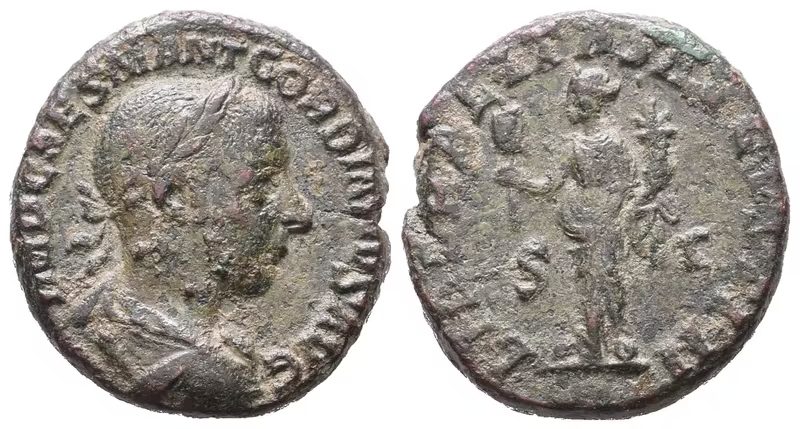
Gordian III., sestercius, Řím, RIC 290a
Gordian III. (238 - 244) mincovna Řím, raženo 239, stojící Liberalitas držící abacus a roh hojnosti, RIC 290a
Skladem 1 ks - Code: BE079-0120.2
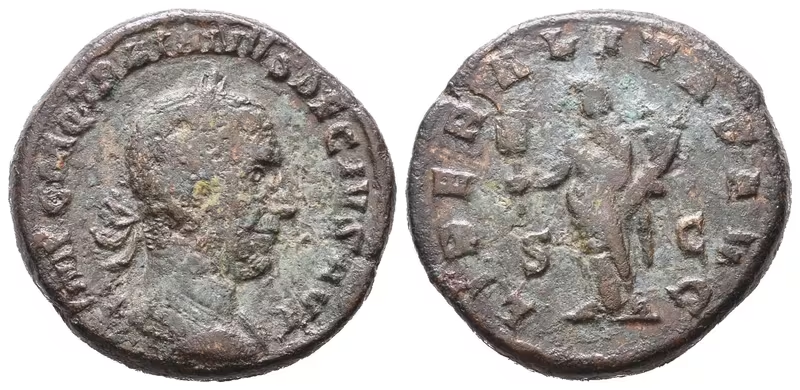
Decius, sestercius, Řím, RIC 120a
Trajan Decius (249 - 251) mincovna Řím, stojící Liberalitas držící abacus a roh hojnosti, RIC 120a
Skladem 1 ks - Code: BE074-0038B
Philippus I., Antoninian, RIC.38b
Philip I. Arab (244 - 249) Antoninian, 244 - 247, Roma, Rv: LIBERALITAS AVGG II, stojící Liberalitas zleva drží abacus a roh hojnosti, RIC.38b, RSC.87 krásná zachovalost, pěkně vyražený, patina, zbytky lesku, vady střížku (3,92 g)
Skladem 1 ks - Code: BE074-0038B.1
Philippus I., Antoninian, RIC.38b
Philip I. Arab (244 - 249) Antoninian, 244 - 247, Roma, Rv: LIBERALITAS AVGG II, stojící Liberalitas zleva drží abacus a roh hojnosti, RIC.38b, RSC.87 pěkná zachovalost, patina, pěkně vyražený, drobná vada střížku (4,80 g)
Skladem 1 ks