Alexander Bach
Alexander Bach (1813–1893) was an Austrian politician, longtime minister of the interior and the principal face of the centralised neo-absolutist regime after the revolutionary year 1848. From his name the concept of "Bach's absolutism" took hold, a period of strict state control, police and bureaucracy in the Habsburg Monarchy.
Alexander Bach was born in 1813 in Loosdorf in Lower Austria and studied law. He entered public life as a lawyer and deputy in the stormy period of the revolutions of 1848. He at first appeared rather as a supporter of moderate changes, but soon became one of the most visible representatives of the return to a firmly governed state. In the Habsburg Monarchy the revolutionary upheaval had opened questions of constitution, national rights and modern administration, but at the same time provoked fear of the disintegration of the multinational composite state. It was upon this fear that the policy of the following years was built — one that emphasised the unity of the empire, centralisation and the strengthening of executive power.
From 1849 Bach became minister of the interior and gradually acquired exceptional influence over the shape of the state. His policy is associated with the period in which the monarchy relied on the bureaucratic apparatus, police oversight and firm direction from the centre. Emphasis was placed on uniform regulations, linguistic and administrative standardisation, the strengthening of state administration in the provinces and the weakening of the political autonomy of the estates and of regional institutions. In practice this meant the extension of the administrative hierarchy, more consistent control of the press and of associational life, and an effort to forestall political mobilisation that might once again lead to unrest. In the Czech lands this era was reflected in tangible police oversight and in tensions between state power and part of the public, especially among educated strata and the national movement.
For this reason the term "Bach's absolutism" (or the "Bach system") came to be used for this phase. It is not absolutism in the traditional Baroque sense, but a more modern form of centralised administration that relied on documents, statistics, offices and security forces. At the same time, however, one cannot overlook the fact that certain modernising elements of the state were also developing in the same period: improvements in administrative procedures, an emphasis on infrastructure and on the predictability of governance. This "double" character of the age — harsh political control on the one hand and the advancing modernisation of administration on the other — is key to understanding Bach's role.
History
Bach's influence began to wane after the second half of the 1850s, when the monarchy came under pressure from foreign-policy failures and from internal needs for change. In 1859 he left the government and his system gradually loosened towards cautious constitutional experiments and the later return of parliamentary forms. Even so the name of Alexander Bach remained in political memory as a symbol of the period in which the Habsburg Monarchy attempted to "tighten the screws" and to govern a multinational state with a firm hand. In the Czech setting the term "Bach" became almost a shorthand for police oversight, censorship and bureaucratic severity, even though the real history of the period was more complex than a mere caricature of one man.
For numismatics and the history of money Bach's era is of interest chiefly indirectly: as a time of strong centralisation that was reflected in the direction of the economy, finances and state institutions. In practice this meant an effort towards greater uniformity and control, which also concerned areas where stability was key — that is, taxes, state revenues and the rules for the circulation of legal tender. In a multinational composite state, money moreover had a symbolic dimension: coins were a daily reminder of the sovereign and of state authority, and the state therefore tried to act in a trustworthy and predictable way.
In the 1850s, the transformation of monetary relations in the broader German and Central European area also continued. The monarchy sought a more stable framework for trade and payments, because industry, transport and the internal market were developing. In such a situation the importance grew of standardising denominations, of delimiting monetary relations more precisely and of simplifying accounting in practice. Although Alexander Bach was not a "coinage" specialist, his style of rule — a strong executive and an emphasis on uniform governance — created an environment in which such changes were more readily pushed through from above, without broader public political debate.
Bach's absolutism and links to the currency
For collectors of Habsburg strikes Bach's era most often overlaps with the periods of the reign of Franz Joseph I in his early phase, when coins and bank circulation became an ever more important part of the modern economy. From the point of view of interpretation, it is essential that coins from this period bear not only the value and the sovereign's portrait but also the "imprint" of the state style: an emphasis on the unity of the monarchy, on order and on centralised administration. The name of Alexander Bach therefore appears in numismatic texts as a political framework that helps to understand why in the middle of the 19th century the state placed such emphasis on control, stability and uniform rules.
In our auction and shop
- Code: BE062-0601Recommended
Alexander Severus, Dupondius, Ric. 601
Alexander Severus (222 - 235) Dupondius, 222 - 231, Rv: RESTITVTOR MON S C, stojící císař zleva drží žezlo, pozvedá pravou ruku, RIC.601
Skladem 1 ks - Code: BE062-0642Recommended
Alexander Severus, Sestercius, RIC.642
Alexander Severus (222 - 235) Sestercius, 231 - 235, Rv: PROVIDENTIA AVG S C, stojící Providentia čelně drží dva klasy nad modiem a roh hojnosti, RIC.642
Skladem 1 ks - Code: BE062-0040.2
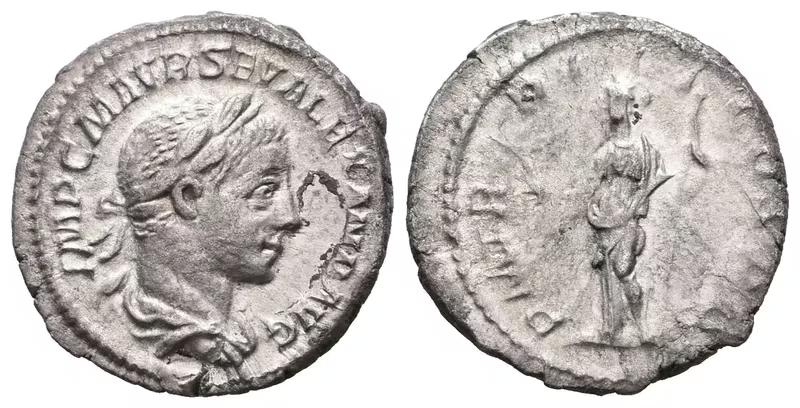
Severus Alexander, denár, Řím, RIC 40
Severus Alexander (222 - 235) mincovna Řím, raženo 224, stojící Pax s ratolestí a dlouhou holí, RIC 40
Skladem 1 ks - Code: BE062-0141.1
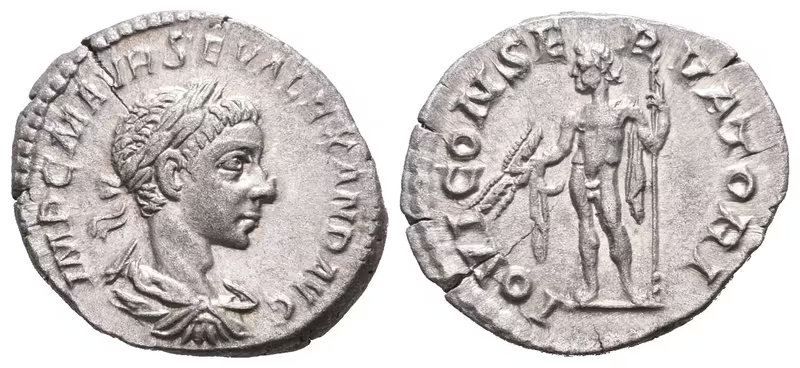
Severus Alexander, denár, Řím, RIC 141
Severus Alexander (222 - 235) mincovna Řím, Jupiter s bleskem a kopím, IOVI CONSERVATORI, RIC 141
Skladem 1 ks