Amberg
Amberg is a historic town in the Upper Palatinate (Bavaria) which during the Middle Ages and the early modern period became known for iron mining and processing as well as for minting. Thanks to its position on trade routes and nearby ore deposits, Amberg ranked among the economically most important towns of the region.
Amberg is first documented in writing in the 11th century and already in the High Middle Ages it became an important urban centre of north-eastern Bavaria. A key role was played by its position on the Vils river and above all by the economic hinterland of the Upper Palatinate, which was for centuries linked with iron-ore mining, charcoal burning and iron production. The surroundings of Amberg in particular belonged to areas with a marked concentration of deposits and with a backdrop of forests that supplied charcoal for the smelters and hammer mills. The town was thus not only an administrative and commercial hub, but also a place where iron was transformed into goods — from semi-finished products to wares destined for more distant markets.
Politically, during the Middle Ages Amberg found itself in a space where the interests of various branches of the House of Wittelsbach intersected. In 1329 the Upper Palatinate passed to the Palatine branch of the Wittelsbachs and Amberg gradually became one of the most important towns of the region. In the late Middle Ages and the 16th century the town profited from the iron trade and the related crafts, which was reflected in its urban and social development. Its prosperity was reinforced by the fact that, in an era of expanding monetary economy, a stable supply of metals and a functioning market were important for both the ruler and the urban elites.
Amberg's history was also significantly affected by the religious and political transformation of the 16th and 17th centuries. The Upper Palatinate at one point leaned towards the Reformation, but during the Thirty Years' War it later passed under Bavarian rule and the forced re-Catholicisation led to the departure of part of the population. These upheavals affected not only society but also the economy: commercial ties, administration and the conditions for production and finance all changed. Even so, Amberg remained an important regional centre and its economic tradition rested on the long-standing strong mining backdrop of the Upper Palatinate.
History
In a wider historical arc, Amberg can be understood as a town in which the interconnection of raw materials, crafts, trade and state power is clearly visible. Where wealth and the flow of goods concentrated, it was natural to consider minting activities as well — that is, how economic life is "translated" into coins which circulate among people while at the same time bearing the mark of the authority that stands behind their value.
Amberg is described as a mining and minting town because iron ore was extracted in its hinterland for many centuries and the region ranked among the most important "iron" areas of Central Europe. Mining was followed by a network of hammer mills, smelters and crafts that ensured processing and trade. Such an environment naturally supported the development of municipal institutions, markets and financial needs — from wages paid to the workforce to long-distance trade, which required reliable coins and exchange relations.
From a numismatic point of view it is important that Amberg had its own minting activity which changed in different periods according to the political situation and monetary needs. For collectors, municipal or regional mints are interesting because they often produced coins in connection with the wider monetary system of the empire and neighbouring lands while at the same time carrying local marks, mint-master signs or characteristic abbreviations and lettering styles. It is precisely these details that are often decisive in identification: for older strikes the legibility of legends and marks is what matters, while for later ones it is the combination of year of issue, mint mark and state of preservation.
Mining, minting and collector context
Amberg also appears in the numismatic "story of circulation": as a town connected with trade and production it was a place where coins from various regions met. It is therefore appealing for collectors to follow Amberg not only as the origin of coins but also as a node through which money passed — and where the economic prosperity of the region was reflected in the quantity and variety of currency in circulation. Those who focus on Central European strikes can perceive Amberg as one of the gateways of the Upper Palatinate: a landscape where it was long decided which metal, which goods and which coins would actually be "in circulation" in the region.
In our auction and shop
- Code: GF-BK004
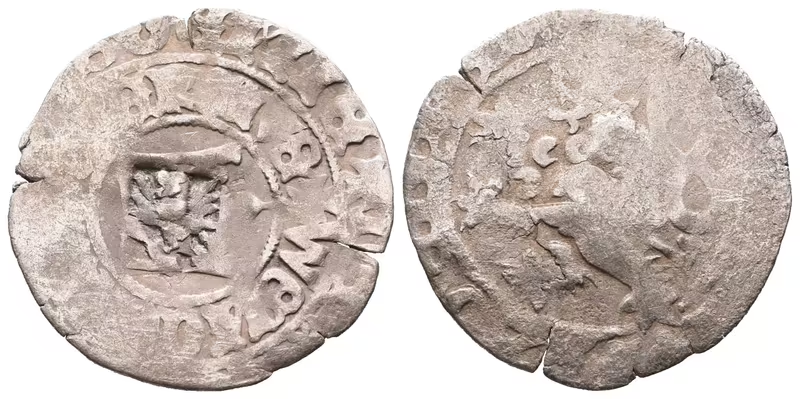
Václav IV., Pražský groš s kontramarkou Amberg
Václav IV. (1378 - 1419) Pražský groš s kontramarkou města Amberg, Smolík 4, Krusy A 3,5
Skladem 1 ks - Code: NABAV-G1774A
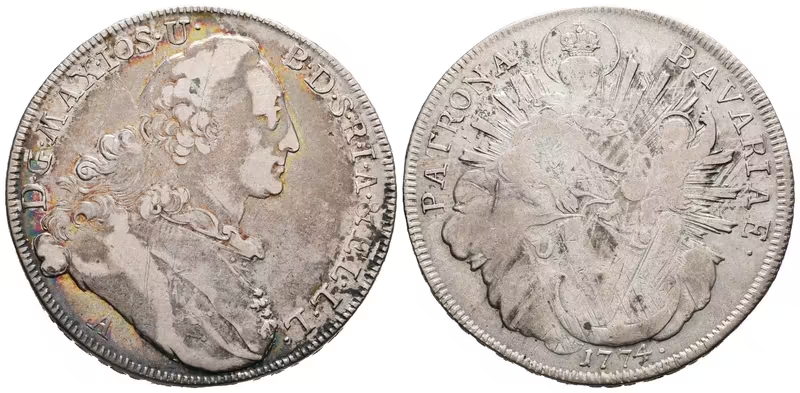
Bavorsko, Tolar 1774 A, Amberg
Bavorsko (Bayern), Maximilian III. Josef (1745 - 1777) Tolar 1774 A, Amberg - madona, KM.234.2, pěkná zachovalost, patina, just.
Skladem 1 ks - Code: NABAV-G1773A
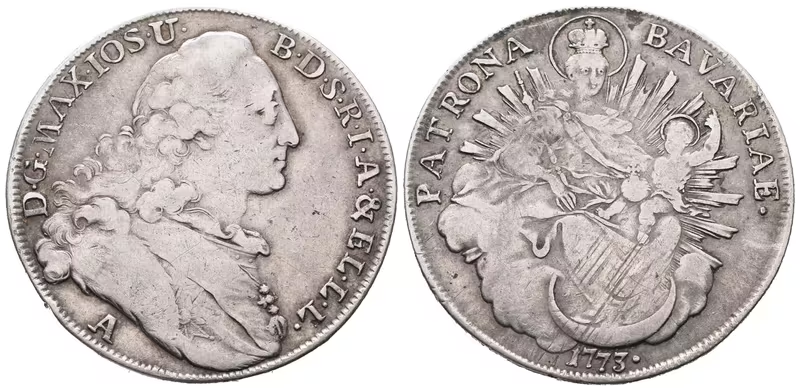
Bavorsko, Tolar 1773 A, Amberg
Bavorsko (Bayern), Maximilian III. Josef (1745 - 1777) Tolar 1773 A, Amberg - madona, KM.234.2, pěkná zachovalost, patina, just.