Andorra
Andorra is a small principality in the Pyrenees between France and Spain, known for its long tradition of self-government and a specific state arrangement with two co-princes. Although it is one of the smallest countries in Europe, it has an interesting history and has made a marked mark in numismatics through modern euro coins and collector issues.
Andorra lies in a mountain valley that was for centuries naturally protected and at the same time only marginally passable, which was reflected in its development. In the Middle Ages it was an area contested by local secular and ecclesiastical authorities. It is precisely from these disputes that the unusual political model typical of Andorra to this day was born: the country had two supreme rulers whose rights balanced one another so as to prevent it from being dominated by a single strong player.
Over time it became established that the co-princes were on one side the French monarch (later the President of France) and on the other the Bishop of Urgell in Spain. This dual suzerainty framework gave Andorra a certain protection and stability, because it was "covered" by the influence of two neighbouring powers without becoming fully part of them. At the same time, however, Andorra maintained its own institutions of local administration and laws that regulated the everyday life of its inhabitants.
For centuries Andorra was above all a country of shepherds, smallholder agriculture and mountain crafts. Life in the Pyrenees was hard and economic possibilities limited, which supported emphasis on communal rules and on managing resources and land sustainably. The modern transformation came only in the 20th century, when transport improved, tourism began to develop and Andorra exploited its position and tax environment to develop services and trade. From an originally poor mountain area it thus became a prosperous micro-principality with a high standard of living.
History
Politically Andorra gradually modernised and strengthened its own statehood. Today's form of the state rests on constitutional principles that define the powers of domestic institutions and the role of the co-princes. The result is a model unique in Europe: Andorra is an independent state but at the same time maintains the historical form of a dual head of state, which has a more representative and balancing character. Thanks to this Andorra is often cited as an example of how even a very small state can sustain itself between larger neighbours over the centuries if it has clearly set rules and can pragmatically adapt them to the times.
For numismatics Andorra is interesting mainly because today it uses the euro and issues its own Andorran euro coins. For small states the possibility of striking the national side of euro coins is significant: although it is a common currency, it is precisely the motifs on the reverse that express the country's identity and make ordinary currency a collector-attractive item. For Andorran euro coins, what appeals to collectors is the combination of small mintage, distinct national symbolism and the fact that the country itself is touristically and culturally "exotic" within Europe.
Alongside the euro coins Andorra also appears in a wider collector context as a micro-principality that long functioned on the boundary of the monetary and trading influences of France and Spain. In everyday life the currencies of the surrounding states were historically used here, which is interesting for collectors as an example of how currency naturally mixes in small countries according to trade ties. The modern numismatic appeal of Andorra, however, rests above all on the fact that its coins combine a European standard with a local story.
Currency, euro coins and collector significance
When collecting Andorran euro coins, what matters above all is condition (for circulation pieces coins without dents and scratches tend to be more valuable) and for collector packagings the completeness and intactness of the original packaging. For collectors of the "eurozone" Andorra is a favourite target, because it makes it possible to supplement a collection with strikes from a small country which in circulation are not as common as the coins of large states.
In our auction and shop
- Code: SAND-C1994
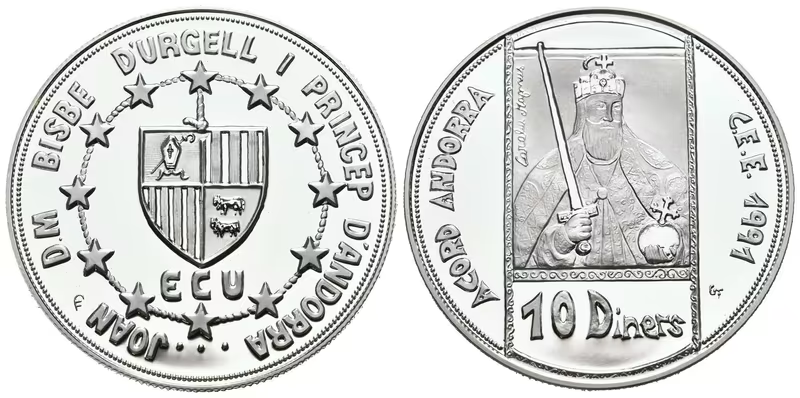
Andorra, 10 Diners 1994 - Karel Veliký, ECU série, heraldika
Andorrské knížectví 10 Diners 1994 - Karel Veliký, ECU série, heraldika, KM# 98 Ag (.925), 38 mm (31,8 g), v kapsli. Stav mince odpovídá fotografii.
- Code: SAND-C1992
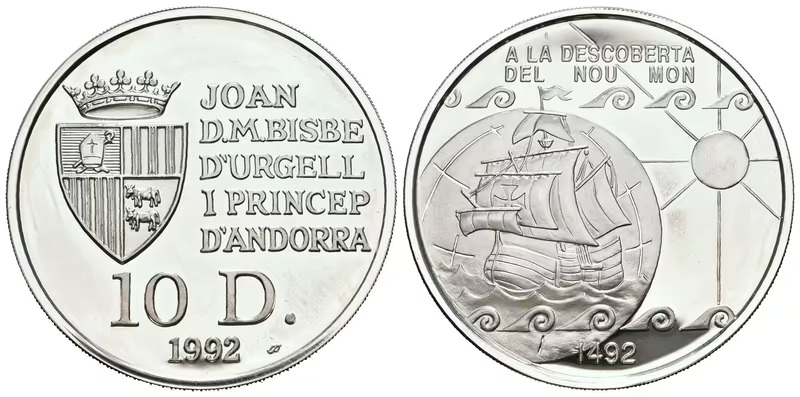
Andorra, 10 Diners 1992 - Objevení Nového světa - Kolumbova plachetnice Santa María, 500. výročí
Andorrské knížectví 10 Diners 1992 - Objevení Nového světa - Kolumbova plachetnice Santa María, 500. výročí, KM# 98 Ag (.925), 38 mm (31,47 g), v kapsli. Stav mince odpovídá fotografii.
- Code: SAND-C1996
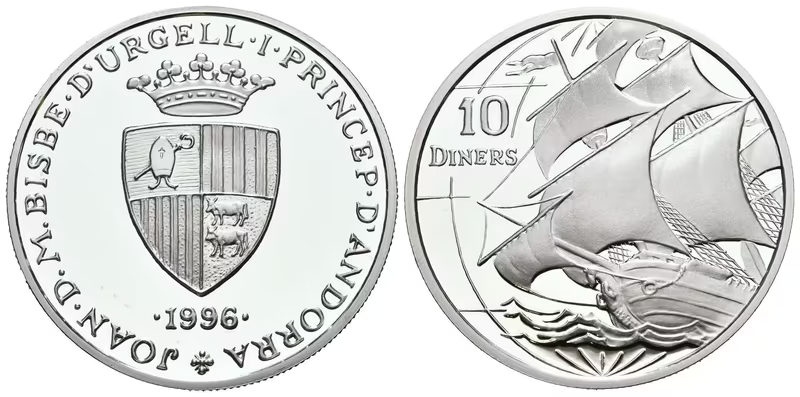
Andorra, 10 Diners 1996 - Plachetnice - karavela
Andorrské knížectví 10 Diners 1996 - Plachetnice - karavela Ag (.925), 38 mm (31,47 g), v kapsli. Stav mince odpovídá fotografii.
- Code: SAND-D2009
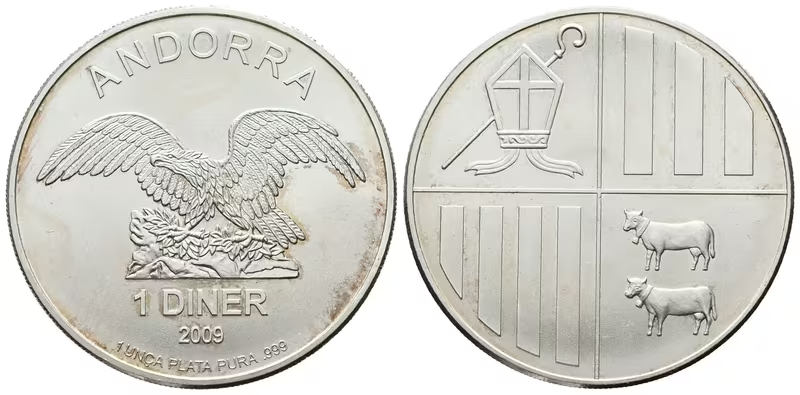
Andorra, 1 Diner 2009 - Orel zlatý, andorrský státní znak
Andorrské knížectví 1 Diner 2009 - Orel zlatý, andorrský státní znak Ag (.999), 38 mm (31,1 g), BU, v kapsli. Stav mince odpovídá fotografii.