Andrew Carnegie
Andrew Carnegie was a Scottish-American industrialist and philanthropist who made his fortune in steelmaking and became one of the most influential patrons of the late 19th and early 20th century. He became famous for the view that a great fortune should be used for the benefit of the public, especially for education and culture.
Andrew Carnegie (1835–1919) was born in the Scottish town of Dunfermline into the family of a weaver, which in the period of industrial change found itself in a difficult situation. When he was still a boy, the family emigrated to the United States and settled in Pennsylvania. Carnegie began in working-class trades, but gradually, thanks to his ability to learn and seize opportunities, he made his way into the environment of telegraphs and railways — the very sectors that were then shaping modern America. Work in communications and transport gave him experience with organisation, with investment and with how rapidly an economy can change when new technologies enter it.
In the second half of the 19th century the centre of American industry shifted to heavy engineering and steel. Carnegie understood that steel would be key for railways, bridges, ships and the building of cities, and he began to build his own enterprise. He asserted himself as a tough but exceptionally effective entrepreneur: he invested in modern processes, concentrated production in large works and rigorously watched costs. His ability to organise capital and logistics — from raw materials through transport to sales — was also essential. He gradually built up Carnegie Steel, one of the most powerful industrial companies of its time, and became a symbol of the era when the USA was becoming an industrial giant.
Carnegie's name, however, is also associated with the darker side of industrial ascent, especially with social conflicts between employers and workers. At a time when working conditions and wages were becoming political topics, strikes and violent clashes took place. Carnegie himself liked to present himself as a man who supported education and progress, but in practice his enterprises functioned according to the harsh logic of the time: performance, discipline and pressure on costs. It is precisely this tension — between the image of the patron and the reality of industrial relations — that ranks among the most discussed aspects of his legacy.
History
The greatest turning point came at the beginning of the 20th century, when Carnegie decided to retire from active business. In 1901 he sold his steel empire to the financier John Pierpont Morgan; the deal led to the creation of U.S. Steel, the first truly enormous industrial concern. By this Carnegie became one of the richest people in the world, but what is important is that from that moment on he concentrated his energy primarily on philanthropy. His approach was not just spontaneous charity: it stemmed from the conviction that a rich person has a moral duty to return part of their fortune to society in a way that helps people "help themselves".
Carnegie financed the creation of thousands of public libraries, supported universities, science and cultural institutions. He founded trusts that were to function over the long term and focused on projects he considered systemic — education, accessibility of knowledge, support for talent. In the USA and in the United Kingdom buildings and institutions bearing his name arose, which still today recall his ambition to link private wealth with public benefit. He died in 1919, at a time when the world after the First World War was rapidly changing, and his legacy became part of the wider debate about the role of large capital in modern society.
Andrew Carnegie is often cited as a typical representative of the "Gilded Age": a time when rapid industrial growth created huge private fortunes and at the same time deepened social differences. His philanthropy therefore provokes two different interpretations. One emphasises that he invested in education and culture on a large scale and helped make books and knowledge available to millions of people. The other recalls that such wealth arose in a system that was often harsh towards workers, and that patronage cannot fully balance the social conflicts of the industrial age. It is precisely this ambiguity that is important in his story: it shows how closely progress, power and responsibility can be intertwined.
Philanthropy, legacy and collector context
Carnegie's legacy is today evident on the map of cities and institutions: libraries, concert halls, university departments and trusts bear his name as a reminder that he understood education as a path to social advancement. From a practical point of view it is interesting that his philanthropy was not focused only on "one-off gifts" but on building infrastructure — buildings, funds and organisations that can function long after the founder's death. In this he differed from many donors of his time, who supported rather representative projects without long-term management.
In the collector world the name Carnegie may appear indirectly. At the turn of the 19th and 20th centuries commemorative medals, badges and various metal mementos developed in connection with public buildings, the opening of libraries and institutional anniversaries. Such items need not be "coins" in the strict sense, but they belong to the field of collecting metal mementos and document how public prestige and philanthropy were reflected in material culture. With such pieces it is important to follow provenance and period origin, because later replicas may be visually similar but have an entirely different collector value.
Carnegie thus remains an example of a man who managed to link industrial success with the ambition to change society. Whether his image is perceived critically or admiringly, he belongs among the figures for whom the "story of money" is also a story of ideas: what wealth is supposed to mean and what trace it can leave behind.
In our auction and shop
- Code: RX-USA-007
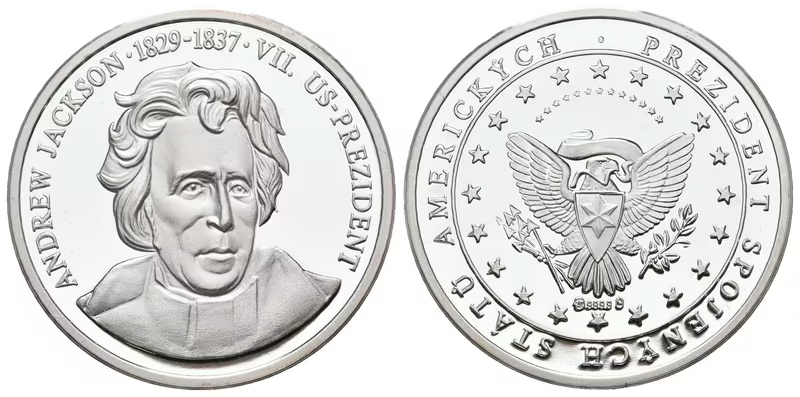
USA, medaile - Andrew Jackson, 7. prezident USA
Soukromá ražba - série Prezidenti USA Medaile - Andrew Jackson, 7. prezident USA Ag (.9999), 30 mm (8,5 g), v kapsli. Stav mince odpovídá fotografii. Jedná se o druhotný prodej. (Možná oxidace, atd.. ! - VIZ FOTOGRAFIE !)
Skladem 1 ks - Code: RX-USA-006
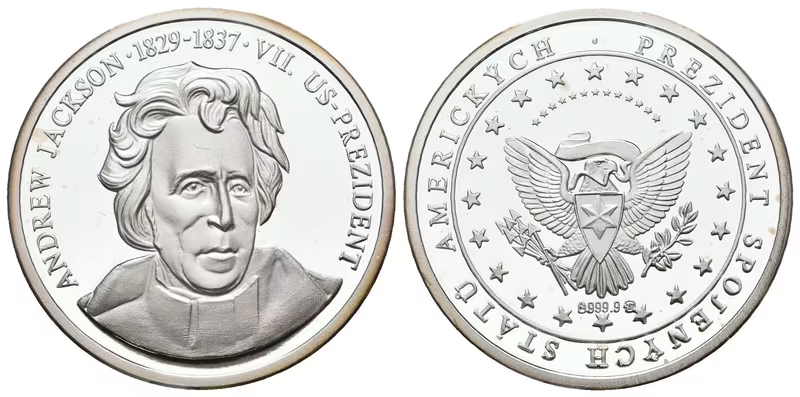
USA, medaile - Andrew Jackson, 7. prezident USA, státní znak USA
Soukromá ražba - série Prezidenti USA Medaile - Andrew Jackson, 7. prezident USA, státní znak USA Ag (.9999), 30 mm (8,4 g), v kapsli. Stav mince odpovídá fotografii.