Augustus (title)
Augustus is the honorific Latin title meaning "venerable" or "sacredly honoured", which the Senate conferred on Octavianus in 27 BC and which thereafter became part of the titulature of the Roman emperors. On coins it appears most often in the form AVGVSTVS or in the abbreviations AVG.
The word augustus had a strong religious and social resonance in the Roman environment. It was not merely a "courteous" form of address but an expression suggesting exceptional dignity and authority. When the Senate conferred this title on Octavianus in 27 BC, a new type of political language arose: outwardly, the ruler avoided the designation of king, but he gained a title that symbolically raised him above other citizens. This opened the way for an imperial regime in which power rested not only on the army and offices but also on carefully constructed legitimacy.
In the following centuries Augustus became a standard part of imperial titulature. In Roman practice it was often joined with the title Caesar, and later also with the distinction between a "higher" and a "lower" ruler in periods of multiple emperors: in some periods Augustus was the title for the chief emperor, while Caesar designated a co-ruler or successor. Although the specific meaning of the titles shifted over time, their common denominator was their role in propaganda: a title on a coin said that the issuer was a legitimate ruler whose authority was recognised throughout the empire.
History
For numismatics it is exceptionally important how the title was written. On coins, classical Latin epigraphy was used, in which U and V were often not distinguished — and so we read AVGVSTVS, even though we pronounce "Augustus". At the same time abbreviations were common, since space on the flan was limited: one encounters shortened forms such as AVG, and sometimes longer abbreviations within the whole titulature. It is precisely the ability to read these abbreviations that is the basic skill in identifying Roman coins, because the titulature often allows the coin to be attributed to a specific ruler and sometimes even to a narrower time range.
The influence of the title reached beyond the borders of ancient Rome. In the later European environment Latin titulature became part of royal representation, and the Roman tradition functioned as a source of prestige. This is particularly evident with the Holy Roman Emperors, whose Latin titles on coins and in documents often contain the word Augustus or the established phrase Semper Augustus. In the Czech setting this element is sometimes traditionally interpreted as "ever augmenter of the empire", which shows how the old Roman title was reshaped into the medieval understanding of the ruler's role. For collectors Augustus is therefore not merely a "word from a legend" but also a key to understanding why rulers for centuries claimed kinship with the Roman heritage.
How the title appears on coins
On Roman coins the title is most often found in the form AVGVSTVS or in abbreviations linked to a whole chain of titles (for instance to the designation of the chief priest, the holder of tribunician power or "father of the homeland"). In practice this means that a single coin may have several abbreviations on both obverse and reverse, and reading them correctly is essential for identification. With later emperors, the title may appear in the plural (during joint rule) or in combination with other names.
With the coins of medieval and early modern emperors of the Holy Roman Empire, the "Augustan" element of the titulature is often part of long legends. It may be given in full, or abbreviated as AVG, or as part of an established formula. When reading one must reckon with the period's graphic shorthand, ligatures, and the fact that the letters U and V are written uniformly. For collectors it is therefore useful to have to hand a table of the most common abbreviations and to learn to distinguish when this concerns the title Augustus and when a part of another word. The correct reading of a legend often decides whether the coin is attributed only in general terms or precisely — and thereby its collector and historical value.
In our auction and shop
- Code: XA-RIC01
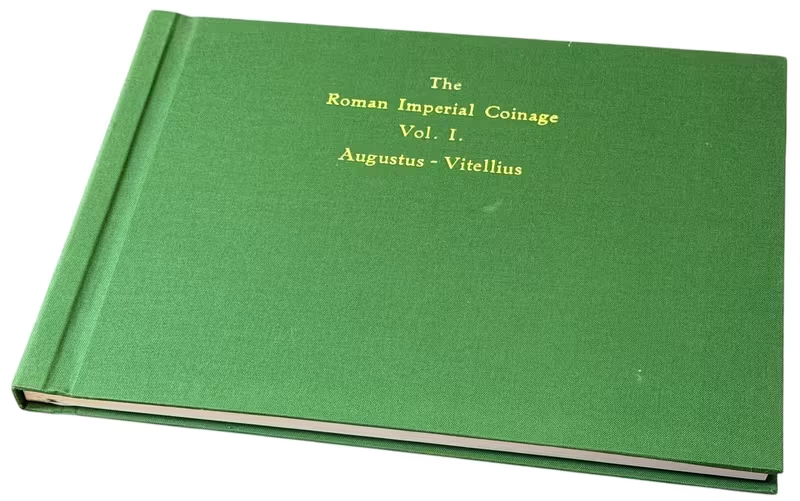
Roman Imperial Coinage Vol. I.
Sutherland, C. H. V. The Roman Imperial Coinage (RIC): Volume I. - Augustus - Vitelius (31 BC - 69 AD) Katalog mincí a medailí římského císařství. Popis jednotlivých mincoven včetně variant. Londýn 1984 (Reprint), 304 stran a 32 tabulek s vyobrazeními,…
Skladem 1 ks - Code: BE002-1711
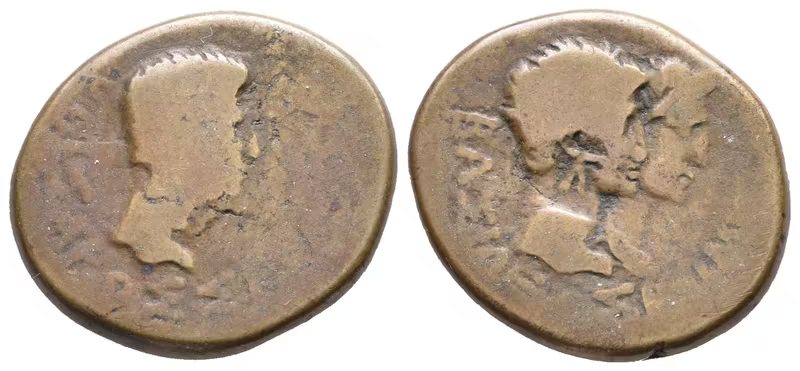
Augustus, Thrakia, AE 23
Augustus (27 př. Kr. - 14 po Kr.) Thrakia, Rhometalkos I., AE 23, 11 př. Kr. - 12 n.l., Busta Rhoemetalka a Pythodoris zprava, opis / Busta Augusta zprava, opis. RPC 711, SNG Copenhagen 1188-9, ned., na Av. kontramarka, patina
- Code: BE002-0056
Augustus, Dupondius, RIC. 56
Augustus (27 př. Kr. - 14 po Kr.) Dupondius, Rv: CONSENSV SENAT ET EQ ORDIN P Q R, sedící Augustus (?) zleva na kurulském křesle drží větvičku, posmrtná ražba za Caliguly, RIC.56 (Gaius), zelená patina
- Code: XA-RSC01
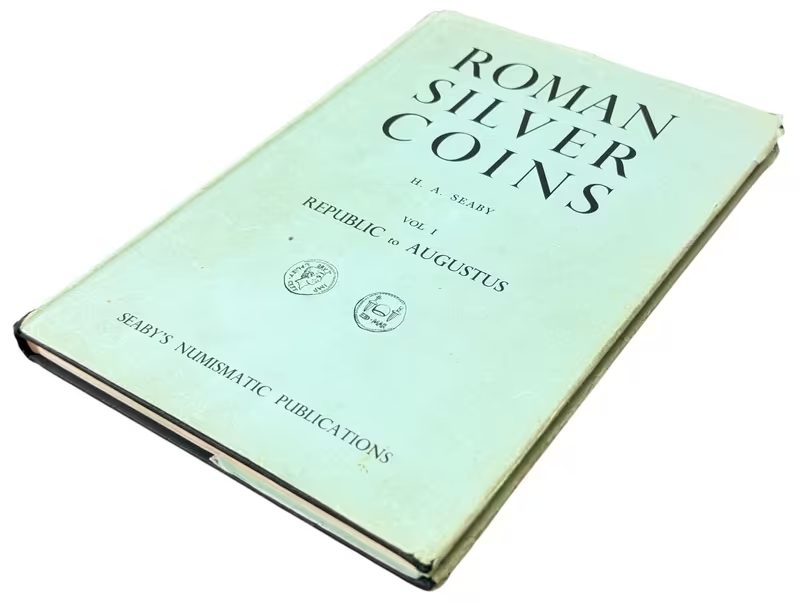
Roman Silver Coins I.
Seaby, H. A. Roman Silver Coins (RSC), Volume III., Republika - Augustus Katalog mincí a medailí pozdní římské republiky a ranného římského císařství. Popis jednotlivých mincoven včetně variant. Londýn 1952, 138 stran a vyobrazení, vázané, papírový…