Christian II of Saxony
Christian II of Saxony (1583-1611) was Elector of Saxony reigning from 1591 to 1611, eldest son of Elector Christian I of Saxony, who ascended the throne as an eight-year-old child after the death of his father and ruled during the critical period of rising confessional tensions preceding the Thirty Years' War. Christian II is important in numismatics for…
Christian II was born on 23 September 1583 in Dresden as the eldest son of Elector Christian I of Saxony and Sophia of Brandenburg. After his father Christian I's death in 1591 he inherited the electoral title at the age of only eight. Because of his minority, the administration of Saxony was taken over by a regency council led by his mother Sophia of Brandenburg and the Saxon councillors, who continued the Protestant policy of the previous electors.
The regency (1591-1601) was characterised by the continuation of Lutheran orthodoxy and a cautious policy towards the rising confessional tensions in the Holy Roman Empire. Saxony maintained its position as leader of the Protestant electors but avoided open confrontation with Emperor Rudolf II. The regency council took care to preserve the Peace of Augsburg and coordinated with other Protestant princes.
Personal rule began in 1601, when the eighteen-year-old Christian assumed full power. He continued the Protestant tradition of his predecessors and supported the University of Wittenberg as a centre of Lutheran theology. The Elector proved to be a capable but cautious ruler who sought to avoid conflicts and to maintain Saxon prosperity through trade and diplomacy.
Marriage to Hedwig of Denmark in 1602 strengthened ties with Lutheran Denmark and the Scandinavian countries. This alliance was strategically important due to the rising Catholic offensive in the German lands and the need for Protestant solidarity. Hedwig brought a considerable dowry and diplomatic contacts that strengthened Saxony's position in northern Europe.
History
The economic policy of Christian II continued the tradition of supporting mining and crafts. The Saxon silver mines in the Ore Mountains achieved high production, which made possible the mintage of quality coins and the financing of electoral policy. Christian also supported the textile industry and trade with Poland, thereby strengthening the economic foundations of Saxon power.
Imperial policy became more complex during the Donauwörth incident of 1607 and the rising tensions between the Catholic League and the Protestant Union. Christian sought to keep Saxony out of these conflicts, but his Protestant conviction gradually pushed him into opposition to imperial policy. The Elector supported deliberations on a Protestant union but did not formally join it.
The sudden death of Christian II on 23 June 1611 at the age of 27 struck Saxony at a critical moment of rising pre-war tensions. The Elector left only minor sons, which led to another regency at a time when the Protestant princes needed strong leadership. Administration was taken over by his brother Johann Georg I, who later led Saxony during the Thirty Years' War.
Christian's reign represented the last peaceful period before the catastrophe of the Thirty Years' War. His cautious policy and effort at compromise contrasted with the radicalising confessional conflict, but perhaps prolonged peace by several years. His death weakened the Protestant party at the time of critical negotiations about the future of the Holy Roman Empire.
In our auction and shop
- Code: NASAS52-A1592
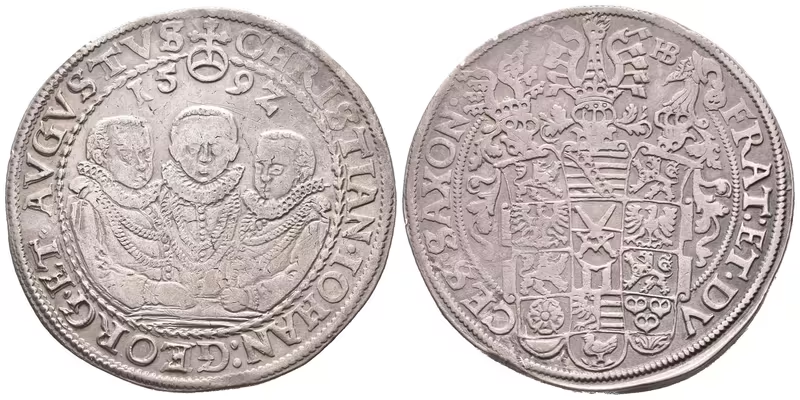
Sasko, Tolar 1592
Sachsen, Christian II., Johann Georg I. a August (1591 - 1611) Tolar 1592 HB, Dresden (28,57 g), Keilitz/Kahnt 185, Dav. 9820, tmavá patina, škr. jinak pěkná zachovalost
- Code: NASAS52-A1594
Sasko, Tolar 1594
Sachsen, Christian II., Johann Georg I. a August (1591 - 1611) Tolar 1594 HB, Dresden (28,97 g), Keilitz/Kahnt 185, Dav. 9820, pěkná zachovalost, patina, vady střížku
- Code: NASAS52-A1595
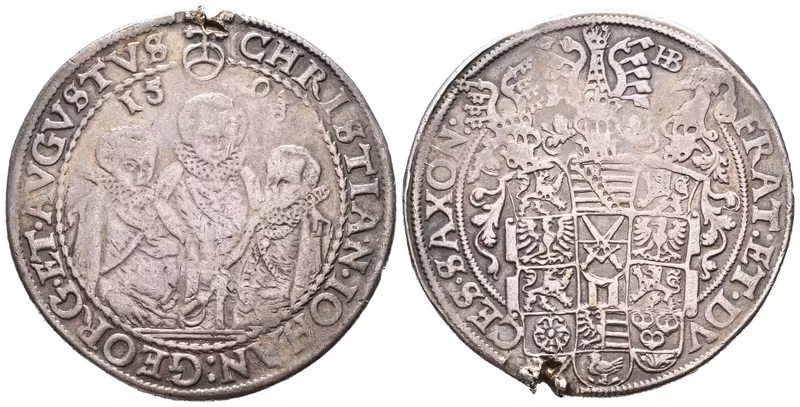
Sasko, Tolar 1595
Sachsen, Christian II., Johann Georg I. a August (1591 - 1611) Tolar 1595(3?) HB, Dresden (28,23 g), Keilitz/Kahnt 185, Dav. 9820, tmavá patina, čištěn, poškozená hrana, m.o.
- Code: NASAS52-A1598
Sasko, Tolar 1598
Sachsen, Christian II., Johann Georg I. a August (1591 - 1611) Tolar 1598 HB, Dresden (29,15 g), Keilitz/Kahnt 185, Dav. 9820, zbytky lesku, oxidace, pěkný Rv. s leskem