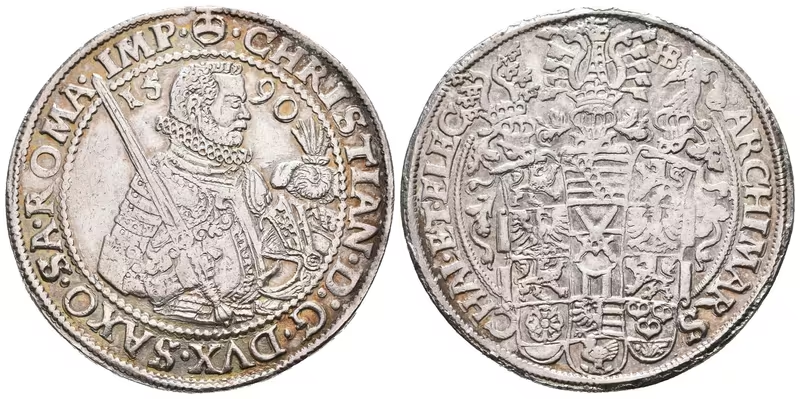
Christian I of Saxony
Christian I of Saxony (1560-1591) was the Albertine Elector of Saxony, who ruled from 1586 to 1591. His short reign falls at the close of the 16th century and entered the history books through his efforts to strengthen court representation and the financing of the state; for collectors he is interesting as the issuer of Saxon silver strikes.
Christian I of Saxony was born in 1560 in Dresden as the son of Elector August I of Saxony and Anne of Denmark. Within the Holy Roman Empire Saxony belonged among the most important Protestant lands, and its court in Dresden had the reputation of a well-administered and economically strong country. Christian grew up in an environment that placed emphasis on education, on the administration of the country and also on representation - that is, on the Elector acting as one of the key players in imperial politics. When he ascended the electoral throne after his father's death in 1586, he took over a system of state finance and administration that was in many respects stable, but at the same time sensitive to costly court operations and to the political ambitions that intensified in the Empire at the close of the 16th century.
Christian's reign is usually rated as short but marked by a change of style of government. While August I was known rather for an economical and disciplined approach to administration, Christian relied more on court circles and strengthened representation - and thereby expenditure. In Saxony's politics this was a time when tension between the confessional blocs was again increasing and the electoral court had to balance carefully its relations with other Protestant princes and with imperial power. Alongside that, internal matters also played a role: the administration of the country, the collection of taxes, the financing of military obligations and maintaining confidence in the monetary circulation, which was crucial for the developed Saxon economy.
History
The Elector died in 1591, before reaching the age of thirty-one, and left a minor successor, Christian II of Saxony. The subsequent period of regency is important for the history of Saxony because in it the need for stability clearly showed itself: continuity of administration, cohesion of the estates and also an intelligible monetary policy so that the country would remain a trustworthy partner in trade. It is precisely at the turn of the 16th and 17th centuries that monetary conditions in central Europe began gradually to grow more complicated, and for many countries it was increasingly difficult to maintain the uniform quality of small coins in everyday circulation.
Under Christian I of Saxony, Saxony continued in the tradition of high-quality silver strikes, on which it built its monetary credibility. In circulation the higher silver denominations linked to the thaler currency were used, along with small coins for everyday payments in towns and the countryside. For collectors, typical examples are the Saxon thalers and their parts, which bear the electoral titulature and the territorial coats of arms; thanks to clear dating to the years 1586-1591 they fit well into series of rulers and make it possible to follow the development of the coin image and the style of the portrait.
Coins and monetary conditions in Electoral Saxony
In the wider German space it was important that the coins should stand up beyond the borders of one's own country. Merchants, towns and markets compared the quality of strikes by weight, fineness and by whether they conformed to commonly accepted standards. For this reason Saxon coins are also greatly influenced by the fact that they come from a country with a long mining and minting tradition, supported by the extraction and processing of silver. On circulating pieces wear is often encountered today, so legibility of the legends, preservation of the details of the coats of arms and natural patina decide identification. In practice collectors also evaluate variants of legends and small differences in the composition of shields or in the drawing of the portrait, because it is precisely these nuances that can distinguish individual types and year-dates within the short period of his rule.
Christian I is thus a rewarding ruler in numismatics: his strikes are tightly defined in time, come from an important Electorate and at the same time fall in a period preceding the monetary upheavals of the first decades of the 17th century. For a collection focused on the "German states" he represents a natural link between the long reign of August I and the subsequent regency under Christian II, when alongside political questions the need to maintain trust in the currency and the stability of the country's economic life was also addressed.
In our auction and shop
- Code: NABRAUC-B1630
Brunšvick-Lüneburg, Tolar 1630 HS
Braunschweig - Wolfenbüttel-Celle, Christian von Minden (1611 - 1633) Reichsthaler 1630 HS, Clausthal, KM.90, Welt.924, Dav.6475, velmi pěkná zachovalost, patina, zbytky lesku, rysky a vady střížku (28,62 g)
Skladem 1 ks - Code: NASAS51-A1590
Sasko, Tolar 1590
Sachsen, Christian I. (1586 - 1591) Tolar 1590 HB, Dresden (28,61 g), Keilitz/Kahnt 142, Dav. 9806, pěkná patina, lehce hlazen, opracovaná hrana
- Code: NASAS51-A1589
Sasko, Tolar 1589 HB
Sasko, Christian I. (1586 - 1591) Tolar 1589 HB-Dresden, Dav.9806, Keilitz/Kahnt.142, velmi pěkná zachovalost, tmavá patina, nep. zbytky lesku, drobné rysky a hranky
- Code: NASCS-C1676
Schwarzburg, 2/3 Tolaru 1676
Schwarzburg - Sonderhausen, Christian Wilhelm I. (1670 - 1721) 2/3 Tolar (Gulden) 1676, minc. Arnstadt, Dav.950, Bethe 806, tmavá patina, lehký dvojráz, drobné vady střížku, vzácný